Home
Class 11
PHYSICS
Two particles of equal mass go around a ...

Two particles of equal mass go around a circle of radius R under the action of their mutual gravitational attraction. Find the speed of each particle.

A

`v=sqrt((Gm)/(R))`

B

`v=sqrt((Gm)/(2R))`

C

`v=(1)/(2)sqrt((Gm)/(R))`

D

`v=sqrt((4Gm)/(R))`

Text Solution

Verified by Experts

The correct Answer is:
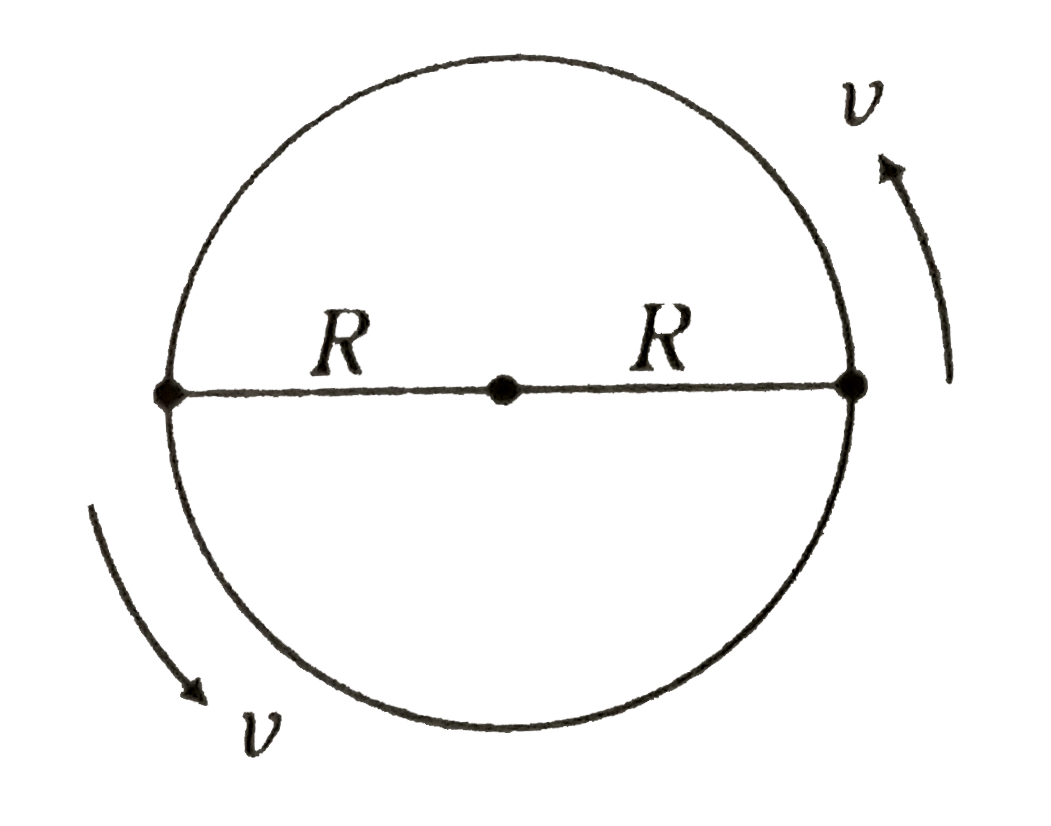
C

As gravitational force provides the centripetal force to the satellite to revolve around the earth

`(G.m.m)/(4R^(2))=(mv^(2))/((R))rArrv=(1)/(2)sqrt((Gm)/(R))`
Promotional Banner

Topper's Solved these Questions

  • GRAVITATION

    DC PANDEY ENGLISH|Exercise (B) Chapter Exercises|31 Videos
  • GRAVITATION

    DC PANDEY ENGLISH|Exercise (C) Chapter Exercises|45 Videos
  • GRAVITATION

    DC PANDEY ENGLISH|Exercise Check Point 10.6|20 Videos
  • GENERAL PHYSICS

    DC PANDEY ENGLISH|Exercise INTEGER_TYPE|2 Videos
  • KINEMATICS

    DC PANDEY ENGLISH|Exercise INTEGER_TYPE|10 Videos

Similar Questions

Explore conceptually related problems

Two particles of equal mass go round a circle of radius R under the action of their mutual gravitational attraction. Find the speed of each particle.

Two particles of equal mass go around a circle of radius R under the action of their mutual gravitational attraction. The speed v of each particle is

Two particles of equal masses m go round a circle of radius R under the action of their mutual gravitational attraction. The speed of each particle is v=sqrt((Gm)/(nR)) . Find the value of n.

Four particles of equal masses M move along a circle of radius R under the action of their mutual gravitational attraction. Find the speed of each particle.

Two particles of equal mass (m) each move in a circle of radius (r) under the action of their mutual gravitational attraction find the speed of each particle.

Four particles of equal mass are moving round a circle of radius r due to their mutual gravitational attraction . Find the angular velocity of each particle .

Four particles, each of mass M and equidistant from each other, move along a circle of radius R under the action of their mutual gravitational attraction. The speed of each particle is:

Four particles, each of mass M and equidistant from each other, move along a circle of radius R under the action of their mutual gravitational attraction. The speed of each particle is:

Four particles, each of mass M and equidistant from each other, move along a circle of radius R under the action of their mutual gravitational attraction. The speed of each particle is:

Two particles of equal mass m_(0) are moving round a circle of radius r due to their mutual gravitational interaction. Find the time period of each particle.

DC PANDEY ENGLISH-GRAVITATION-(A) Chapter Exercises
  1. A planet of mass m moves around the Sun of mass Min an elliptical orbi...

    Text Solution

    |

  2. A rocket is launched vertical from the surface of the earth of radius ...

    Text Solution

    |

  3. Two particles of equal mass go around a circle of radius R under the a...

    Text Solution

    |

  4. Suppose a smooth tunnel is dug along a straight line joining two point...

    Text Solution

    |

  5. A satellite is moving in a circular orbit round the earth with a diame...

    Text Solution

    |

  6. If the mass of moon is (M)/(81), where M is the mass of earth, find th...

    Text Solution

    |

  7. What is the energy required to launch a m kg satellite from earth's su...

    Text Solution

    |

  8. The orbital angular momentum of a satellite revolving at a distance r ...

    Text Solution

    |

  9. Two spherical bodies of masses M and 5M and radii R and 2R are release...

    Text Solution

    |

  10. Two spheres of masses m and 2m are separated by distance d. A particle...

    Text Solution

    |

  11. A ring of mass m(1) and radius R is fixed in space at some location. A...

    Text Solution

    |

  12. An artificial satellite is moving in a circular orbit around the earth...

    Text Solution

    |

  13. A person brings a mass of 1 kg from infinity to a point . Initally the...

    Text Solution

    |

  14. What impulse need to be given to a body of mass m, released from the s...

    Text Solution

    |

  15. The figure represents two concentric shells of radii R(1) and R(2) and...

    Text Solution

    |

  16. Four equal masses (each of mass M) are placed at the corners of a squa...

    Text Solution

    |

  17. Energy of a satellite in circular orbit is E(0). The energy required t...

    Text Solution

    |

  18. Pertaining to two planets, the ratio of escape velocities from respect...

    Text Solution

    |

  19. An object is released from a height twice the radius of the earth on t...

    Text Solution

    |

  20. A planet of mass m revolves in elliptical orbit around the sun of mass...

    Text Solution

    |

