Home
Class 11
PHYSICS
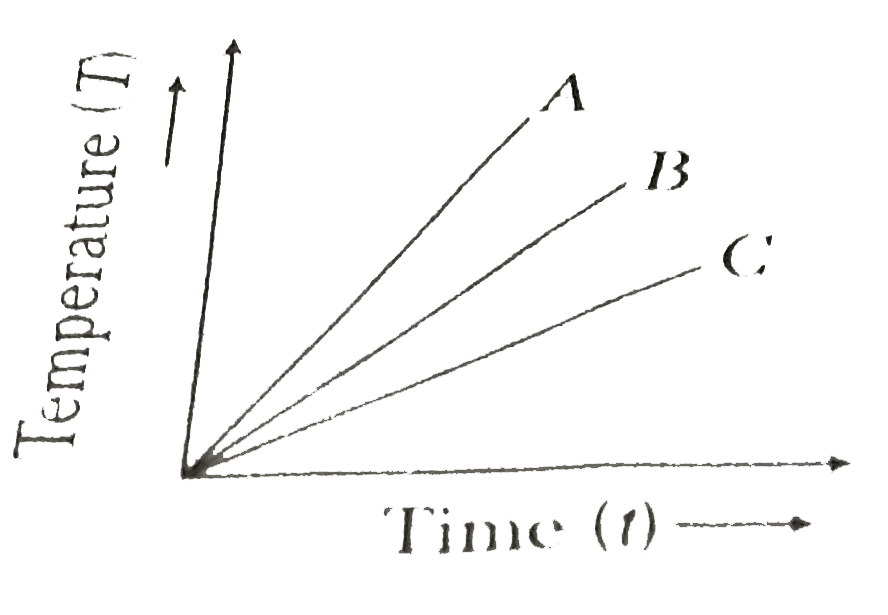
The temperatures versus time graph is sh...

The temperatures versus time graph is shown in figure. Which of the substance A,B and C has the lowest heat capacity if heat is supplied to all of them at equal rates.

A

A

B

B

C

C

D

All the above

Text Solution

Verified by Experts

The correct Answer is:

A

Slope `alpha` (1)/(Heat capacity)
Promotional Banner

Topper's Solved these Questions

  • CALORIMETRY AND HEAT TRANSFER

    DC PANDEY ENGLISH|Exercise Check points 16.3|20 Videos
  • CALORIMETRY AND HEAT TRANSFER

    DC PANDEY ENGLISH|Exercise Check points 16.4|29 Videos
  • CALORIMETRY AND HEAT TRANSFER

    DC PANDEY ENGLISH|Exercise Check point 16.1|10 Videos
  • CALORIMETRY & HEAT TRANSFER

    DC PANDEY ENGLISH|Exercise Level 2 Subjective|14 Videos
  • CENTRE OF MASS

    DC PANDEY ENGLISH|Exercise Medical entrances gallery|27 Videos

Similar Questions

Explore conceptually related problems

The variation of pressure versus volume is shown in the figure. The gas is diatomic and the molar specific heat capacity for the process is found to xR. Find the value of x. .

Pressure versus temperature graph of an ideal gas is shown in figure. Density of the gas at point A is rho_(0) . Density at B will be

Heat is supplied to a certain homogeneous sample of matter, at a uniform rate. Its temperature is plotted against time, as shown Which of the following conclusions can be drawn? (i) Its specific heat capacity is greater in the solid state than the liquid state. (ii) Its specific heat capacity is greater in the liquid state than in the solid state. (iii) Its latent heat of vaporization is greater than its latent heat of fusion. (iv) Its latent heat of vaporization is smaller than its latent heat of fusion

A substance is in the solid from at 0^(@)C . The amount of heat added to this substance and its temperature is plotted in the graph . The specific heat capacity of the solid substance is 0.5 "cal"//"g"^(@)C . Specific heat capacity in the liquid state is -

A substance is in the solid from at 0^(@)C . The amount of heat added to this substance and its temperature is plotted in the graph . The specific heat capacity of the solid substance is 0.5 "cal"//"g"^(@)C . Latest heat capacity in melting process is -

graph of an ideal gas is as shown in figure. Heat is supplied to the gas in process (s).

The temperature of a hot liquid in a container of negligible heat capacity falls at the rate of 3K//min due to heat emission to the surroundings, just before it begins to solidify. The temperature then remains constant for 30min , by the time the liquid has all solidfied. Find the ratio of specific heat capacity of liquid to specific latent heat of fusion.

Refer to the plot of temperature versus time (figure) showing the changes in the state if ice on heating (not to scale). Which of the following is correct ? .

If molar heat capacity of the given process (as shown in figure) is C , then

As a physicist, you put heat into a 500 g solid sample at the rate of 10.0 kJ//min , while recording its temperature as a function of time. You plot your data and obtain the graph shown in figure. . (a) What is the latent heat of fusion for this solid? (b) What is the specific heat of solid state of the material?
