Home
Class 11
PHYSICS
A student takes 50 g wax (specific heat ...


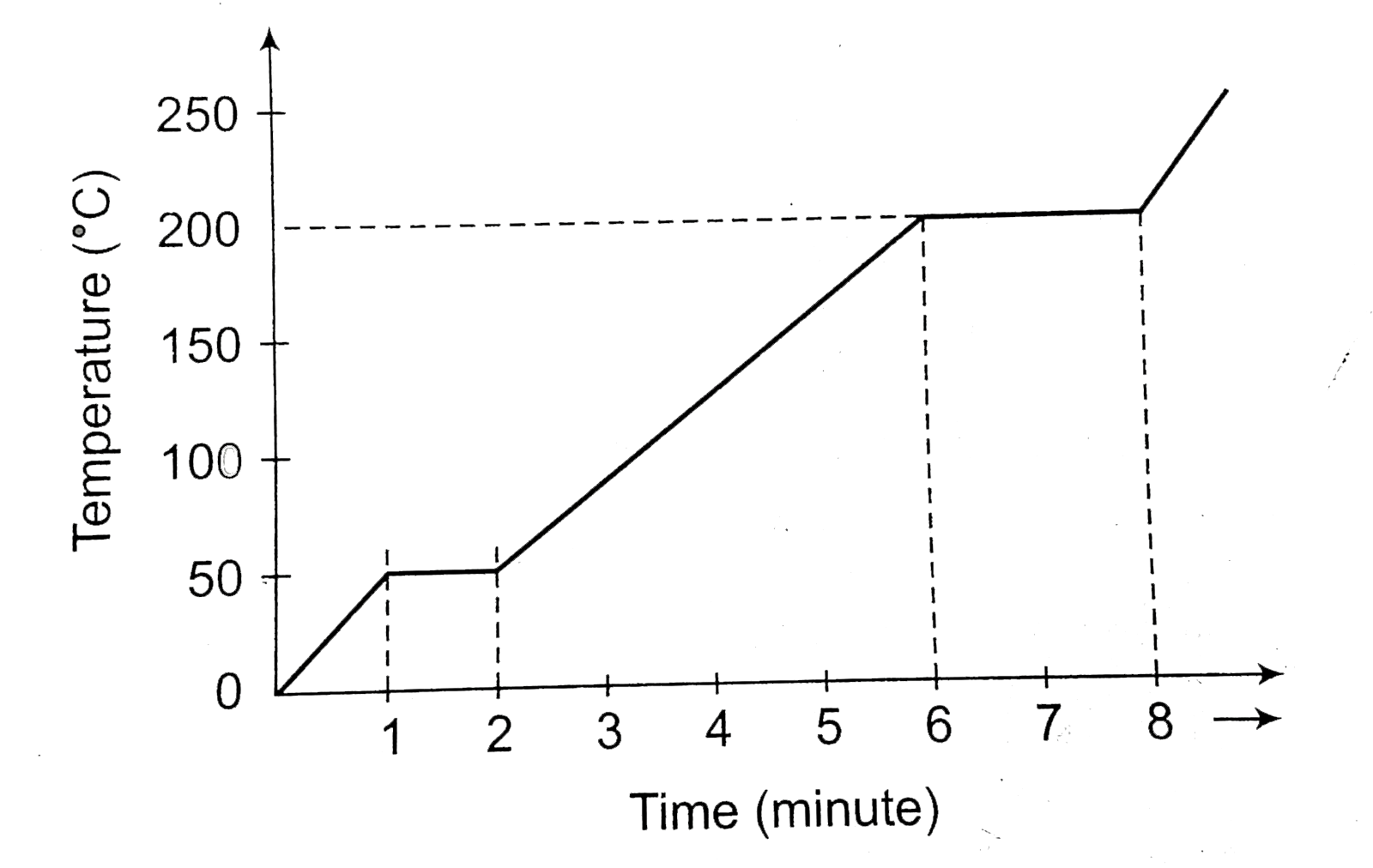
A student takes 50 g wax (specific heat `=0.6 kcal//kg^(@)C`) and heats it till it boils. The graph between temperature and time is as follows. Heat supplied to the wax per minute and boiling point are respectively.

A

500 cal,`50^(@)C`

B

1000 cal, `100^(@)C`

C

1500 cal, `200^(@)C`

D

1000 cal, `200^(@)C`

Text Solution

Verified by Experts

The correct Answer is:

C

From t =0 to t=1min
`DeltaQ = msDeltaT = 50/100 xx 06 xx 1000 xx(50 xx 0) = 1500 cal`
Promotional Banner

Topper's Solved these Questions

  • CALORIMETRY AND HEAT TRANSFER

    DC PANDEY ENGLISH|Exercise Check points 16.3|20 Videos
  • CALORIMETRY AND HEAT TRANSFER

    DC PANDEY ENGLISH|Exercise Check points 16.4|29 Videos
  • CALORIMETRY AND HEAT TRANSFER

    DC PANDEY ENGLISH|Exercise Check point 16.1|10 Videos
  • CALORIMETRY & HEAT TRANSFER

    DC PANDEY ENGLISH|Exercise Level 2 Subjective|14 Videos
  • CENTRE OF MASS

    DC PANDEY ENGLISH|Exercise Medical entrances gallery|27 Videos

Similar Questions

Explore conceptually related problems

If liquefied oxygen at 1 atmospheric pressure is heated from 50K to 300k by supplying heat at constant rate. The graph of temperature vs time will be

(a) Calculate the energy needed to raise the temperature of 10.0g of iron from 25^(@)C to 500^(@)C if specific heat capacity of iron if 0.45J( .^(@)C)^(-1)g^(-1) (b) What mass of gold ( of specific heat capacity 0.13J ( .^(@)C)^(-1)g^(-1) can be heated can be heated through the same temperature difference when supplied with the same amount of energy as in (a) ?

100 g of ice (latent heat 80 cal/g, at 0^(@)C ) is mixed with 100 g of water (specific heat 1" cal"//g-""^(@)C ) at 80^(@)C . The final temperature of the mixture will be :-

A certain amount of ice is supplied heat at a constant rate for 7 minutes. For the first one minute the temperature rises uniformly with time. Then, it remains constant for the next 4 minute and again the temperature rises at uniform rate for the last two minutes. Calculate the final temperature at the end of seven minutes. (Given, L of ice = 336 xx (10^3) J//kg and specific heat of water = 4200 J//kg-K ).

A slab of ice at 0^@ C is constantly heated till the steam is formed at 100^@ C. Draw a graph showing the change in temperature with time. Label the various parts of the graph properly.

The diagram below shows the change of phases of a substance on a temperature vs time graph on heating the substance at a constant rate. What is the boiling and melting point of the substance ?

A metal piece of mass 20 g is heated to a constant temperature of 100^@ C. Then it is added in a calorimeter of mass 50 g and specific heat capacity 0.42 J g^(-1) K^(-1) , containing 50 g of water at 20^@ C. After stirring the water, the highest temperature recorded is 22^@ C. Calculate the specific heat capacity of metal. Specific heat capacity of water = 4.2 J g^(-1)K^(-1)

A copper block of mass 60kg is heated till its temperature is increased by 20^(@)C . Find the heat supplied to the block. Specific heat capacity of = 0.09 cal g^(-1)-C .

A copper block of mass 0.06 kg is heated till its temperature is inreased by 20^(@)C . Find the heat supplied to the block. [specific heat of copper =9xx10^(-2)calg^(-1).^(@)C^(-1) ]

Aluminium container of mass of 10 g contains 200 g of ice at -20^(@)C . Heat is added to the system at the rate of 100 calories per second. What is the temperature of the system after four minutes? Draw a rough sketch showing the variation of the temperature of the system as a function of time . Given: Specific heat of ice = 0.5"cal"g^(-1)(.^(@)C)^(-1) Specific heat of aluminium = 0.2"cal"g^(-1)(.^(@)C)^(-1) Latent heat of fusion of ice = 80"cal"g^(-1)
