Home
Class 11
PHYSICS
A block of metal is heated to a temperat...

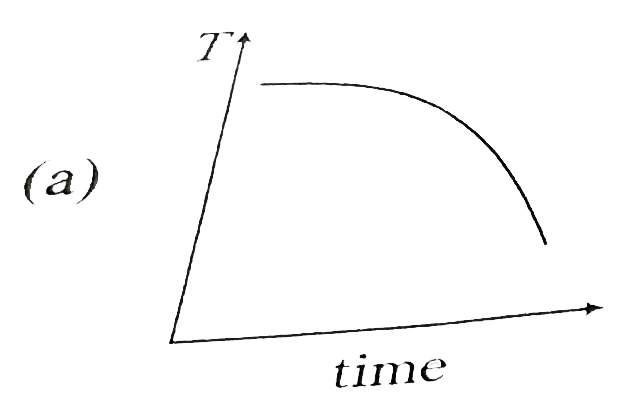
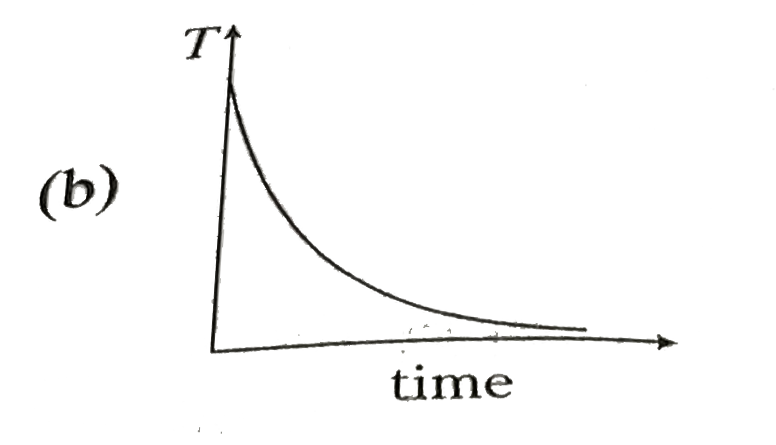
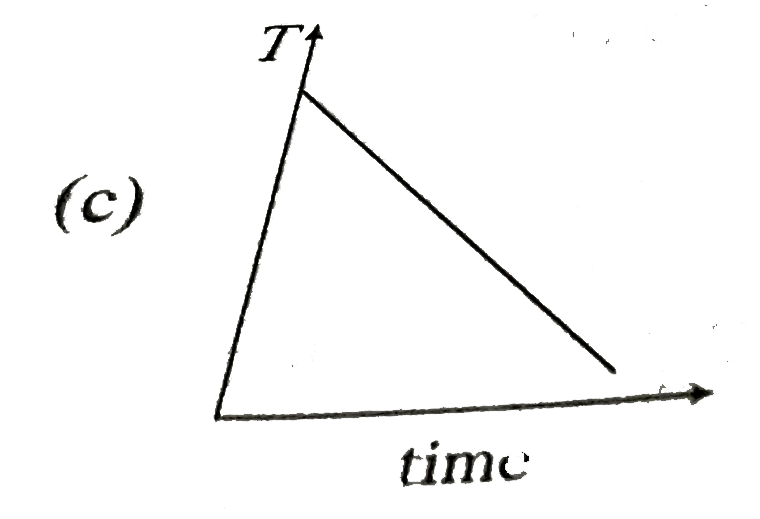
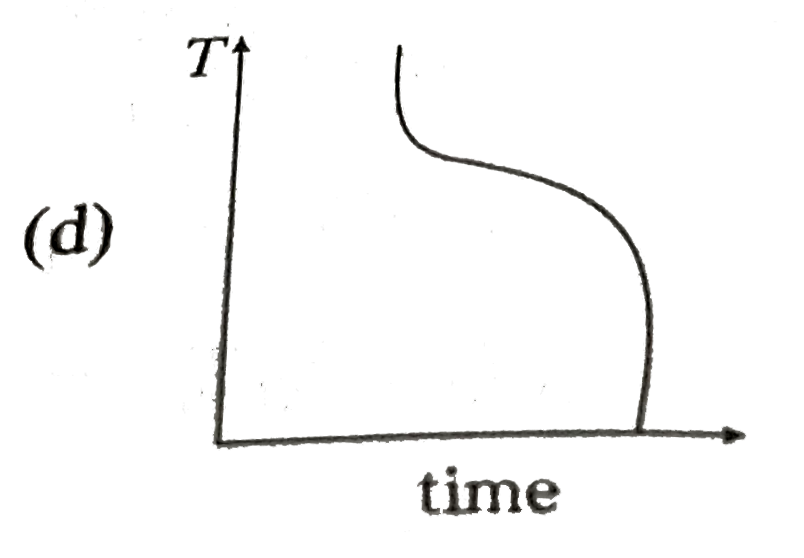
A block of metal is heated to a temperature much higher than the room temperature and allowed to cool in a room free from air currents. Which of the following curves correctly represents the rate of cooling

A

B

C

D

Text Solution

AI Generated Solution

The correct Answer is:

To solve the problem of determining the correct curve that represents the rate of cooling of a heated metal block, we can follow these steps: ### Step 1: Understand Newton's Law of Cooling Newton's Law of Cooling states that the rate of change of temperature of an object is proportional to the difference between its temperature and the ambient temperature. Mathematically, this can be expressed as: \[ \frac{dT}{dt} = -k (T - T_0) \] where: - \( T \) is the temperature of the object, - \( T_0 \) is the ambient temperature, - \( k \) is a positive constant that depends on the characteristics of the object and the environment. ### Step 2: Set Up the Initial Conditions Assume the initial temperature of the metal block is \( T_i \) (much higher than \( T_0 \)), and we want to find the temperature \( T_f \) at time \( t \). ### Step 3: Integrate the Equation We can rearrange the equation and integrate it: \[ \int \frac{dT}{T - T_0} = -k \int dt \] This results in: \[ \ln |T - T_0| = -kt + C \] where \( C \) is the integration constant. ### Step 4: Solve for the Constant To find \( C \), we can use the initial condition at \( t = 0 \): \[ \ln |T_i - T_0| = C \] ### Step 5: Substitute Back Substituting back into the equation gives: \[ \ln |T - T_0| = -kt + \ln |T_i - T_0| \] Exponentiating both sides results in: \[ |T - T_0| = |T_i - T_0| e^{-kt} \] ### Step 6: Final Temperature Equation This can be simplified to: \[ T = T_0 + (T_i - T_0)e^{-kt} \] This shows that the temperature \( T \) approaches \( T_0 \) as \( t \) increases, and the rate of cooling is exponential. ### Step 7: Analyze the Graphs From the derived equation, we can see that the temperature decreases exponentially over time. Therefore, we need to identify which of the given curves represents an exponential decay. ### Step 8: Conclusion After analyzing the options, we find that: - **Option B** represents an exponential decrease in temperature over time, which matches our derived equation. - Other options either show linear decrease or do not approach the ambient temperature correctly. Thus, the correct answer is **Option B**. ---
Promotional Banner

Topper's Solved these Questions

  • CALORIMETRY AND HEAT TRANSFER

    DC PANDEY ENGLISH|Exercise Taking it together|51 Videos
  • CALORIMETRY AND HEAT TRANSFER

    DC PANDEY ENGLISH|Exercise Assertion and reason|17 Videos
  • CALORIMETRY AND HEAT TRANSFER

    DC PANDEY ENGLISH|Exercise Check points 16.3|20 Videos
  • CALORIMETRY & HEAT TRANSFER

    DC PANDEY ENGLISH|Exercise Level 2 Subjective|14 Videos
  • CENTRE OF MASS

    DC PANDEY ENGLISH|Exercise Medical entrances gallery|27 Videos

Similar Questions

Explore conceptually related problems

Which of the following resist hydrolysis at room temperature

A hot liquid is kept in a big room. Its temperature is plotted as a function of time. Which of the following curves may represent the plot?

At room temperature which of the following species is/are present in polymeric form.

A piece of glass is heated to a high temperature and then allowed to cool. If it cracks, a probable reason for this is the following property of glass

Name a metal which is liquid at room temperature.

Which of the following halides does not hydrolyse at room temperature?

Which of the following alkane is not liquid at room temperature?

A metal block is resting on a rough wooden surface. A horizontal force applied to the block is increased uniformly. Which of the following curves correctly represents velocity of the block ?

"A solid sphere of copper of radius R and a hollow sphere of the same material of inner radius r and outer radius R are heated to the same temperature and allowed to cool in the same environment. Which of them starts cooling faster ?''

DC PANDEY ENGLISH-CALORIMETRY AND HEAT TRANSFER-Check points 16.4
  1. The ratio of the Emissive power to the absorption power of all substan...

    Text Solution

    |

  2. If between wavelength lambda andlambda + dlambda, e(lambda) and a(lamb...

    Text Solution

    |

  3. There is a black spot on a body. If the body is heated and carried in ...

    Text Solution

    |

  4. In MKS system, Stefan's constant is denoted by sigma. In CGS system mu...

    Text Solution

    |

  5. A black body radiates 20 W at temperature 227^(@)C. If temperature of ...

    Text Solution

    |

  6. Two spherical black bodies of radii R(1) and R(2) and with surface tem...

    Text Solution

    |

  7. A sphere has a surface area of 1.0 m^(2) and a temperature of 400 K an...

    Text Solution

    |

  8. Two spheres of the same material have radii 1m and 4m and temperatures...

    Text Solution

    |

  9. The area of a hole of heat furnace is 10^(-4)m^(2). It radiates 1.58xx...

    Text Solution

    |

  10. If a body cools down from 80^(@) Cto 60^(@) C in 10 min when the tempe...

    Text Solution

    |

  11. A block of metal is heated to a temperature much higher than the room ...

    Text Solution

    |

  12. If wavelengths of maximum intensity of radiations emitted by the sun a...

    Text Solution

    |

  13. The maximum wavelength of radiation emitted at 200 K is 4 μm. What wil...

    Text Solution

    |

  14. The maximum energy in thermal radiation from a source occurs at the wa...

    Text Solution

    |

  15. The intensity of radiation emitted by the sun has its maximum value at...

    Text Solution

    |

  16. In the figure, the distribution of energy density of the radiation emi...

    Text Solution

    |

  17. The temperature of a body in increased from 27^(@)C to 127^(@)C. By wh...

    Text Solution

    |

  18. The calories of heat developed in 200 W heater in 7 min is estimated

    Text Solution

    |

  19. The thickness of a metallic plate is 0.4 cm. The temperature between i...

    Text Solution

    |

  20. A spherical black body with radius 12 cm radiates 450 w power at 500 K...

    Text Solution

    |
