Home
Class 11
PHYSICS
A ring consisting of two parts ADB and A...

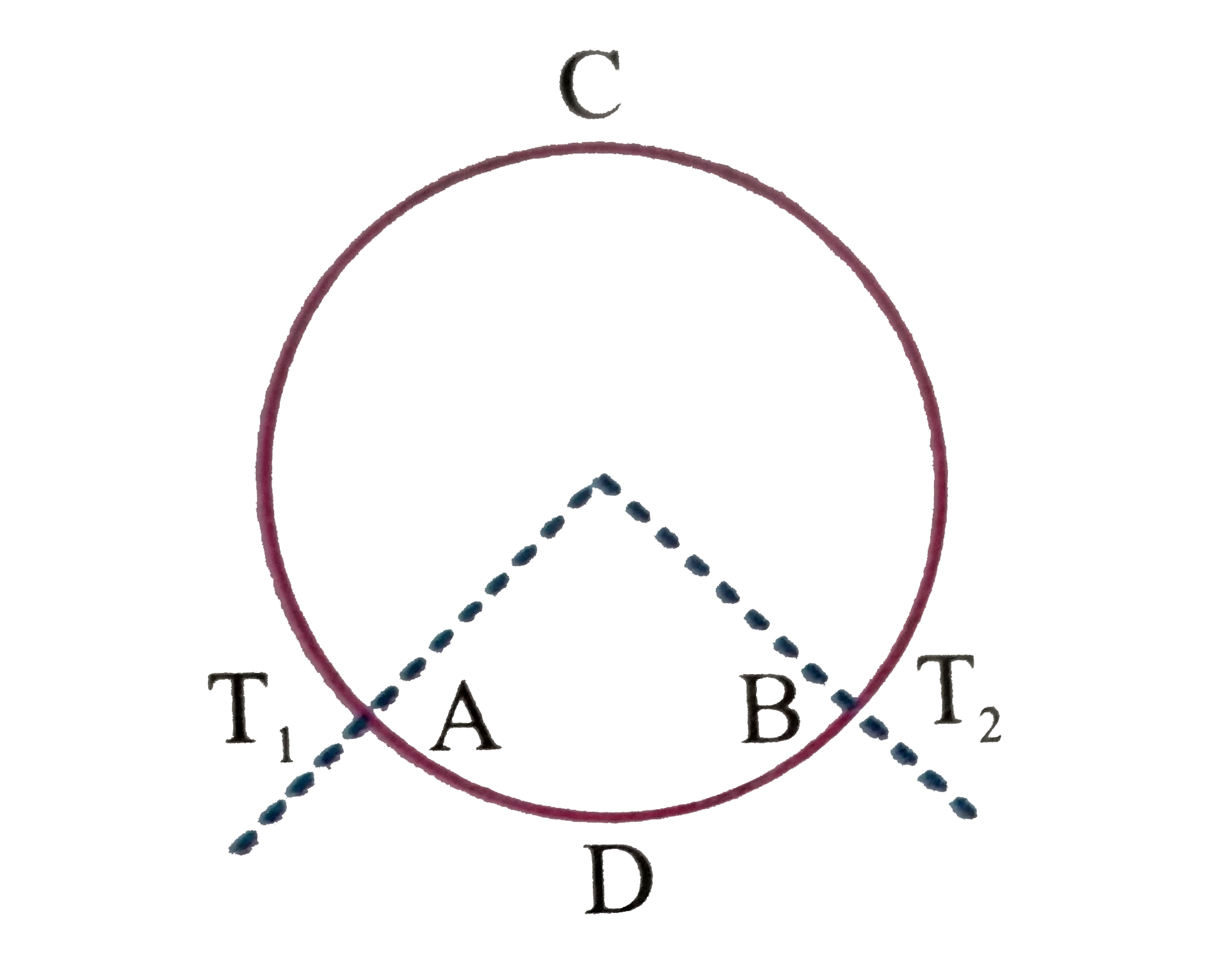
A ring consisting of two parts `ADB` and `ACB` of same conductivity k carries an amount of heat `H` The `ADB` part is now replaced with another metal keeping the temperature `T_1)` and `T_(2)` constant The heat carried increases to `2H` What should be the conductivity of the new `ADB` Given `(ACB)/(ADB)=3`
.

A

`7/3 K`

B

`2 k`

C

`5/2 K`

D

`3 K `

Text Solution

Verified by Experts

The correct Answer is:

A

Heat carried increases to 2 times. Therefore, new net thermal resistance will remain half.
`therefore` `R^(') = R/2 rArr (R_(1)^(')R_(2)^('))/(R_(1)^(')+R_(2)^('))=(R_(1)R_(2))/(2(R_(1)+R_(2))`
or `((3l//KA)(l//K^(')A))/((3l//KA)+(l//K^(')A))=((3l//KA)(l//KA))/(2{(3l)/(KA)+l/(KA)})`
Solving, this we get `K^(') = 7/3K`
Promotional Banner

Topper's Solved these Questions

  • CALORIMETRY AND HEAT TRANSFER

    DC PANDEY ENGLISH|Exercise Assertion and reason|17 Videos
  • CALORIMETRY AND HEAT TRANSFER

    DC PANDEY ENGLISH|Exercise Match the columns|4 Videos
  • CALORIMETRY AND HEAT TRANSFER

    DC PANDEY ENGLISH|Exercise Check points 16.4|29 Videos
  • CALORIMETRY & HEAT TRANSFER

    DC PANDEY ENGLISH|Exercise Level 2 Subjective|14 Videos
  • CENTRE OF MASS

    DC PANDEY ENGLISH|Exercise Medical entrances gallery|27 Videos

Similar Questions

Explore conceptually related problems

Consider two rods of same length and different specific heats ( S_1 and S_2 ), conductivities K_1 and K_2 and area of cross section ( A_1 and A_2 ) and both having temperature T_1 and T_2 at their ends. If the rate of heat loss due to conduction is equal then

A rod of length l and cross sectional area A has a variable conductivity given by K=alphaT , where alpha is a positive constant T is temperatures in Kelvin. Two ends of the rod are maintained at temperatures T_1 and T_2(T_1gtT_2) . Heat current flowing through the rod will be

A rod of length l with thermally insulated lateral surface consists of material whose heat conductivity coefficient varies with temperature as k= a//T , where a is a constant. The ends of the rod are kept at temperatures T_1 and T_2 . Find the function T(x), where x is the distance from the end whose temperature is T_1 .

A rod of length l and cross-section area A has a variable thermal conductivity given by K = alpha T, where alpha is a positive constant and T is temperature in kelvin. Two ends of the rod are maintained at temperature T_(1) and T_(2) (T_(1)gtT_(2)) . Heat current flowing through the rod will be

Two metal rods 1 and 2 of same lengths have same temperature difference between their ends. Their thermal conductivities are K_(1) and K_(2) and cross sectional areas A_(1) and A_(2) respectively. If the rate of heat conduction in 1 is four times that in 2, then

Four identical rods AB, CD, CF and DE are joined as shown in figure. The length, cross-sectional area and thermal conductivity of each rod are l, A and K respectively. The ends A, E and F are maintained at temperature T_(1) , T_(2) and T_(3) respectively. Assuming no loss of heat to the atmosphere, find the temperature at B .

A cylindrical block of length 0.4 m and area of cross-section 0.04 m^2 is placed coaxially on a thin metal disc of mass 0.4 kg and of the same cross - section. The upper face of the cylinder is maintained at a constant temperature of 400 K and the initial temperature of the disc is 300K. if the thermal conductivity of the material of the cylinder is 10 "watt"// m-K and the specific heat of the material of the disc is 600J//kg-K , how long will it take for the temperature of the disc to increase to 350 K? Assume for purpose of calculation the thermal conductivity of the disc to be very high and the system to be thermally insulated except for the upper face of the cylinder.

Three rods of same cross-section but different length and conductivity are joined in series . If the temperature of the two extreme ends are T_(1) and T_(2) (T_(1)gtT_(2)) find the rate of heat transfer H.

Two conducting cylinders of equal length but different radii are connected in series between two heat baths kept at temperatures T_(1) = 300K and T_(2) = 100 K , as shown in the figure. The radius of the bigger cylinder is twice that of the smaller one and the thermal conductivities of the materials of the smaller and the larger cylinders are K_(1) and K_(2) respectively. If the temperature at the junction of the two cylinders in the steady state is 200 K, then K_(1)//K_(2)= __________.

The temperature of the two outer surfaces of a composite slab, consisting of two materials having coefficients of thermal conductivity K and 2K and thickness x and 4x respectively. Temperatures on the opposite faces of composite slab are T_(1) and T_(2) where T_(2)gtT_(1) , as shown in fig. what is the rate of flow of heat through the slab in a steady state?

DC PANDEY ENGLISH-CALORIMETRY AND HEAT TRANSFER-Taking it together
  1. 19 g of water at 30^@C and 5 g of ice at -20^@C are mixed together in ...

    Text Solution

    |

  2. Work done in converting 1 g of ice at -10^@C into steam at 100^@C is

    Text Solution

    |

  3. Two rigid boxes containing different ideal gases are placed on a table...

    Text Solution

    |

  4. The figure given below shows the cooling curve of pure wax material af...

    Text Solution

    |

  5. Three conducting rods of same material and cross-section are shown in ...

    Text Solution

    |

  6. Two rods with the same dimensions have thermal conductivities in the r...

    Text Solution

    |

  7. Two identical conducting rods are first connected independently to two...

    Text Solution

    |

  8. Three rods of identical area of cross-section and made from the same m...

    Text Solution

    |

  9. Two identical rods are made of different materials whose thermal condu...

    Text Solution

    |

  10. The temperature change versus heat supplied curve is given for 1 kg of...

    Text Solution

    |

  11. 2kg of ice at -20^@C is mixed with 5kg of water at 20^@C in an insulat...

    Text Solution

    |

  12. 10 gm of ice cubes at 0^(@)"C" are released in a tumbler (water equi...

    Text Solution

    |

  13. A cylindrical metallic rod in thermal contact with two reservation of ...

    Text Solution

    |

  14. if 1 g of steam is mixed with 1 g of ice, then the resultant temperatu...

    Text Solution

    |

  15. The rate of flow of heat through 12 identical conductors made of same ...

    Text Solution

    |

  16. Equal masses of three liquids A, B and C have temperature 10^(@)C, 25^...

    Text Solution

    |

  17. In an industrial process 10 kg of water per hour is to be heated from ...

    Text Solution

    |

  18. Two identical conducting rods AB and CD are connected to a circular c...

    Text Solution

    |

  19. A ring consisting of two parts ADB and ACB of same conductivity k carr...

    Text Solution

    |

  20. Water is being boiled in a flat bottomed kettle placed on a stove The ...

    Text Solution

    |
