Home
Class 11
PHYSICS
Three rods of equal length of same mater...

Three rods of equal length of same material are joined to form an equivalent triangle `ABC` as shown figure. Area of cross-section of rod `AB` is `S` of rod `BC` is `2S` and that of `AC` is `S` , then

`{:(,"Column-I",,"Column-II"),((A),"Temperature of junction" B,(p),"Greater than" 50^(@)C),((B),"Heat current in" AB,(q),"Less than" 50^(@)C),((C),"Heat current in BC",(r),"Is equal to current in BC"),(,,(s),"Is " 2/3 "times heat current in AC"),(,,(t),"None"):}`

Text Solution

Verified by Experts

The correct Answer is:
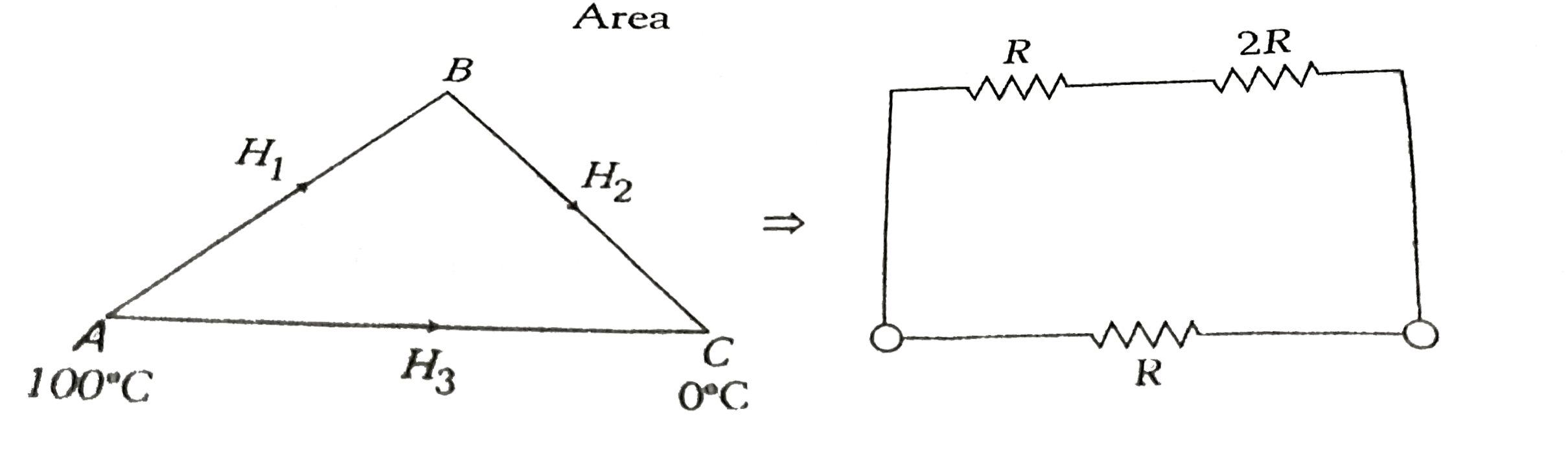
A, B, C

Thermal resistance `alpha 1/Area`

So let, `R_(BC)` = R
Then `R_(AB) +R_(AC)` = 2R
`H_(1) = H_(2)`
`(100-theta_(B))/R = (theta_(B)-0)/(2R)`
`therefore` `theta_(B) = 66.7^(@)`C
`R_(ABC)`-3R and `R_(AC)`=R
`H_(1) = H_(2) = H_(3)/3`
Promotional Banner

Topper's Solved these Questions

  • CALORIMETRY AND HEAT TRANSFER

    DC PANDEY ENGLISH|Exercise Medical entrance s gallery|38 Videos
  • CALORIMETRY AND HEAT TRANSFER

    DC PANDEY ENGLISH|Exercise Assertion and reason|17 Videos
  • CALORIMETRY & HEAT TRANSFER

    DC PANDEY ENGLISH|Exercise Level 2 Subjective|14 Videos
  • CENTRE OF MASS

    DC PANDEY ENGLISH|Exercise Medical entrances gallery|27 Videos

Similar Questions

Explore conceptually related problems

Three rods of equal length of same material are joined to form an equilateral triangle ABC as shown in figure. Area of cross-section of rod AB is S, of rod BC is 2S and that of AC is S. Then match the following.

Three rods of equal of length are joined to from an equilateral triangle ABC. D is the midpoint of AB. The coefficient of linear expansion is alpha_(1) for AB and alpha_(2) for AC and BC . If the distance DC remains constant for small changes in temperature,

Two concentric spherical shells are as shown in figure. Match the following columns {:(,"Column-I",,"Column-II"),("(A)","Potential at A","(p)","greater than B"),("(B)","Gravitational field at A","(q)","less than B"),("(C)","As one moves from C to D","(r)","Potential remains constant"),("(D)","As one moves from D to A","(s)","Gravitational field decreases"),(,,"(t)","None"):}

Four rods of material X and three rods of material Y are connected as shown in figure. All the rods are of identical lengths and cross-sectional area. Given thermal resistance of rod of material X, R_(x) = R and thermal conductivities of materials are related by relation K_(Y) = 2K_(X) . {:(,"Column-I",,"Column-II"),((A),"Thermal resistance between B and E" ,(p),(500)/(13).^(@)C ),((B),"Thermal resistance between A and F" ,(q),(700)/(13).^(@)C ),((C),"Temperature of junction B" ,(r),(2R)/(3)), ((D),"Temperature of junction D" ,(s),(13R)/(6)):}

{:(,"Column I",,"Column II"),(("A"),R//L,(p),"Time"),(("B"),C//R,(q),"Frequency"),(("C"),E//B,(r),"Speed"),(("D"),sqrt(epsilon_(0)mu_(0)),(s),"None"):}

Three rods of equal length, area of cross section and thermal conductivity are connected as shown in the figure. There is no heat loss through lateral surface of the rods and temperature of ends are T_(A)=100^(@)C, T_(B)=70^(@)C and T_(C)=50^(@)C . Find the temperature of junction.

Three liquids A, B and C having same specific heat and mass m , 2 m and 3 m have temperature 20^(@)C , 40^(@)C and 60^(@)C respectively. Temperature of the mixture when: {:(,"Column-I",,"Column-II"),((A),"A and B are mixed",(p),35^(@)C),((B),"A and C are mixed",(q),52^(@)),((C),"B and C are mixed",(r),50^(@)),((D),"A,B and C all three are mixed",(s),45^(@)),(,,(t),"None"):}

Four rods of equal length l and mass m each forms a square as shown in figure Moment of inertia about three axes 1,2 and 3 are say I_(1),I_(2) and I_(3) . Then, match the following columns {:(,"Column-I",,"Column-II"),("(A)",I_(1),"(p)",(4)/(3)ml^(2)),("(B)",I_(2),"(q)",(2)/(3)ml^(2)),("(C)",I_(3),"(r)",(1)/(2)ml^(2)),(,,"(s)","None"):}

If theta is the abgle between two vectors A and B , then match the following two columns. {:(,"Column I ",,"Column II"),((A),A.B=|AxxB|,(P),theta=90^(@)),((B),A.B=B^(2),(Q),theta=0^(@)or 180^(@)),((C),|A+B|=|A-C|,(r),A=B),((D), |AxxB|=AB,(s),"None"):}

Two rods of same length and same material having area of cross section A and 4A respectively are joined as shown in the figure. If T_(A) and T_(B) are temperatures of free ends in steady state. The temperature of junction point C is (Assume no heat loss wil take place through lateral surface)

