Home
Class 11
PHYSICS
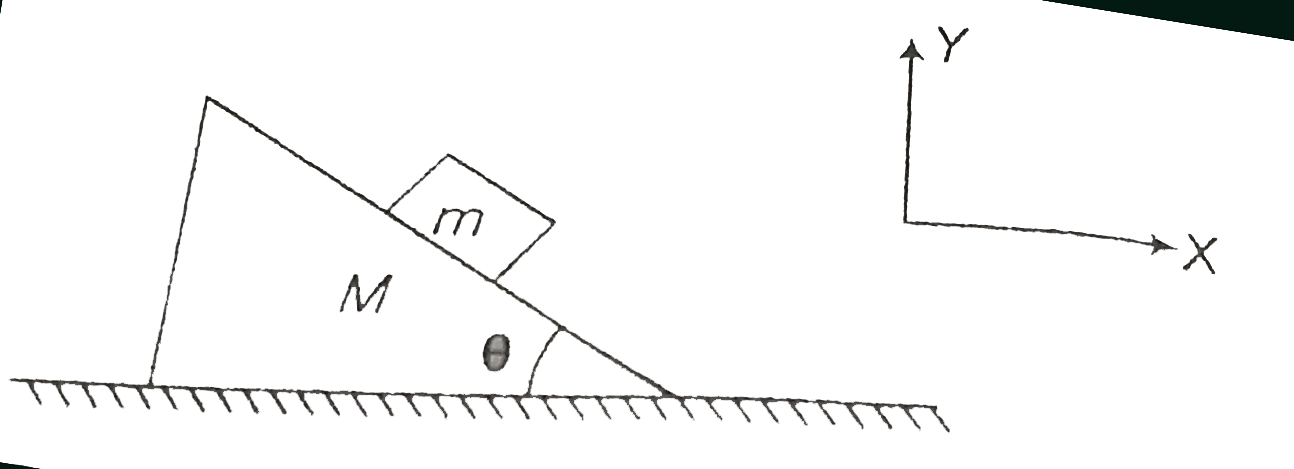
Consider the shown arrangement. Assume a...

Consider the shown arrangement. Assume all surfaces to be smooth. If N represents magnitudes of normal reaction between block and wedge, then acceleration of M along horizontal is equla to

A

`(N sin theta)/(M)` along + veX-axis

B

`(N cos theta)/(M)` along - veX-axis

C

`(N sin theta)/(M)` along - veX-axis

D

`(N sin theta)/(m+M)` along - veX-axis

Text Solution

Verified by Experts

The correct Answer is:

C

( c) Wedge move due to horizontal component of normal reaction.
Thus `" " a=(N_(H))/(M)=(N sin theta)/(M)" " `(along-ve X-axis)
Promotional Banner

Topper's Solved these Questions

  • LAWS OF MOTION

    DC PANDEY ENGLISH|Exercise Match the columns|7 Videos
  • LAWS OF MOTION

    DC PANDEY ENGLISH|Exercise Medical entrances gallery|39 Videos
  • LAWS OF MOTION

    DC PANDEY ENGLISH|Exercise Check point 5.4|20 Videos
  • KINEMATICS 1

    DC PANDEY ENGLISH|Exercise INTEGER_TYPE|15 Videos
  • LAWS OF THERMODYNAMICS

    DC PANDEY ENGLISH|Exercise Level 2 Subjective|18 Videos

Similar Questions

Explore conceptually related problems

All surface are smooth. Find the acceleration of mass m relative to wedge when wedge is moving with acceleration 'a'

A block of mass 1kg is pushed on a non-movable wedge of mass 2kg and height h=30cm with a velocity u=6m//sec . Before striking the wedge it travels 2m on a rough horizontal portion. Velocity is just sufficient for the block to reach the top of the wedge. Assuming all surfaces are smooth except the given horizontal part and collision of block and wedge is jerkless, the friction coefficition of the rough horizontal part is :

Two blocks A and B of masses 10 kg and 5 kg respectively are placed inside a cart which is moving horizontally with an acceleration of 2 m/s^2 as shown in the figure. If all the surfaces are smooth then the ratio of normal reaction between the block A and vertical surface of the cart and normal reaction between the blocks A and B is

In the figure shown, all surfaces are smooth and the pulley is massless. A constant force of magnitude F = (mg)/(2) is acting on the block of mass M. The acceleration of the block M is :

All surfaces are smooth. Find the horizontal displacements of the block and wedge when the block slides down from top to bottom.

Two blocks A and B of masses 2kg and 3kg respectively, are placed on a horizontal surface as shown (one on top of other). Find the ratio of magnitude of normal reaction between A and B to that between B and the surface, respectively

In the figure if block A and wedge b will move with same acceleration, then the magnitude of normal reaction between the block and the wedge will be (There is no friction between block and the wedge and the wedge moves on horizontal surface as shown.)

Consider the situation shown in figure. All the surfaces are frictions and the string and the pulley are light. Find the magnitude of the acceleration of the two blocks.

All the surfaces are smooth as shown in figure. The acceleration of mass m relative to wedge is :

A block of mass m slides down on a wedge of mass M as shown in figure .Let a_(1) be the asseleration of the acceleration of and a_(2) the the acceleration od block 1 N_(1) is the normal reaction between block and wedge and N_(2) the normal reaction between wedge and gound .frication is absent everwhere .Select the correct alternative(s)

DC PANDEY ENGLISH-LAWS OF MOTION-Chapter exercises (A) Taking it together
  1. A chain of mass M and length L is held vertical by fixing its upper en...

    Text Solution

    |

  2. A 40 N block is supported by two ropes. One rope is horizontal and oth...

    Text Solution

    |

  3. Consider the shown arrangement. Assume all surfaces to be smooth. If ...

    Text Solution

    |

  4. In the above problem normal reaction between ground and wedge will hav...

    Text Solution

    |

  5. Starting from rest a body slides down a 45^(@) inclined plane in twice...

    Text Solution

    |

  6. A block of mass 0.1kg is belt againest a wall appliying a horizontal f...

    Text Solution

    |

  7. A block of mass m is given an initial downward velocity v(0) and left ...

    Text Solution

    |

  8. A block of mass m slides down an inclined plane of inclination theta w...

    Text Solution

    |

  9. The upper half of an inclined plane of inclination theta is perfectly ...

    Text Solution

    |

  10. Pushing force making an angle theta to the horizontal is applied on a ...

    Text Solution

    |

  11. In the arrangement shown in Fig there is no friction between of mass ...

    Text Solution

    |

  12. Two masses m and M are attached with strings as shown. For the system ...

    Text Solution

    |

  13. A man has fallen into a ditch of width d and two of his friends are sl...

    Text Solution

    |

  14. Two beads A and B move along a semicircular wire frame as shown in fig...

    Text Solution

    |

  15. Two blocks of masses m and 2m are placed one over the other as shown i...

    Text Solution

    |

  16. If a body looses half of its velocity on penetrating 3 cm in a wooden ...

    Text Solution

    |

  17. A ball is moving towards the wall as shown in diagram then its momentu...

    Text Solution

    |

  18. Two weights w(1) and w(2) are suspended from the ends of a light strin...

    Text Solution

    |

  19. A dynamometer D is attached to two bodies of masses M=6 kg and m=4 kg....

    Text Solution

    |

  20. Two blocks are connected over a massless pulley as shown in figure. Th...

    Text Solution

    |
