Home
Class 11
PHYSICS
A block of mass m is thrown upwards with...

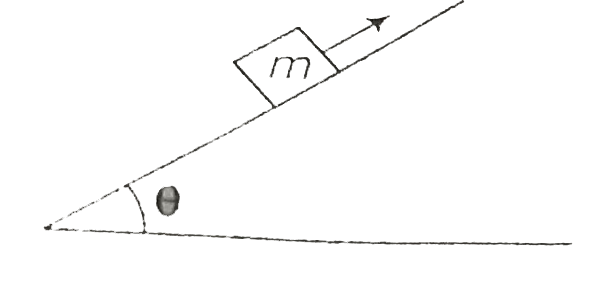
A block of mass m is thrown upwards with some initial velocity as shown in figure. On the block

`{:("Column I","Column II"),("(A) Net force in horizontal direction","(p) Zero"),("(B) Net force in vertical direction",(q) m(g sin theta+mug cos theta)),("(C) Net force along the plane",(r)m(g sin theta cos theta+mu g cos^(2) theta)),("(D) Net force perpendicular to plane",(s)m(g sin^(2) theta+mug sin theta cos theta)):}`

Text Solution

Verified by Experts

The correct Answer is:

A`rarr`r,B`rarr`s,C`rarr`q,D `rarr`p

Force of friction and `mg sin theta` both are downwards.
`therefore` Acceleration of the block is `a=(g sin theta+mu g cos theta)` down the plane
Now, net force in any direction is equal to, F=m(component of acceleration in that direction)
Promotional Banner

Topper's Solved these Questions

  • LAWS OF MOTION

    DC PANDEY ENGLISH|Exercise Medical entrances gallery|39 Videos
  • LAWS OF MOTION

    DC PANDEY ENGLISH|Exercise Chapter exercises (A) Taking it together|71 Videos
  • KINEMATICS 1

    DC PANDEY ENGLISH|Exercise INTEGER_TYPE|15 Videos
  • LAWS OF THERMODYNAMICS

    DC PANDEY ENGLISH|Exercise Level 2 Subjective|18 Videos

Similar Questions

Explore conceptually related problems

Block of mass 'm' is sliding up on the smooth incline plane, with some constant velocity. Now, on the block match the magnitude value of the forces on 'm' in the given directions take the components of all the forces in the given direction) {:("Column - I","Column -II"),("A) Net force component is horizontal direction ","P) zero"),("B) Net - force compnent in vertical direction", "Q) " mg sin theta cos theta),("C) Net force component along the incline plane ","R)" mg sin theta),("D) Net force component perpendicular to the incline plane ","S) " mg (1-cos^(2) theta)):}

a sin^(2) theta + b cos^(2) theta =c implies tan^(2) theta =

Given : 4 sin theta = 3 cos theta , find the value of : (i) sin theta (ii) cos theta (iii) cot^(2) theta - "cosec"^(2) theta (iv) 4 cos^(2) theta - 3 sin^(2) theta + 2

If 1/6 sin theta, cos theta and tan theta are in G.P. then the general solution for theta is

Let l= sin theta, m=cos theta and n=tan theta . Q. If theta=7 radian, then :

If sin theta+ cos theta = p and sec theta + cosec theta = q ; show that q(p^2-1) = 2p

The value of (sintheta+i cos theta)^n is (A) sin n theta+i cos ntheta (B) cos ntheta-i sin n theta (C) cos ((npi)/2- ntheta)+is sin ((npi)/2- ntheta) (D) none of these

c(1+cos2theta)= (A) c 2sin^2theta (B) c2cos^2theta (C) c2tan^2theta (D) none of these

Find the A.M. between: ( cos theta + sin theta )^(2) and ( cos theta - sin theta)^(2)

Let l= sin theta, m=cos theta and n=tan theta . If theta=5 radian, then :
