Home
Class 12
PHYSICS
A hydrogen like atom (atomic number Z) i...

A hydrogen like atom (atomic number Z) is in a higher excited state of quantum number n. The excited atom can make a transition to the first excited state by successively emitting two photons of energy 10.2 eV and 17.0 eV, respectively. Alternatively, the atom from the same excited state can make a transition to the second excited state by successively emitting two photons of energies 4.25 eV and 5.95 eV, respectively Determine the values of n and Z. (lonization energy of H-atom = 13.6 eV)

Text Solution

Verified by Experts
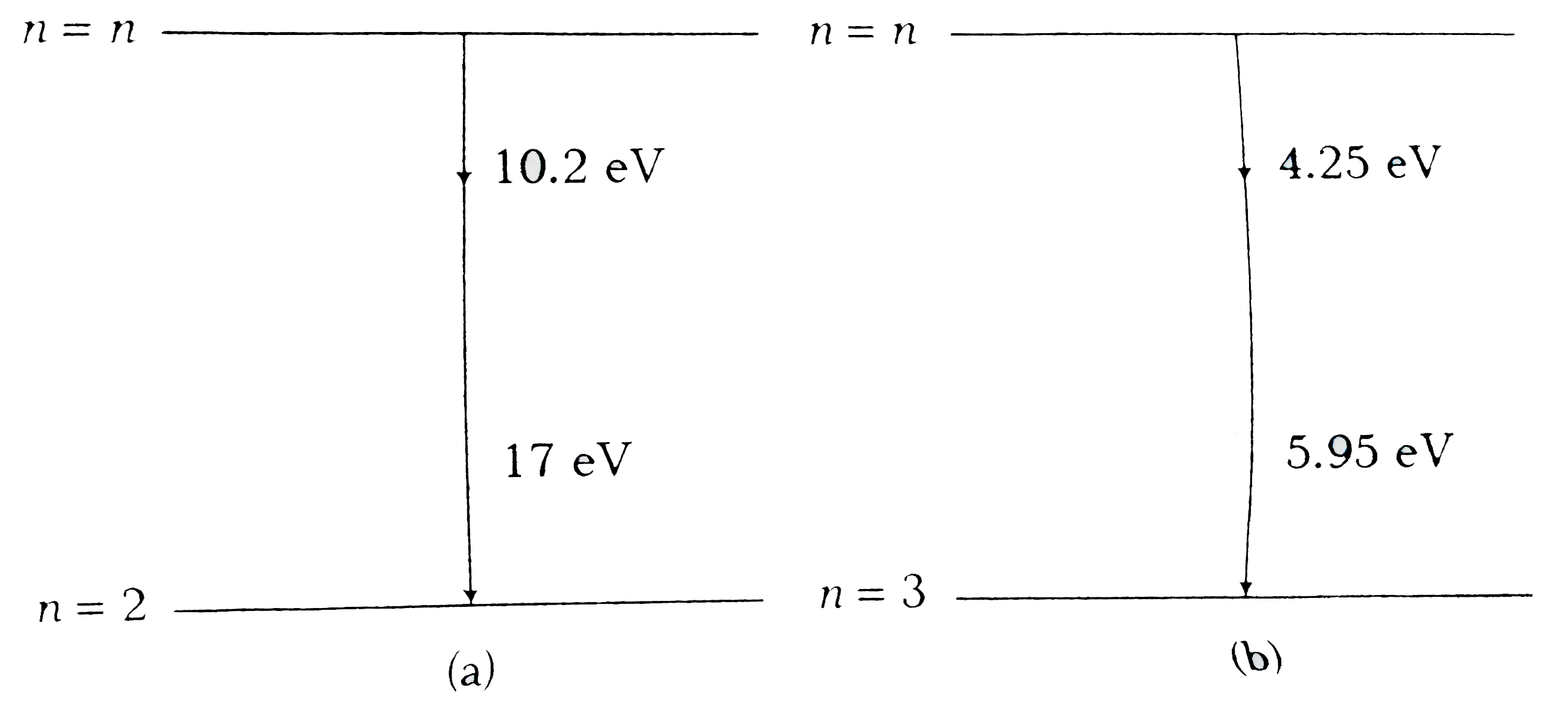
According to the question,

We, know energy of electron in nth is given by
`DeltaE=13.6Z^(2)((1)/(n_(1)^(2))-(1)/(n_(2)^(2)))`
Case I
Energy emitted by photon, `DeltaE=10.20+17`
=27.2 eV
So, `" " 10.2+17=13.6Z^(2)((1)/(2^2)-(1)/(n^(2)))" " ( :.n_(1)=2, n_(2)=n)`
`" " 27.2=13.6Z^(2)((1)/(4)-(1)/(n^(2)))" " ....(i)`
Case II
Energy emitted by photons, `Delta 4.25+5.95=10.2 eV`
`4.25xx5.95=13.6Z^(2)((1)/(3^(2))-(1)/(n^(2)))" " ( :.n_(1)=3,n_(2)=n)`
`10.2=13.6 Z^(2)((1)/(9)-(1)/(n^(2)))" " ....(ii)`
On divinding Eq. (i) by Eq. (ii) we get
`(27.22)/(10.2)=(1//4-1//n^(2))/(1//9-1//n^(2))`
`rArr" "(27.2)/(9)-(27.2)/(n^(2))=(10.2)/(4)-(10.2)/(n^(2))`
`rArr" " (17.2)/(n^(2))=(27.9)/(9)-(10.2)/(4)`
`rArr" " n^(2)=36rArrn=6`
Substituding the value of n in Eq. (i) , we get
`27.2=13.6Z^(2)((1)/(4)-(1)/(n^(2)))=13.6Z^(2)((1)/(4)-(1)/(6^(2)))`
`=13.6 Z^(2)((1)/(4)-(1)/(36))=13.6 Z^(2)((9-1)/(36))=13.6Z^(2)xx(2)/(9)`
`Z^(2)=9rArrZ=3`
Promotional Banner

Topper's Solved these Questions

  • ATOMS

    DC PANDEY ENGLISH|Exercise Check point 12.1|14 Videos
  • ATOMS

    DC PANDEY ENGLISH|Exercise Check point 12.2|16 Videos
  • ALTERNATING CURRENT

    DC PANDEY ENGLISH|Exercise JEE MAIN|62 Videos
  • CAPACITORS

    DC PANDEY ENGLISH|Exercise OBJECTIVE_TYPE|1 Videos

Similar Questions

Explore conceptually related problems

A hydrogen like atom (atomic number z ) is in a higher excited state of quantum number n . This excited atom can make a transition to the first excited state by successively emitting two photons of energies 10.2 eV and 17.0 eV respectively. Alternatively the atom from the same excited state can make a transition to the second excited state by successively emitting 2 photons of energy 4.25 eV and 5.95 eV respectively. Determine the value of (n+z)

A hydrogen like species (atomic number Z) is present in a higher excited state of quantum number n. This excited atom can make a transitionn to the first excited state by successive emission of two photons of energies 10.20 eV and 17.0 eV respectively. Altetnatively, the atom from the same excited state can make a transition to the second excited state by successive of two photons of energy 4.25 eV and 5.95 eVv respectively. Determine the value of Z.

A hydrogen like atom (atomic number Z) is in a higher excited satte of quantum number n .This excited atom can make a transition to the first excited state by succesively emitting two photon of energies 10.20 eV and 17.00 eV .Alternatively, the atom from the same excited state can make a transition to the second excited state by successively emitting twio photon of energy 4.25 ev and 5.95 eV Determine the followings: The atom during transition from n = 1 to n = 2 emit radiation in the region of

The ratio of the energies of the hydrogen atom in its first to second excited state is

the energy required to excite an electron in hydrogen atom to its first excited state is

The energy of an atom or ion in the first excited state is -13.6 eV. It may be

When a hydrogen atom is excited from ground state to first excited state, then

A hydrogen atom ia in excited state of principal quantum number n . It emits a photon of wavelength lambda when it returnesto the ground state. The value of n is

Energy of H-atom in the ground state is -13.6 eV, hence energy in the second excited state is

The energy of the electron in the ground state of H-atom is -13.6 eV . The energy of the first excited state will be

DC PANDEY ENGLISH-ATOMS-MEDICAL ENTRANCES GALLERY
  1. A hydrogen like atom (atomic number Z) is in a higher excited state o...

    Text Solution

    |

  2. Given the value of Rydberg constant is 10^(7)m^(-1), the waves number ...

    Text Solution

    |

  3. When an alpha particle of mass m moving with velocity v bombards on a ...

    Text Solution

    |

  4. Electrons of mass m with de-Broglie wavelength lambda fall on the targ...

    Text Solution

    |

  5. If an electron in a hydrogen atom jumps from the 3rd orbit to the 2nd ...

    Text Solution

    |

  6. Number of spectral lines in hydrogen atom is

    Text Solution

    |

  7. Minimum excitation potential of Bohr's first orbit in hydrogen atom is

    Text Solution

    |

  8. If the frequency of K(alpha), K(beta) and L(alpha) , X-ray lines of a...

    Text Solution

    |

  9. The magnetic moment (mu) of a revolving electron around the nucleus va...

    Text Solution

    |

  10. The ionization enegry of the electron in the hydrogen atom in its grou...

    Text Solution

    |

  11. A photon of wavelength 300nm interacts with a stationary hydrogen atom...

    Text Solution

    |

  12. Consider 3rd orbit of He^(+) (Helium) using nonrelativistic approach t...

    Text Solution

    |

  13. What is the wavelength of light for the least energetic photon emitted...

    Text Solution

    |

  14. The wavelength of k(alpha) X- rays produced by an X - rays tube is 0....

    Text Solution

    |

  15. The de-Broglie wavelength of an electron in 4th orbit is (where, r=rad...

    Text Solution

    |

  16. The de-Broglie wavelength of an electron is the same as that of a 50 k...

    Text Solution

    |

  17. The ionisation energy of hydrogen is 13.6 eV . The energy of the photo...

    Text Solution

    |

  18. Hydrogen atom in ground state is excited by a monochromatic radiation ...

    Text Solution

    |

  19. If, an electron in hydrogen atom jumps from an orbit of lelvel n=3 to ...

    Text Solution

    |

  20. In the spectrum of hydrogen atom, the ratio of the longest wavelength ...

    Text Solution

    |

  21. The Rutherford charge experiment proves than an atom consists of

    Text Solution

    |

