Home
Class 12
PHYSICS
For the given incident ray as shown in f...

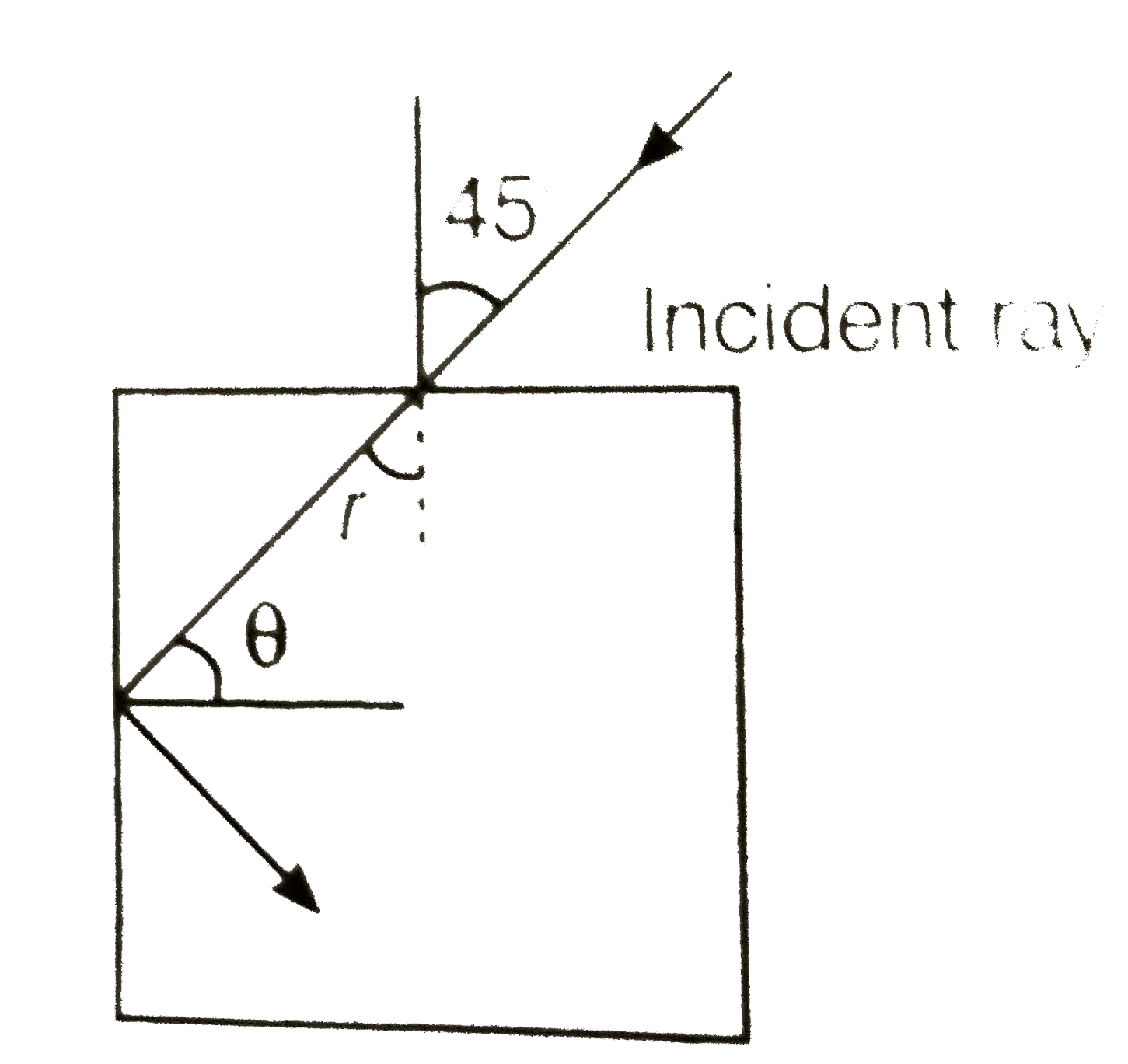
For the given incident ray as shown in figure, the condition of total internal reflection of the ray will be satisfied if the refractive indesx of block will be

A

`cos theta=3lambda//2d`

B

`cos theta=lambda//4d`

C

`sec theta-cos theta=lambda//d`

D

`sec theta-cos theta=4lambda//d`

Text Solution

Verified by Experts

The correct Answer is:
B

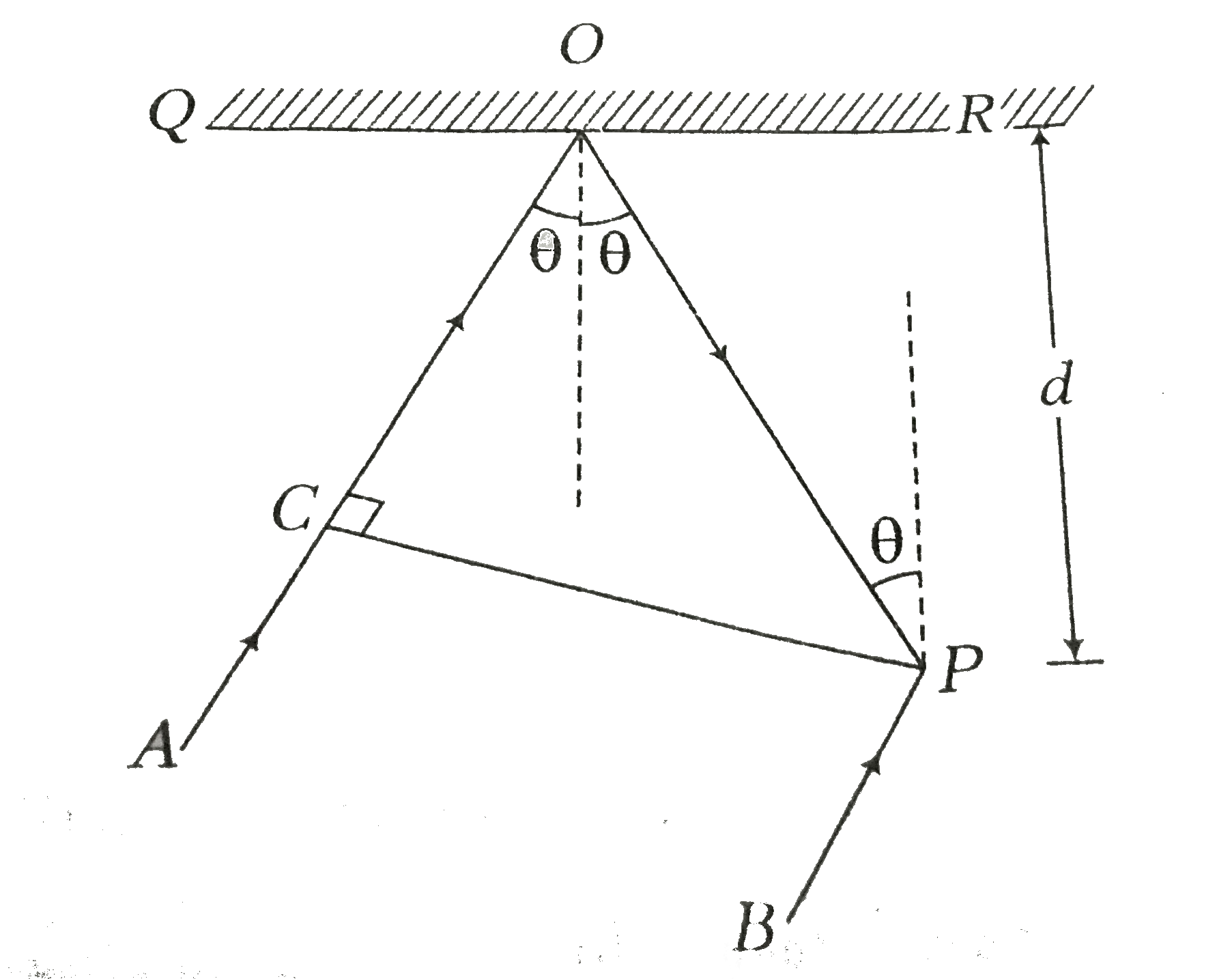
Path difference between the two rays is given by

`Delta=CO+PO`
`because PR=d`
So, `PO=dsec thetha`
and `CO=PO cos 2theta=dsec thetacos 2theta`
So, `Delta=(d sec theta+d sec theta cos 2 theta)`
Phase difference between two rays is `phi=pi` (as one ray is reflected one and another is direct)
Now, for constructive interference path difference should be even multiple of half wavelength
i.e., `Delta=lambda//2, 3lambda//2`
So, `d sec theta+d sec theta cos 2theta=lambda/2`
or `d sec theta(1+cos 2theta)=lambda/2`
or `d sec theta(2cos^(2)theta)=lambda/2`
`:. cos theta=lambda//4d`
Promotional Banner

Topper's Solved these Questions

  • WAVE OPTICS

    DC PANDEY ENGLISH|Exercise Assertion reason|8 Videos
  • WAVE OPTICS

    DC PANDEY ENGLISH|Exercise match column|4 Videos
  • WAVE OPTICS

    DC PANDEY ENGLISH|Exercise Check point|65 Videos
  • SOLVED PAPERS 2018

    DC PANDEY ENGLISH|Exercise JIPMER|22 Videos

Similar Questions

Explore conceptually related problems

For a given incident ray as shown in Fig., the condition of total internal reflection of ray will be satisfied if the refractive index of the block will be. .

Under what conditions is the phenomenon of total internal reflection between the critical angle of incidence and the refractive index of the medium.

At what angle should a ray of light be incident on the face of a prism of refracting angle 60^(@) so that it just suffers total internal reflection at the other face ? The refractive index of the prism is 1.524.

A cubical block of glass of refractive index n_1 is in contact with the surface of water of refractive index n_2. A beam of light is incident on vertical face of the block. After refraction a total internal reflection at the base and refraction at the opposite face take place. The ray emerges at angle theta as shown. The value of theta is given by

A ray of light strikes a plane mirror at an angle of incidence 45^@ as shown in Figure . After reflection,l the ray passes through a prism of refractive indes 1.5 whos apex angle is 4^@ . Through what angle must the mirror be rotated it total deviation of the ray be 90^@ ?

A light ray moving in medium-I (of refractive index n_(1) ) is incident on interface of two media and it is totally internally reflected at the interface. Now, refractive index n_(2) of medium-II is decreased, then

A ray of light is incident on the left vertical face of glass cube of refractive index n_2, as shown in figure. The plane of incidence is the plane of the page, and the cube is surrounded by liquid (refractive index =n_1 ). What is the largest angle of incidence theta_1 for which total internal reflection occurs at the top surfaces?

A ray of light AO is incident on a diverging lens as shown in figure. The focal plane of the lens is also given. The possible direction of the refracted ray will be

A ray of light incident on one of the face of a prism as shown. After refraction through this surface ray is incident on base of the prism. The refractive index of the prism is sqrt(3) . The net deviation of the ray due to prism is

The path of a ray of light passing through an equilateral glass prism ABC is shown in figure. The ray of light is incident on face BC at the critical angle for just total internal reflection. The total internal reflection. The total angle of deviation after the refraction at face AC is 108^@ . Calculate the refractive index of the glass.

DC PANDEY ENGLISH-WAVE OPTICS-taking it together
  1. In Young's double slit experiment the y-coordinates of central maxima ...

    Text Solution

    |

  2. In Young's double slit experiment, wavelength lambda=5000Å the distanc...

    Text Solution

    |

  3. A parallel beam of light of intensity I is incident on a glass plate. ...

    Text Solution

    |

  4. In the Young's double slit experiment, the intensities at two points P...

    Text Solution

    |

  5. A monochromatic beam of light fall on YDSE apparatus at some angle (sa...

    Text Solution

    |

  6. Figure shows a standard two slit arrangement with slits S(1), S(2). P(...

    Text Solution

    |

  7. In Young's double slit experiment, the two slits acts as coherent sour...

    Text Solution

    |

  8. In the ideal double-slit experiment, when a glass-plate (refractive in...

    Text Solution

    |

  9. In the standard Young's double slit experiment, the intensity on the s...

    Text Solution

    |

  10. In a Young's double slit experiment, D equals the distance of screen a...

    Text Solution

    |

  11. White light is used to illuminate the two slits in a Young's double sl...

    Text Solution

    |

  12. The intensity of each of the two slits in Young's double slit experime...

    Text Solution

    |

  13. In a double-slit experiment, fringes are produced using light of wavel...

    Text Solution

    |

  14. An interference is observed due to two coherent sources S1 placed at o...

    Text Solution

    |

  15. Intensity at centre in YDSE is l(0) if one slit is covered. Then inten...

    Text Solution

    |

  16. Two coherent light sources A and B are at a distance 3lambda from each...

    Text Solution

    |

  17. Two coherent sources separated by distance d are radiating in phase ha...

    Text Solution

    |

  18. Consider a ray of light incident from air onto a slab of glass (refrac...

    Text Solution

    |

  19. Two ideal slits S(1) and S(2) are at a distance d apart, and illuninat...

    Text Solution

    |

  20. For the given incident ray as shown in figure, the condition of total ...

    Text Solution

    |

