Home
Class 12
PHYSICS
The angle of incidence at which reflecte...

The angle of incidence at which reflected light is totally polarised for reflection from air to glass (refractive index n) is

A

`sin^(-1) mu`

B

`"sin"^(-1)(1/mu)`

C

`"tan"^(-1)(1/mu)`

D

`tan^(-1)(mu)`

Text Solution

Verified by Experts

The correct Answer is:
D

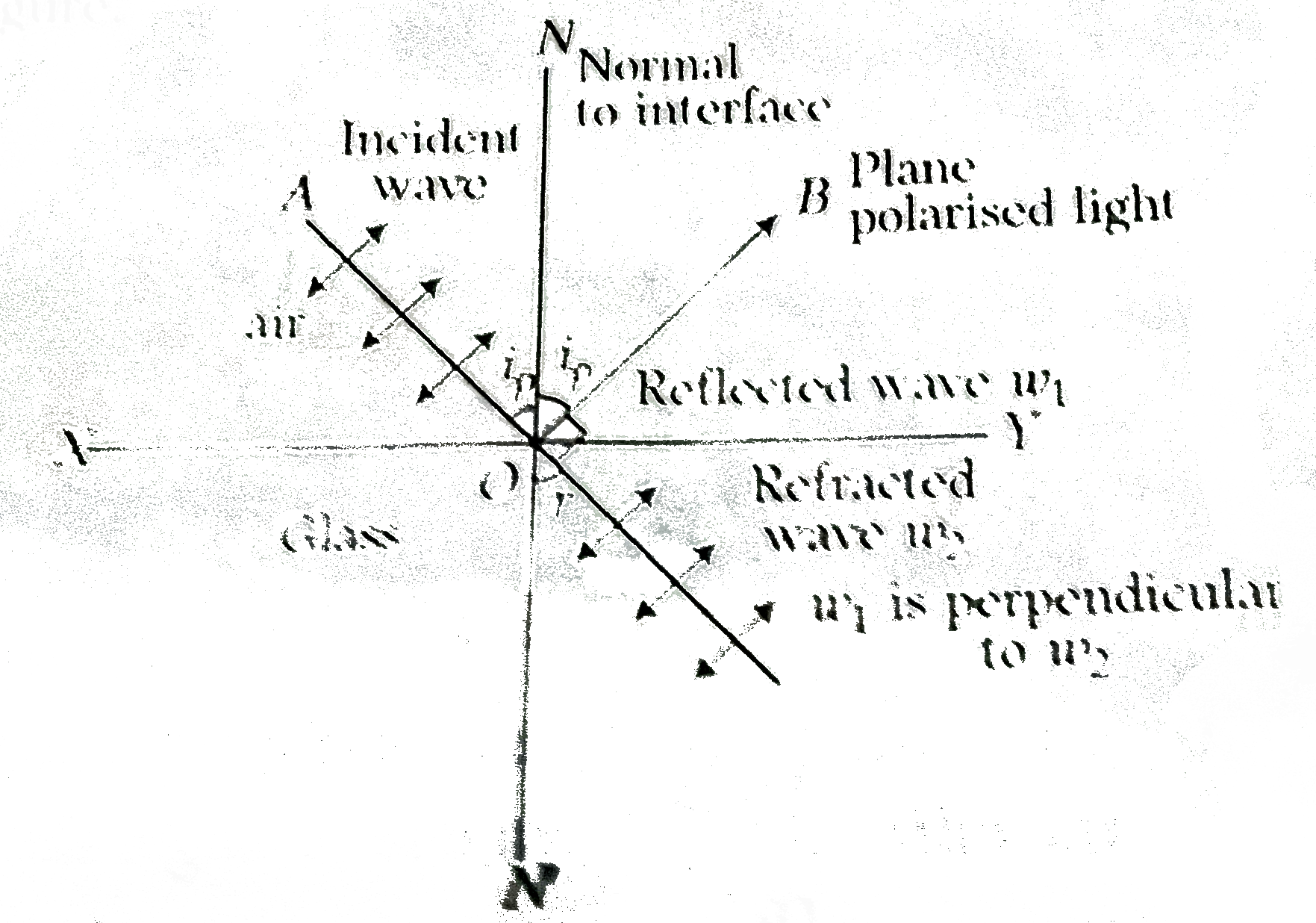
Suppose `i_(P)` is the Brewster angle when unpolarised light is incident at an polarising angle the reflected component along OB and refracted component along OC in the following figure

Now, `angleBOY+angleYOC=90^(@)`
`(90-i_(P))+(90^(@)-r)=90^(@)`
Here, r is the angle of refractive
i.e., `90^(@)-i_(P)=r`
According to Shell's law `mu=(sini)/(sinr)`
When `i=i_(P)r=90^(@)-i_(p)`
Then `mu=(sin i_(p))/(sin(90^(@)-i_(p)))`
`=(sin i_(p))/(cos i_(p))=tani_(p)`
`i_(p)=tan^(-1)(mu)`
where, `i_(p)` is polarised angle
Promotional Banner

Topper's Solved these Questions

  • WAVE OPTICS

    DC PANDEY ENGLISH|Exercise For JEE main (Only one option is Correct )|22 Videos
  • WAVE OPTICS

    DC PANDEY ENGLISH|Exercise For JEE Advanced Only one option is correct|22 Videos
  • WAVE OPTICS

    DC PANDEY ENGLISH|Exercise match column|4 Videos
  • SOLVED PAPERS 2018

    DC PANDEY ENGLISH|Exercise JIPMER|22 Videos

Similar Questions

Explore conceptually related problems

The angle of incidence at which reflected light is totally polarized for reflection from air to glass (refractive index n),

Unpolarized light is incident on a plane surface of glass of refractive index mu at angle i . If the reflected light gets totally polarized, write the relation between the angle i and refractive index mu .

A beam of light travelling in water strikes a glass plate, which is also immersed in water. When the angle of incidence is 51^@ , the reflected beam is found to be plane polarised . What is the refractive index of glass if the refractive index of water is (4)/3 ? [tan 51^(@)=1.235]

A beam of light strikes a surface at angle of incidence of 60^(@) and reflected beam becomes completely polarised . The refractive index of glass surface is -

When light is incident from air to glass at an angle 57^@ , the reflected beam is completely polarised. If the same beam is incident from water to glass, the angle of incidence at which reflected beam is completely polarised will be

A ray of light travelling in a transparent medium falls on a surface separating the medium from air at an angle of incidence of 45^(@) . The ray undergoes total internal reflection. If n is the refractive index of the medium with respect to air, select the possible value of n from the following.

(a) How does one demonstrate, using a suitable diagram, that unpolarised light when passed through a Polaroid gets polarised? (b) A beam of unpolarised light is incident a glass-air interface. Show using a suitable ray diagram, that light reflected from the interface is totally polarised, when mu=tani_(B) , when mu is the refractive index of glass with respect to air and i_(B) , is the Brewster's angle.

Distinguish between unpolarised and plane polarised light. An unpolarised light is incident on the boundary between two transparent media. State the consition when the reflected wave is totally plane polarised. Find out the expression for the angle of incidence in this case.

The angle of incidence of a light beam onto a reflecting surface is continuously varied. The reflected ray is found to be completely polarized when the angle of incidence is 60^(@) . What is the index of refraction of the reflecting material ?

A light ray moving in medium-I (of refractive index n_(1) ) is incident on interface of two media and it is totally internally reflected at the interface. Now, refractive index n_(2) of medium-II is decreased, then

DC PANDEY ENGLISH-WAVE OPTICS-medical entrances
  1. Colours of thin soap bubbles are due to

    Text Solution

    |

  2. In Young's double slit experiment, the ratio of maximum and minimum in...

    Text Solution

    |

  3. In Young's double slit interference experiment, using two coherent wav...

    Text Solution

    |

  4. The angle of incidence at which reflected light is totally polarised f...

    Text Solution

    |

  5. A polarised light intensity I(0) is passed through another polariser w...

    Text Solution

    |

  6. A fringe width of a certain interference pattern is beta=0.002 cm What...

    Text Solution

    |

  7. In young's double-slit experiment, the slit are 2 mm apart and are ill...

    Text Solution

    |

  8. If two slits is Young's experiment are 0.4 mm apart and fringe width o...

    Text Solution

    |

  9. Light of wavelength lambda from a point source falls on a small circul...

    Text Solution

    |

  10. Which of the following phenomena support the wave theory of light? 1...

    Text Solution

    |

  11. lambda(1) and lambda(2) are used to illuminated the slits. beta(1) and...

    Text Solution

    |

  12. When we close one slit in the Young's double slit experiment then

    Text Solution

    |

  13. A beam of light incident on a glass slab (mu=1.54) in a direction as s...

    Text Solution

    |

  14. In young's double slit experiment, the path difference between two int...

    Text Solution

    |

  15. A parallel beam of fast moving electrons is incident normally on a nar...

    Text Solution

    |

  16. White light reflected from a soap film (Refractive index =1.5 ) has a ...

    Text Solution

    |

  17. In Young's double slit experiment, the fringe width is 1 xx 10^(-4) m...

    Text Solution

    |

  18. Assertion: To observe diffraction of light the size of obstacle/apertu...

    Text Solution

    |

  19. Assertion: The pattern and position of fringes always remain same even...

    Text Solution

    |

  20. Assertion : Corpuscular theory fails to explain the velocities of ligh...

    Text Solution

    |

