Home
Class 12
CHEMISTRY
Explain S(N) - 1 reaction mechanism....

Explain `S_(N) - 1` reaction mechanism.

Text Solution

Verified by Experts
`SN^(1)` reaction
When tertiary butyl bromide is heated with aqueous potassium hydroxide, tertiary butyl alcohol is formed and follows the first order kinetics. i.e. The rate of reaction depends on the concentration of only one reactant i.e. tertiary butyl bromide
`underset(" "r=K[(CH_(3))_(3)CBr]^(1))((CH_(3))CBr+KOH to CH_(3)-underset(CH_(3))underset(|)overset(CH_(3))overset(|)C-OH+KBr)`
Mechanism :
Step-1 : Formation of Carbocation.
`CH_(3)-underset(CH_(3))underset(|)overset(CH_(3))overset(|)C-Br overset("Slow")toCH_(3)-underset(CH_(3))underset(|)overset(CH_(3))overset(|)(" C"^(o+))+Br^(-)`
This is the rate determining step.
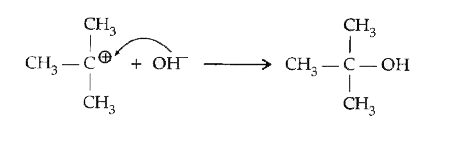
Step-2: Attack of nucleophile on carbocation
The nucleophile `OH^(-)` attacks the positive center of carbocation from any one of the direction forming tertiary butyl alcohol
Promotional Banner

Topper's Solved these Questions

  • SOLVED PAPER II PUC MARCH-2016

    OSWAAL PUBLICATION|Exercise PART-C |11 Videos
  • SOLVED PAPER II PUC JULY - 2016

    OSWAAL PUBLICATION|Exercise PART -E|19 Videos
  • SOLVED PAPER II PUC TOPPER'S ANSWER MARCH-2015

    OSWAAL PUBLICATION|Exercise PART -D|30 Videos

Similar Questions

Explore conceptually related problems

Explain S_(N) - 2 reaction mechanism ?

Explain S_(N^(-))2 reaction mechanism.

Explain sex determination mechanism in honey bees.

(a) Explain S_(N)1 mechanism for the conversion of tertiary butyl bromide to tertiary butyl alcohol. (b) Complete the following reactions : (i) CH_(3) - CH = CH_(2) + HI rarr (ii) (iii) CH_(3)CH_(2)Br underset("Aq Ethanol")overset(AgCN)rarr

Explain the autoregulatory mechanism of GFR.

Explain the addition of mechanism of HCN to aldehyde or ketones.

Explain S_(N)2 mechanism taking an example of chloromethane.

i) Explain S_(N)2 mechanism taking an example of chloromethane. ii) Write the general equation for the reaction of primary alcohol with SOCl_(2) .

OSWAAL PUBLICATION-SOLVED PAPER II PUC MARCH-2016 -PART-D
  1. Calculate the packing efficiency in a simple cubic lattice.

    Text Solution

    |

  2. An element crystallizes in fcc lattice. If the edge length of the unit...

    Text Solution

    |

  3. Give reason for the following. Brownian movement of colloidal partic...

    Text Solution

    |

  4. What is peptization ? Give an example.

    Text Solution

    |

  5. Derive an integrated rate equation for the rate constant of a first-or...

    Text Solution

    |

  6. Draw the graph for [R] versus time (t) for a zero order reaction. Give...

    Text Solution

    |

  7. Write the mechanism of acid catalysed dehydration of ethanol to ethene...

    Text Solution

    |

  8. What is the effect of the following groups on the acidity of phenol ? ...

    Text Solution

    |

  9. (a) Write the Haworth's structure for lactose. (b) Give an example ...

    Text Solution

    |

  10. Explain S(N) - 1 reaction mechanism.

    Text Solution

    |

  11. Explain Fittig reaction with equation.

    Text Solution

    |

  12. What is cross aldol condensation. Give an example.

    Text Solution

    |

  13. Explain decarboxylation reaction with an example.

    Text Solution

    |

  14. What is the major product of the following reaction ?

    Text Solution

    |

  15. What are condensation polymers? Given an example.

    Text Solution

    |

  16. Write the following: (i) IUPAC name for the monomer of natural rubb...

    Text Solution

    |

  17. Give an example for a co-polymer.

    Text Solution

    |

  18. Explain Hoffmann bromamide degradation for the preparation of methanam...

    Text Solution

    |

  19. Complete the following reactions : (i) (ii) C(6)H(5)NH(2) +NaNO(2...

    Text Solution

    |

  20. Give reason: Ammonia is more basic than aniline.

    Text Solution

    |

