Text Solution
Verified by Experts



Topper's Solved these Questions
PRINCIPLES OF INHERITANCE AND VARIATION
ICSE|Exercise PRACTICE QUESTIONS ( VERY SHORT ANSWER TYPE QUESTIONS)|31 VideosPRINCIPLES OF INHERITANCE AND VARIATION
ICSE|Exercise PRACTICE QUESTIONS ( SHORT ANSWER TYPE-I QUESTIONS)|15 VideosORGANISMS AND POPULATIONS
ICSE|Exercise COMPETITION CORNER (ASSERTION AND REASON TYPE QUESTIONS)|22 VideosQUESTION PAPER 2022 TERM 1
ICSE|Exercise MULTIPLE CHOICE QUESTIONS|45 Videos
Similar Questions
Explore conceptually related problems
ICSE-PRINCIPLES OF INHERITANCE AND VARIATION-MULTIPLE CHOICE QUESTION
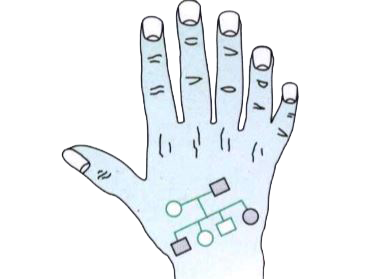
- The given figure of a human shows a pedigree analysis. Answer the foll...
Text Solution
|
- The genetic ratio of 9:3:3:1 is due to:
Text Solution
|
- Choose the chromosome, in a human, that possesses least number of gene...
Text Solution
|
- G. J. Mendel was a:
Text Solution
|
- Select the incorrect match.
Text Solution
|
- In a dihybrid cross, if you get 9:3:3:1 ratio it denotes that:
Text Solution
|
- A monohybrid cross produced tall and dwarf pea plants in ratio of 3:1....
Text Solution
|
- Common test to find genotype of hybrid is by:
Text Solution
|
- Which one is a test cross?
Text Solution
|
- Mating of an organism to a double recessive in order to determine whet...
Text Solution
|
- A cross between two tall plants resulted in offspring having few dwarf...
Text Solution
|
- The term genetics was proposed by:
Text Solution
|
- The F2 genotypic ratio of monohybrid cross is:
Text Solution
|
- A dihybrid for qualitative trait is crossed with homozygous recessive ...
Text Solution
|
- In order to find out the different types of gametes produced by a pea ...
Text Solution
|
- The autosomal disorder/disease in humans is:
Text Solution
|
- Distance between the genes and percentage of recombination shows:
Text Solution
|
- In Mirabilis jalapa, the number of F2 red flowered plants in a cross ...
Text Solution
|
- In pea plants, yellow seeds are dominant to green. If a heterozygous y...
Text Solution
|
- Which of the following is best suited for codominance?
Text Solution
|
- Incomplete dominance is shown by:
Text Solution
|