Home
Class 10
PHYSICS
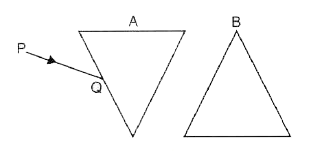
Figure below shows two identical prisms ...

Figure below shows two identical prisms A and B placed with their faces parallel to each other. A ray of light of single colour PQ is incident at the face of the prism A. complete the diagram to show the path of the ray till it emerges out of the prism B.

Text Solution

Verified by Experts

The emergent ray out of the prism B will be parallel to the incident ray PQ
Promotional Banner

Topper's Solved these Questions

  • REFRACTION OF LIGHT AT PLANE SURFACES

    ICSE|Exercise EXERCISE-4(B) MULTIPLE CHOICE TYPE|2 Videos
  • REFRACTION OF LIGHT AT PLANE SURFACES

    ICSE|Exercise EXERCISE-4(B) NUMERICALS|2 Videos
  • REFRACTION OF LIGHT AT PLANE SURFACES

    ICSE|Exercise EXERCISE-4(A) NUMERICALS|4 Videos
  • REFRACTION OF LIGHT

    ICSE|Exercise DIAGRAM BASED MCQ:|5 Videos
  • REFRACTION THROUGH A LENS

    ICSE|Exercise EXERCISE-5(D) (MULTIPLE CHOICE TYPE)|2 Videos

Similar Questions

Explore conceptually related problems

Figure shows two identical prisms P and Q placed with their faces parallel to each other. A light ray AB of yellow colour is incident at the face of the prism P. Complete the diagram to show the path of the ray till it emerges out of the prism Q.

A ray of light PQ is incident normally on the hypotenuse of a right angled prism ABC as shown in the diagram given below: Copy the diagram and complete the path of the ray PQ till it emerges from the prism.

A ray of light PQ is incident normally on the hypotenuse of a right angled prism ABC as shown in the diagram. Name an instrument where this action of the prism is used.

Figure below shows a light ray of green colour incident on the prisms A,B and C. in each case, draw the path of the ray of light as it enters and emergest out of the prism. Mark the angle wherever necessary.

(a) Figure shows two isosceles right angled prisms A and B and the light rays incident on the prism A. complete the diagram to show the rays emerging out of the prism B. (b) State the principle used for completing the ray diagram in part (a) above.

Complete the path of the monochromatic light ray AB incident on the surface PQ of the equilateral glass prism PQR till it emerges out of the prism due to refraction.

A ray of light is incident at 60^(@) on one face of a prism of angle 30^(@) and the emergent ray makes 30^(@) with the incident ray. The refractive index of the prism is

A ray of light is incident at 60^(@) on one face of a prism of angle 30^(@) and the emergent ray makes 30^(@) with the incident ray. The refractive index of the prism is

A ray of light falls on a normally on a refracting face of a prism. Find the angle of prism if the ray just fails to emerge from the prism (mu=3//2).

A ray of light incident at an angle 90° with the face of an equilateral prism passes symmetrically. Calculate the refractive index of the material of the prism

ICSE-REFRACTION OF LIGHT AT PLANE SURFACES-EXERCISE-4(B)
  1. What is prism? With the help of a diagram of the principal section of ...

    Text Solution

    |

  2. Diagram (a) and (b) in figure below show the refraction of a ray of li...

    Text Solution

    |

  3. Define the term angle of deviation.

    Text Solution

    |

  4. Complete the following sentence : Angle of deviation is the angle wh...

    Text Solution

    |

  5. What do you understand by the deviation produced by a prism? Why is it...

    Text Solution

    |

  6. (a) How does the angle of deviation produced by a prism change with in...

    Text Solution

    |

  7. State whether the following statement is 'true' or 'false'. The devi...

    Text Solution

    |

  8. How does the deviation produced by a prism depend on (i) the refractiv...

    Text Solution

    |

  9. How does the angle of minimum deviation produced by a prism change wit...

    Text Solution

    |

  10. Write a relation for the angle of deviation (delta) for a ray of light...

    Text Solution

    |

  11. A ray of light incident at an angle of incidence i(1) passes through a...

    Text Solution

    |

  12. Draw a ray diagram to show the refraction of a monochromatic ray throu...

    Text Solution

    |

  13. A light ray of yellow colour is incident on an equilateral glass prism...

    Text Solution

    |

  14. Name the colour of white light which is deviated (i) the most, and (ii...

    Text Solution

    |

  15. Which of the two prisms, A made of crown glass and B made of flint gla...

    Text Solution

    |

  16. How does the angle of deviation depend on the refracting angle of the ...

    Text Solution

    |

  17. An object is viewed through a glass prism with its vertex pointing upw...

    Text Solution

    |

  18. A ray of light is normally incident on one face of an equilateral glas...

    Text Solution

    |

  19. Figure below shows two identical prisms A and B placed with their face...

    Text Solution

    |
