
Home
Class 9
PHYSICS
The following table represents the dista...

The following table represents the distance of a car at different instants in a fixed direction.

(a) Draw a displacement-time graph and with its help, find whether the motion of the car is uniform or non-uniform?
(b) Use graph to calculate :
(i) the velocity of car (ii) the displacement of car at t = 2.5 s and t = 4.5 s.

Text Solution

Verified by Experts
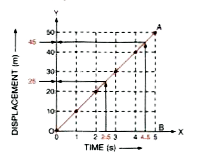
The displacement-time graph for the car is shown in Fig. 2.25. Since it is a straight line OA inclined with the time axis, so the motion of car is with

(b) (i) Velocity = Slope of the straight line OA
`= (BA)/(OB)= ((50 -0)m)/((5-0)s)= (50m)/(5s) = 10 m s^(-1)`
(ii) From the graph it is clear that at t = 2.5 s
displacement is 25 m and at t = 4.5 s
displacement is 45 m .
Promotional Banner

Topper's Solved these Questions

  • MOTION IN ONE DIMENSION

    ICSE|Exercise EXERCISE -2 (A)|28 Videos
  • MOTION IN ONE DIMENSION

    ICSE|Exercise EXERCISE -2 (A) ( Multiple choice type: ) |5 Videos
  • MEASUREMENTS AND EXPERIMENTATION

    ICSE|Exercise TOPIC 2 SIMPLE PENDULUM (4 Marks Questions ) |1 Videos
  • PRESSURE IN FLUIDS AND ATMOSPHERIC PRESSURE

    ICSE|Exercise Exercise -4(B)Numericals|5 Videos

Similar Questions

Explore conceptually related problems

A body at rest is made to fall from the top of a tower. Its displacement at different instants is given in the following table : Draw a displacement-time graph and state whether the motion is uniform or non-uniform?

Following table gives the displacement of a car at different instants of time. (a) Draw the displacement-time sketch and find the average velocity of car. (b) What will be the displacement of car at (i) 2.5 s and (ii) 4.5 s?

Fig. 2.37 (a) shows the displacement-time graph for the motion of a body. Use it to calculate the velocity of body at t = 1 s, 2 s and 3 s, then draw the velocitytime graph for it in Fig. (b).

s-t graph of a particle in motion is as shown below. (a) State, whether the given graph represents a uniform motion or not. (b) Find velocity of the particle.

A car travels a distance 50 km with a velocity 25 km h^(-1) and then 60 km with a velocity 20 km h^(-1) in the same direction. Calculate : (i) the total time of journey and (ii) the average velocity of the car.

Assertion : In displacement-time graph of a particle as shown in figure, velocity of particle changes its direction at point A. Reason : Sign of slope of s-t graph decides the direction of velocity.

A car starts from erest accelerates uniform by for 4 second and then moves with uniform velocity which of the x-t graph represent th motion of the car:-

Engine of a car supplies constant power to the car which accelerates from rest. Car moves along a straight road. If velocity and displacement of car at any time t be v and s respectively then

Aarushi was driving a car with uniform speed of 60 km/h. Draw distance-time graph. From the graph, find the distance travelled by Aarushi in (i) 2 1/2Hou r s (ii) 1/2\ Hou r s

Draw a velocity-time graph for a body moving with an initial velocity u and uniform acceleration a. Use this graph to find the distance travelled by the body in time t.

ICSE-MOTION IN ONE DIMENSION -EXERCISE -2 (C) ( Multiple choice type :)
  1. The following table represents the distance of a car at different inst...

    Text Solution

    |

  2. The correct equation of motion is :

    Text Solution

    |

  3. A car starting from rest accelerates uniformly to acquire a speed 20 k...

    Text Solution

    |

  4. A body starts from rest with a uniform acceleration of 2 m s^(-1) . Fi...

    Text Solution

    |

  5. A body starts with an initial velocity of 10 ms and acceleration 5 ms....

    Text Solution

    |

  6. A vehicle is accelerating on a straight road. Its velocity at any inst...

    Text Solution

    |

  7. A body, initially at rest, starts moving with a constant acceleration ...

    Text Solution

    |

  8. A bullet initially moving with a velocity 20 m s^(-1) strikes a target...

    Text Solution

    |

  9. A train moving with a velocity of 20 m s^(-1)' is brought to rest by a...

    Text Solution

    |

  10. A train travels with a speed of 60 km h^(-1)' from station A to statio...

    Text Solution

    |

  11. A train is moving with a velocity of 90 km h^(-1). It is brought to st...

    Text Solution

    |

  12. A car travels a distance 100 m with a constant acceleration and averag...

    Text Solution

    |

  13. When brakes are applied to a bus, the retardation produced is 25 cm s^...

    Text Solution

    |

  14. A body moves from rest with a uniform acceleration and travels 270 m i...

    Text Solution

    |

  15. A body moving with a constant acceleration travels the distances 3 m a...

    Text Solution

    |

  16. A car travels with a uniform velocity of 25 m s^(-1) for 5 s. The brak...

    Text Solution

    |

  17. A space craft flying in a straight course with a velocity of 75 km s^(...

    Text Solution

    |

  18. A train starts from rest and accelerates uniformly at a rate of 2 m s^...

    Text Solution

    |

