Home
Class 11
CHEMISTRY
Explain why alkyl groups act as electron...

Explain why alkyl groups act as electron donors when attached to a n system

Text Solution

Verified by Experts
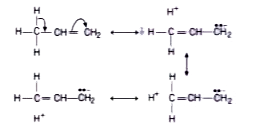
Due to hyperconjugation, alkyl groups act as electron donors when attached to a `pi` system. For example, let us consider hyperconjugation in propene.
Promotional Banner

Topper's Solved these Questions

  • ORGANIC CHEMISTRY : SOME BASIC PRINCIPLES AND TECHNIQUES

    ICSE|Exercise ASSERTION - REASON TYPE QUESTIONS|11 Videos
  • HYDROGEN

    ICSE|Exercise NCERT TEXT-BOOK EXERCISE (With Hints and Solutions)|53 Videos
  • REDOX REACTIONS (OXIDATION AND REDUCTION)

    ICSE|Exercise NCERT TEXT-BOOK. EXERCISES ((With Hints and Solutions)|69 Videos

Similar Questions

Explore conceptually related problems

Explain why alkyl groups act as electron donors when attacted to a pi-system .

Explain why can more than 8 electrons not be accommodated in L shell?

The resonance effect is defined as 'the polarity produced in the molecule by the interaction of two pi -bonds or between a pi -bond and lone pair of electrons present on an adjacentatom.' The effect is transmitted through the chain. In positive resonance effect, the transfer of electrons is away from an atom or substituent group attached to the conjugated system. This electron displacement makes certain positions in the molecule of high electron densities. In negative resonance effect, the transfer of electrons is towards the atom or substituent group attached to the conjugated system. Which of the following does not show resonance effect ?

The resonance effect is defined as 'the polarity produced in the molecule by the interaction of two pi -bonds or between a pi -bond and lone pair of electrons present on an adjacentatom.' The effect is transmitted through the chain. In positive resonance effect, the transfer of electrons is away from an atom or substituent group attached to the conjugated system. This electron displacement makes certain positions in the molecule of high electron densities. In negative resonance effect, the transfer of electrons is towards the atom or substituent group attached to the conjugated system. Which of the following shows +M effect ?

The resonance effect is defined as 'the polarity produced in the molecule by the interaction of two pi -bonds or between a pi -bond and lone pair of electrons present on an adjacentatom.' The effect is transmitted through the chain. In positive resonance effect, the transfer of electrons is away from an atom or substituent group attached to the conjugated system. This electron displacement makes certain positions in the molecule of high electron densities. In negative resonance effect, the transfer of electrons is towards the atom or substituent group attached to the conjugated system. Which of the following carboxylate ions is the most stable ?

The resonance effect is defined as 'the polarity produced in the molecule by the interaction of two pi -bonds or between a pi -bond and lone pair of electrons present on an adjacentatom.' The effect is transmitted through the chain. In positive resonance effect, the transfer of electrons is away from an atom or substituent group attached to the conjugated system. This electron displacement makes certain positions in the molecule of high electron densities. In negative resonance effect, the transfer of electrons is towards the atom or substituent group attached to the conjugated system. What is the IUPAC name for :

The resonance effect is defined as 'the polarity produced in the molecule by the interaction of two pi -bonds or between a pi -bond and lone pair of electrons present on an adjacentatom.' The effect is transmitted through the chain. In positive resonance effect, the transfer of electrons is away from an atom or substituent group attached to the conjugated system. This electron displacement makes certain positions in the molecule of high electron densities. In negative resonance effect, the transfer of electrons is towards the atom or substituent group attached to the conjugated system. Which of the following intermediates is pyramidal in shape ?

The resonance effect is defined as 'the polarity produced in the molecule by the interaction of two pi -bonds or between a pi -bond and lone pair of electrons present on an adjacent atom.' The effect is transmitted through the chain. In positive resonance effect, the transfer of electrons is away from an atom or substituent group attached to the conjugated system. This electron displacement makes certain positions in the molecule of high electron densities. In negative resonance effect, the transfer of electrons is towards the atom or substituent group attached to the conjugated system. Which of the following free radicals is the most stable ?

Explain why : Fluorine has lower electron affinity than chlorine.

The resonance effect is defined as 'the polarity produced in the molecule by the interaction of two pi -bonds or between a pi -bond and lone pair of electrons present on an adjacentatom.' The effect is transmitted through the chain. In positive resonance effect, the transfer of electrons is away from an atom or substituent group attached to the conjugated system. This electron displacement makes certain positions in the molecule of high electron densities. In negative resonance effect, the transfer of electrons is towards the atom or substituent group attached to the conjugated system. The correct statement regarding a carbonyl compound with a hydrogen atom on its alpha carbon, is

ICSE-ORGANIC CHEMISTRY : SOME BASIC PRINCIPLES AND TECHNIQUES -NCERT TEXT-BOOK EXERCISES (WITH HINTS AND SOLUTIONS )
  1. Identify the functional groups is the following compounds:

    Text Solution

    |

  2. Which of the two: O(2)NCH(2)CH(2)O^(–) or CH(3)CH(2)O^(–) is expecte...

    Text Solution

    |

  3. Explain why alkyl groups act as electron donors when attached to a n s...

    Text Solution

    |

  4. Draw the resonance structures for the following compounds. Show the el...

    Text Solution

    |

  5. Draw the resonance structures for the following compounds. Show the el...

    Text Solution

    |

  6. Draw the resonance structures for the following compounds. Show the el...

    Text Solution

    |

  7. Draw the resonance structures for the following compounds. Show the el...

    Text Solution

    |

  8. Draw the resonance structures for the following compounds. Show the el...

    Text Solution

    |

  9. Draw the resonance structures for the following compounds. Show the el...

    Text Solution

    |

  10. What are electrophiles and nucleophiles ? Explain with examples.

    Text Solution

    |

  11. Identify the reagents shown in bold in the following equations as nucl...

    Text Solution

    |

  12. Identify the reagents shown in bold in the following equations as nucl...

    Text Solution

    |

  13. Identify the reagents shown in bold in the following equations as nucl...

    Text Solution

    |

  14. Classify the following reactions in one of the reaction type studied i...

    Text Solution

    |

  15. Classify the following reactions in one of the reaction type studied i...

    Text Solution

    |

  16. Identify the following reactions as either oxidation or reduction : Cl...

    Text Solution

    |

  17. What is Electrophiles?

    Text Solution

    |

  18. What is the relationship between the members of following pairs of str...

    Text Solution

    |

  19. What is the relationship between the members of following pairs of str...

    Text Solution

    |

  20. What is the relationship between the members of following pairs of str...

    Text Solution

    |

