
Home
Class 11
CHEMISTRY
For the following bond cleavages, use cu...

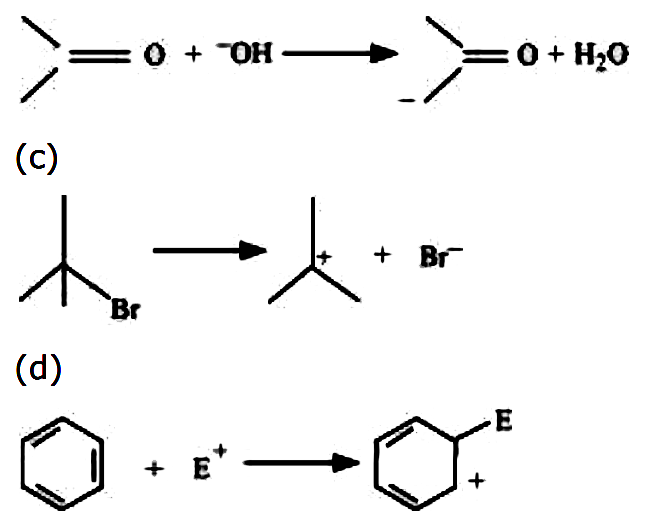
For the following bond cleavages, use curved-arrows to show the electron flow and classify each as homolysis or heterolysis. Identify reactive intermediate produced as free radical, carbocation and carbanion.

Text Solution

Verified by Experts
Promotional Banner

Topper's Solved these Questions

  • ORGANIC CHEMISTRY : SOME BASIC PRINCIPLES AND TECHNIQUES

    ICSE|Exercise ASSERTION - REASON TYPE QUESTIONS|11 Videos
  • HYDROGEN

    ICSE|Exercise NCERT TEXT-BOOK EXERCISE (With Hints and Solutions)|53 Videos
  • REDOX REACTIONS (OXIDATION AND REDUCTION)

    ICSE|Exercise NCERT TEXT-BOOK. EXERCISES ((With Hints and Solutions)|69 Videos

Similar Questions

Explore conceptually related problems

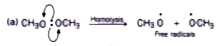
For the following bond cleavages, use curved-arrow to show the electron flow and classify each as homolysis or heterolysis. Identify intermediate products as free radical, carbocation, and carbanion. (a) CH_3O - OCH_3 rarr CH_3 dot O+ dot O CH_3 .

Classify each of the following as homolysis or heterolysis. Identify the reaction intermediates produced , as free radical, carbocation and carbanion.

An organic reaction occurs by using reagents called electrophiles and nucleophiles via the formation of some reactive intermediates called carbocations, carbanions, free radicals, carbenes, nitrenes, radical cations, and radical anions. The most stable carbanion is :

An organic reaction occurs by using reagents called electrophiles and nucleophiles via the formation of some reactive intermediates called carbocations, carbanions, free radicals, carbenes, nitrenes, radical cations, and radical anions. The most stable free radical is :

An organic reaction occurs by using reagents called electrophiles and nucleophiles via the formation of some reactive intermediates called carbocations, carbanions, free radicals, carbenes, nitrenes, radical cations, and radical anions. The most stable carbocation is :

An organic reaction occurs by using reagents called electrophiles and nucleophiles via the formation of some reactive intermediates called carbocations, carbanions, free radicals, carbenes, nitrenes, radical cations, and radical anions. The least stable carbocation is :

An organic reaction occurs by using reagents called electrophiles and nucleophiles via the formation of some reactive intermediates called carbocations, carbanions, free radicals, carbenes, nitrenes, radical cations, and radical anions. Which of the following contains nucleophiles only ?

An organic reaction occurs by using reagents called electrophiles and nucleophiles via the formation of some reactive intermediates called carbocations, carbanions, free radicals, carbenes, nitrenes, radical cations, and radical anions. Which of the following contains electrophiles only ?

Reaction intermdiates are short lived species and are highly reactive. They are formed by heterolytic and homolytic bond fission. There are various types of reaction intermediates in which the most important are carbocation , carbanion and free radical. Carbocation is an organic species in which carbon have positive charge and six electrons in its outermost shell. The stability of carbocation can be increased by positive inductive effect, hyperconjugation and delocalisation. If alpha -atom with respect to carbocation has one or more lone pair of electron then lone pair of electron strongly stabilises the carbocation due to octet completion. Species in which carbon have negative charge is called carbanion. Carbanion carries three bond pairs and one lone pair. The stability of carbanion can be increased by negative inductive effect, negative mesomeric effect and delocalisation. Free radical is a species which have seven electrons in its outermost shell. The stability of free radical can be increased by hyperconjugation and delocalisation. The stability order of following carbocations is

Reaction intermdiates are short lived species and are highly reactive. They are formed by heterolytic and homolytic bond fission. There are various types of reaction intermediates in which the most important are carbocation , carbanion and free radical. Carbocation is an organic species in which carbon have positive charge and six electrons in its outermost shell. The stability of carbocation can be increased by positive inductive effect, hyperconjugation and delocalisation. If alpha -atom with respect to carbocation has one or more lone pair of electron then lone pair of electron strongly stabilises the carbocation due to octet completion. Species in which carbon have negative charge is called carbanion. Carbanion carries three bond pairs and one lone pair. The stability of carbanion can be increased by negative inductive effect, negative mesomeric effect and delocalisation. Free radical is a species which have seven electrons in its outermost shell. The stability of free radical can be increased by hyperconjugation and delocalisation. Which of the following is the most stable carbanion intermediate ?

ICSE-ORGANIC CHEMISTRY : SOME BASIC PRINCIPLES AND TECHNIQUES -NCERT TEXT-BOOK EXERCISES (WITH HINTS AND SOLUTIONS )
  1. What is the relationship between the members of following pairs of str...

    Text Solution

    |

  2. What is the relationship between the members of following pairs of str...

    Text Solution

    |

  3. For the following bond cleavages, use curved-arrows to show the electr...

    Text Solution

    |

  4. For the following bond cleavages, use curved-arrows to show the electr...

    Text Solution

    |

  5. For the following bond cleavages, use curved-arrows to show the electr...

    Text Solution

    |

  6. For the following bond cleavages, use curved-arrows to show the electr...

    Text Solution

    |

  7. Explain the terms Inductive and Electromeric effects. Which electron d...

    Text Solution

    |

  8. Explain the terms Inductive and Electromeric effects. Which electron d...

    Text Solution

    |

  9. Give a brief description of the principles of the following techniques...

    Text Solution

    |

  10. Give a brief description of the principles of the following techniques...

    Text Solution

    |

  11. Give a brief description of the principles of the following techniques...

    Text Solution

    |

  12. Describe the method, which can be used to separate two compounds with ...

    Text Solution

    |

  13. What is the difference between distillation, distillation under reduce...

    Text Solution

    |

  14. Discuss the chemistry of Lassaigne’s test.

    Text Solution

    |

  15. Differentiate between the principle of estimation of nitrogen in an or...

    Text Solution

    |

  16. Discuss the principle of estimation of halogens, sulphur and phosphoru...

    Text Solution

    |

  17. Explain the principle of paper chromatography.

    Text Solution

    |

  18. Why is nitric acid added to sodium extract before adding silver nitrat...

    Text Solution

    |

  19. Explain the reason for the fusion of an organic compound with metallic...

    Text Solution

    |

  20. Name a suitable technique of separation of the components from a mixtu...

    Text Solution

    |

