Home
Class 11
CHEMISTRY
Dicuss the shape of the following molecu...

Dicuss the shape of the following molecules using the VSEPR model:
`AsF_(5)`

Text Solution

Verified by Experts
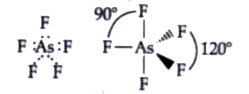
`AsF_(5)`: In this molecule, As is the central atom `(1s^(2), 2s^(2), 2p^(6), 3s^(2), 3p^(6), 3d^(10), 4s^(2), 4p^(3))`. It has five valence electrons. Thus, it has only five bond pairs and no lone pairs. It shares its 5 valence electrons with each of the five fluorine atoms, thus molecule acquires a trigonal bipyramidal shape. It has arsenic at the centre which is covalently bonded to the five fluorine (2F at axial and 3F at equatorial positions) atoms of a trigonal bipyramid. The bond angle is `90^(@) and 120^(@)`
Promotional Banner

Topper's Solved these Questions

  • SAMPLE QUESTION PAPER -2

    ICSE|Exercise Questions & Answers|10 Videos
  • SAMPLE QUESTION PAPER 4

    ICSE|Exercise Questions|70 Videos

Similar Questions

Explore conceptually related problems

Discuss the shape of the following molecules using the VSEPR model: BeCl_(2) , BCl_(3) , SiCl_(4) , AsF_(5) , H_(2)S , PH_(3)

Discuss the shape of the following molecules using the VSEPR model: BeCl_(2) , BCl_(3) , SiCl_(4) , AsF_(5) , H_(2)S , PH_(3)

Discuss the shape of the following molecules using the VSEPR model : SiCl_4 ,PCl_5

Discuss the shape of the following molecules using the VSEPR model : BeCl_2 ,BCl_3

Discuss the shape of the B Cl_(3) molecules using VSEPR model .

Discuss the shape of the SiF_(4) molecule using VSEPR model .

Discuss the shape of the BeF_(2) molecules using VSEPR model

Predict the shapes of the following molecules using VSEPR theory (i) BeCl_(2) (ii) SnCl_(4) (iii) AsF_(5) (iv) H_(2)S (v) HgBr_(2) (vi) PH_(3) (vii) GeF_(2)

The shape of ethylene molecule is

What is the shape of the ClF_(3) molecule?

ICSE-SAMPLE QUESTION PAPER 03-Questions
  1. Discuss the shape of the B Cl(3) molecules using VSEPR model .

    Text Solution

    |

  2. On the basis of VSEPR theory, predict the shapes of the following mole...

    Text Solution

    |

  3. Dicuss the shape of the following molecules using the VSEPR model: A...

    Text Solution

    |

  4. Justify that the following reactions are redox reactions : CuO(s)+H(...

    Text Solution

    |

  5. Justify that the following reactions are redox reactions : Fe(2)O(3)...

    Text Solution

    |

  6. Justify that the following reactions are redox reactions : 4BCl(3)(g...

    Text Solution

    |

  7. Write formulase for the following compounds : Mg(II) chloride

    Text Solution

    |

  8. Write formulas for the following compounds : Nickel (II) sulphate

    Text Solution

    |

  9. Write formulas for the following compounds : Tin (IV) oxide

    Text Solution

    |

  10. Write formulas for the following compounds : Thallium (I) sulphate

    Text Solution

    |

  11. Identify the substance oxidised and reduced, oxidising agent and reduc...

    Text Solution

    |

  12. Calculate the oxidation number of sulphur , chromium and nitrogen in H...

    Text Solution

    |

  13. Explain why A branched chain alkane possesses lower boiling point than...

    Text Solution

    |

  14. Why do alkenes and alkynes undergo addition reactions ? Describe some ...

    Text Solution

    |

  15. How will you convert benzene into (i) p-nitrobromobenzene (ii) m-...

    Text Solution

    |

  16. How will you convert the following: (Give balanced equation) Ethyne...

    Text Solution

    |

  17. How will you bring out the following conversions ? Ethene to ethyn...

    Text Solution

    |

  18. An alkene ‘A’ contains three C – C, eight C – H (sigma) bonds and one...

    Text Solution

    |

  19. Draw the cis and trans structures of hex-2-ene. Which isomer will have...

    Text Solution

    |

  20. PCI5 is 47.1% dissociated at 18°C and one atmospheric pressure. Calcul...

    Text Solution

    |

