Home
Class 9
PHYSICS
In the below figure shows a cube of each...

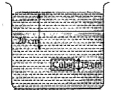
In the below figure shows a cube of each side 15 cm immersed in a tub containing water of density `10^3 "kgm"^(-3)` such that its top surface in 20 cm below the free surface of water. Calculate the resultant thrust on cube
Take atmosphere pressure = `10^5` Pa and `g=9.8 "ms"^(-2)`

Text Solution

Verified by Experts

Resultant Pressure on cube
`=P_2-P_1 = 1.0343xx10^(5) -1.0196 xx 10^(5)`
`=0.0147xx10^5` Pa (or `1.47xx10^3` Pa)
Promotional Banner

Topper's Solved these Questions

  • FLUIDS

    ICSE|Exercise TOPIC 2 (2 Marks Questions ) |45 Videos
  • FLUIDS

    ICSE|Exercise TOPIC 2 (3 Marks Questions ) |23 Videos
  • FLUIDS

    ICSE|Exercise TOPIC 1 (3 Marks Questions ) |18 Videos
  • ELECTRICITY AND MAGNETISM

    ICSE|Exercise TOPIC 2 Magnetism (4 Marks Questions )|6 Videos
  • HEAT AND ENERGY

    ICSE|Exercise EXERCISE -6(D) Multiple Choice Question)|4 Videos

Similar Questions

Explore conceptually related problems

In the below figure shows a cube of each side 15 cm immersed in a tub containing water of density 10^3 "kgm"^(-3) such that its top surface in 20 cm below the free surface of water. Calculate the pressure at the top of the cube Take atmosphere pressure = 10^5 Pa and g=9.8 "ms"^(-2)

In the below figure shows a cube of each side 15 cm immersed in a tub containing water of density 10^3 "kgm"^(-3) such that its top surface in 20 cm below the free surface of water. Calculate the pressure at the bottom of cube Take atmosphere pressure = 10^5 Pa and g=9.8 "ms"^(-2)

Fig. 4.11 shows a cube of each side 15 cm immersed in a tube containing water of density 10^(3) kg m^(-3) such that its top surface is 20 cm below the free surface of water. Calculate (i) the pressure at the top of cube, (ii) the pressure at the bottom of cube, (iii) the resultant pressure on cube. (iv) the resultant thrust on cube. Take atmospheric pressure = 10^(5) Pa and g=9.8 N kg^(-1) .

There is an air bubble of radius 1.0 mm in a liquid of surface tension 0.075Nm^-1 and density 1000 kg m^-3 . The bubble is at a depth of 10 cm below the free surface. By what amount is the pressure inside the bubble greater than the atmospheric pressure? Take g=9.8ms^-2 .

There is an air bubble of radius 1.0mm in a liquid of surface tension 0.075Nm−1 and density 103kgm−3. The bubble is at a depth of 10.0cm below the free surface of a liquid. By what amount is the pressure inside the bubble greater than the atmospheric pressure?

An open water tank has an orifice 10 cm below the surface of water. If there is no loss of energy, then what is the speed of efflux ? (Take g = 10 m s^(-2) )

What is the pressure on a swimmer 10m below the surface of lake? g=10ms^(-2) , atmospheric pressure = 1.01 xx 10^(5)Pa

At what depth below the surface of water will pressure be equal to twice the atmospheric pressure ? The atmospheric pressure is 10N cm^(-2) , density of water is 10^(3)kg m^(-3) and g=9.8 ms^(-2) .

A square plate of side 10 m is placed horizontally 1 m below the surface of water. The atmospheric pressure is 1.013xx10^(5)Nm^(-2) . Calculate the total thrust on the plate. (Density of water rho=10^(3)kg m^(-3), g=9.8ms^(-2))

The area of base of a cylindrical vessel is 300 cm^(2) . Water ("density"=1000 kg m^(-3)) is poured into it up to a depth of 6 cm. Calculate : (a) the pressure and (b) the thrust of water on the base. (g=10ms^(-2)) .
