Home
Class 12
MATHS
ABC is a right-angled triangle in which ...

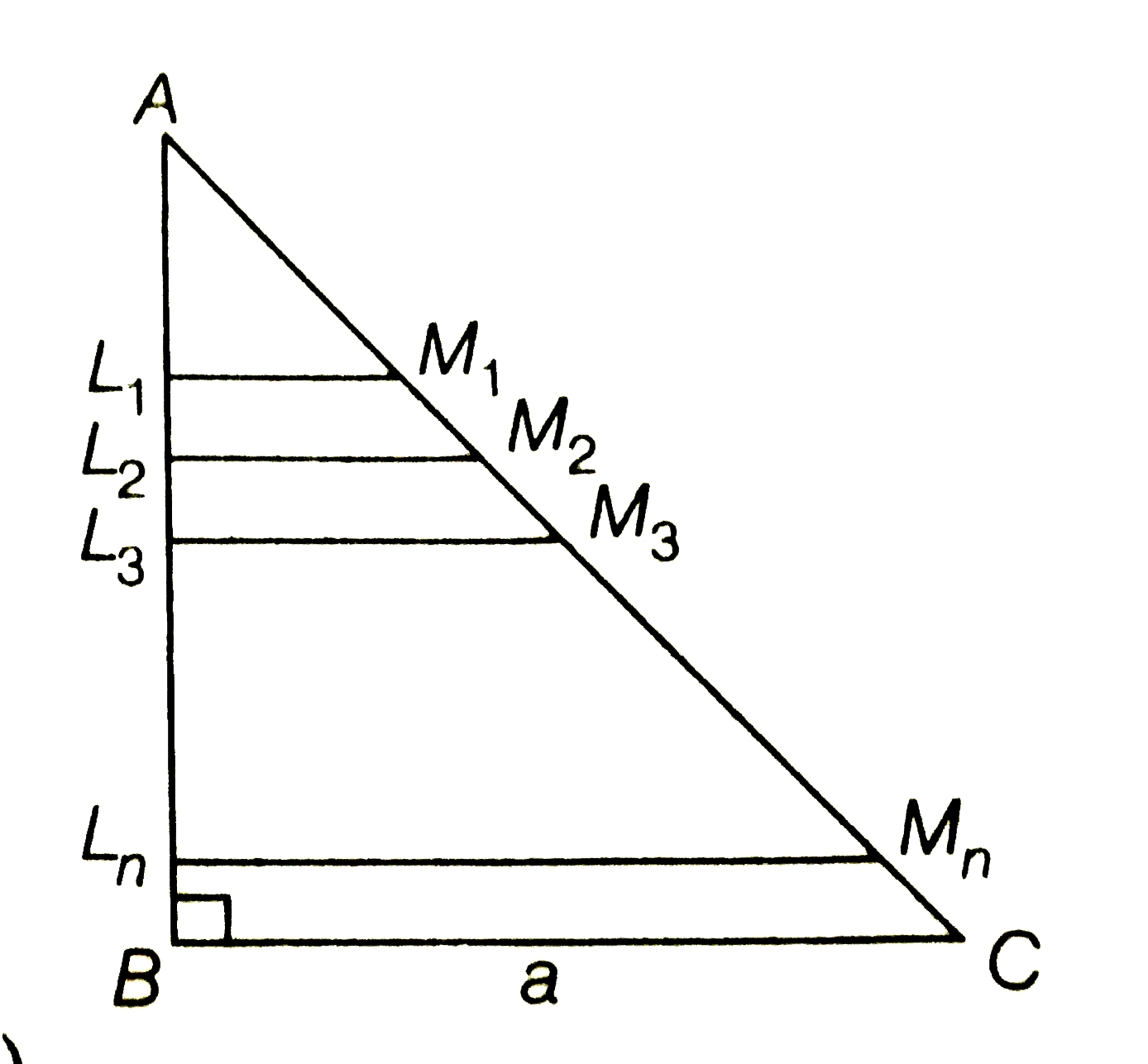
ABC is a right-angled triangle in which `angleB=90^(@) and BC=a.` If n points `L_(1),L_(2),…,L_(n)` on AB is divided in n+1 equal parts and `L_(1)M_(1), L_(2)M_(2),…,L_(n)M_(n)` are line segments paralllel to BC and `M_(1), M_(2),….,M_(n)` are on AC, then the sum of the lengths of `L_(1)M_(1), L_(2)M_(2),...,L_(n)M_(n)` is

A

`(n(n+1))/((2)`

B

`(a(n-1))/(2)`

C

`(an)/(2)`

D

Impossible to find from the given data

Text Solution

Verified by Experts

The correct Answer is:
C

`:. (AL_(1))/(AB)=(L_(1)M_(1))/(BC) implies L_(1)M_(1)=(a)/(n+1)`
Similarly, `L_(2)M_(2)=(2a)/(n+1)`
`L_(3)M_(3)=(3a)/(n+1)`
`vdots " " vdots " " vdots " "`
`L_(n)M_(n)=(na)/(n+1)`
`L_(1)M_(1)+L_(2)M_(2)+"…."+L_(n)M_(n)`
`=(a)/((n+1))(1+2+3+"....."+n)`
`=(a)/((n+1))*(n(n+1))/(2)=(na)/(2)`
Promotional Banner

Topper's Solved these Questions

  • SEQUENCES AND SERIES

    ARIHANT MATHS ENGLISH|Exercise Exercise (More Than One Correct Option Type Questions)|15 Videos
  • SEQUENCES AND SERIES

    ARIHANT MATHS ENGLISH|Exercise Exercise (Passage Based Questions)|24 Videos
  • SEQUENCES AND SERIES

    ARIHANT MATHS ENGLISH|Exercise Exercise For Session 7|7 Videos
  • PROPERTIES AND SOLUTION OF TRIANGLES

    ARIHANT MATHS ENGLISH|Exercise Exercise (Questions Asked In Previous 13 Years Exam)|21 Videos
  • SETS, RELATIONS AND FUNCTIONS

    ARIHANT MATHS ENGLISH|Exercise Exercise (Questions Asked In Previous 13 Years Exam)|12 Videos

Similar Questions

Explore conceptually related problems

A B C is a right-angled triangle in which /_B=90^0 and B C=adot If n points L_1, L_2, ,L_nonA B is divided in n+1 equal parts and L_1M_1, L_2M_2, ,L_n M_n are line segments parallel to B Ca n dM_1, M_2, ,M_n are on A C , then the sum of the lengths of L_1M_1, L_2M_2, ,L_n M_n is (a(n+1))/2 b. (a(n-1))/2 c. (a n)/2 d. none of these

If l_(1), m_(1), n_(1), l_(2), m_(2), n_(2) and l_(3), m_(3), n_(3) are direction cosines of three mutuallyy perpendicular lines then, the value of |(l_(1),m_(1),n_(1)),(l_(2),m_(2),n_(2)),(l_(3),m_(3),n_(3))| is

If the direction cosines of two lines are (l_(1), m_(1), n_(1)) and (l_(2), m_(2), n_(2)) and the angle between them is theta then l_(1)^(2)+m_(1)^(2)+n_(1)^(2)=1=l_(2)^(2)+m_(2)^(2)+n_(2)^(2) and costheta = l_(1)l_(2)+m_(1)m_(2)+n_(1)n_(2) If the angle between the lines is 60^(@) then the value of l_(1)(l_(1)+l_(2))+m_(1)(m_(1)+m_(2))+n_(1)(n_(1)+n_(2)) is

The direction cosines of a line equally inclined to three mutually perpendiclar lines having direction cosines as l_(1),m_(1),n_(1),l_(2),m_(2),n_(2) and l_(3), m_(3),n_(3) are

If lt l_(1), m_(1), n_(1)gt and lt l_(2), m_(2), n_(2) gt be the direction cosines of two lines L_(1) and L_(2) respectively. If the angle between them is theta , the costheta=?

The condition for the lines lx+my+n=0 and l_(1)x+m_(1)y+n_(1)=0 to be conjugate with respect to the circle x^(2)+y^(2)=r^(2) is

If A = [[l_(1),m_(1),n_(1)],[l_(2),m_(2),n_(2)],[l_(3),m_(3),n_(3)]] then Find A+I

If the direction cosines of two lines are l_(1), m_(1), n_(1) and l_(2), m_(2), n_(2) , then find the direction cosine of a line perpendicular to these lines.

If l, m, n denote the side of a pedal triangle, then (l)/(a ^(2))+(m)/(b^(2))+(n)/(c ^(2)) is equal to

If l_(1), m_(1), n_(1) and l_(2),m_(2),n_(2) are the direction cosines of two mutually perpendicular lines, show that the direction cosines of the line perpendicular to both of these are m_(1)n_(2)-m_(2)n_(1),n_(1)l_(2)-n_(2)l_(1),l_(1)m_(2)-l_(2)m_(1) .

ARIHANT MATHS ENGLISH-SEQUENCES AND SERIES-Exercise (Single Option Correct Type Questions)
  1. If the number x,y,z are in H.P. , then sqrt(yz)/(sqrt(y)+sqrt(z)),sqrt...

    Text Solution

    |

  2. If a(1),a(2),".....", are in HP and f(k)=sum(r=1)^(n)a(r)-a(k), then 2...

    Text Solution

    |

  3. ABC is a right-angled triangle in which angleB=90^(@) and BC=a. If n p...

    Text Solution

    |

  4. Let Sn denotes the sum of the terms of n series (1lt=nlt=9) 1+22+333+....

    Text Solution

    |

  5. If a,b,c are in GP, show that the equations ax^(2)+2bx+c=0 and dx^(2)+...

    Text Solution

    |

  6. Sum of the first n terms of the series 1/2+3/4+7/8+(15)/(16)+............

    Text Solution

    |

  7. If in a triangle PQR; sin P, sin Q, sin R are in A.P; then (A)the alt...

    Text Solution

    |

  8. Let a1, a2, ,a(10) be in A.P. and h1, h2, h(10) be in H.P. If a1=h1=2...

    Text Solution

    |

  9. If I(n)=int(0)^(pi)(1-sin2nx)/(1-cos2x)dx then I(1),I(2),I(3),"….." ar...

    Text Solution

    |

  10. Show that If a(b-c) x^2 + b(c-a) xy + c(a-b) y^2 = 0 is a perfect squa...

    Text Solution

    |

  11. The sum to infinity of the series 1+2(1-(1)/(n))+3(1-(1)/(n))^(2)+ ....

    Text Solution

    |

  12. If log(3)2,log(3)(2^(x)-5) and log(3)(2^(x)-7/2) are in A.P., then x i...

    Text Solution

    |

  13. If x,y,z be three positive prime numbers. The progression in which sqr...

    Text Solution

    |

  14. If n is an odd integer greater than or equal to 1, then the value of n...

    Text Solution

    |

  15. If the sides of a right angled triangle are in A.P then the sines of t...

    Text Solution

    |

  16. The 6th term of an AP is equal to 2, the value of the common differenc...

    Text Solution

    |

  17. If the arithmetic progression whose common difference is nonzero the ...

    Text Solution

    |

  18. The coefficient of x^(n) in the expansion of (1+x)(1-x)^(n) is

    Text Solution

    |

  19. Consider the pattern shown below: {:(" Row ",1,1,,,),(" Row ",2,3,5,...

    Text Solution

    |

  20. Let a(n) be the nth term of an AP, if sum(r=1)^(100)a(2r)= alpha " and...

    Text Solution

    |

