Home
Class 12
MATHS
Which of the following could be the sket...

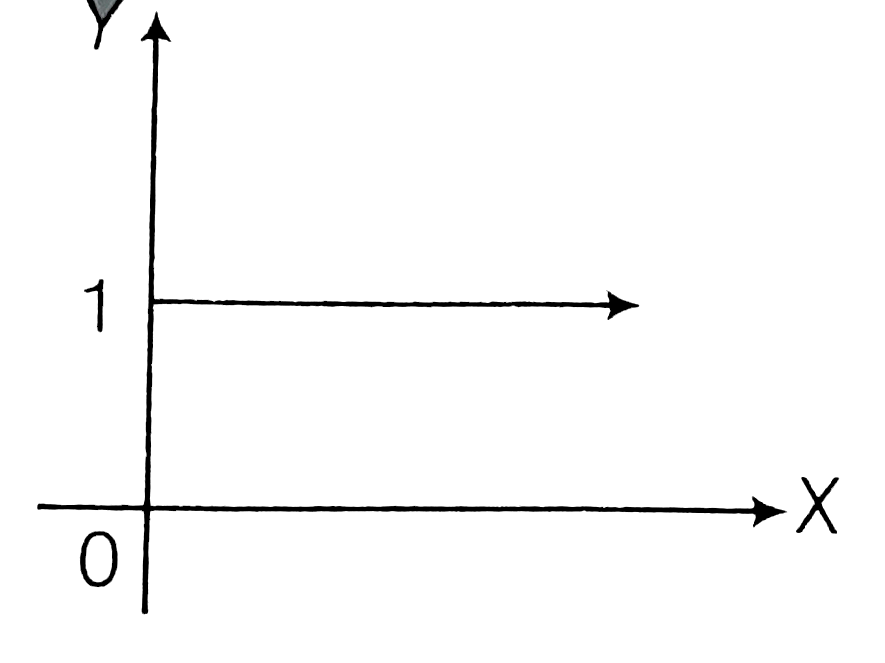
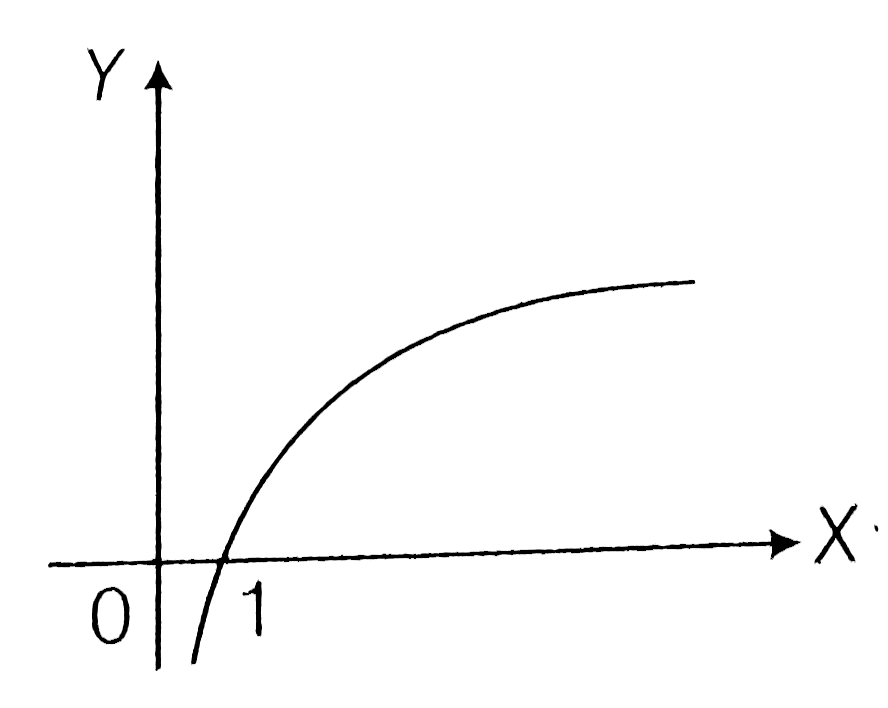
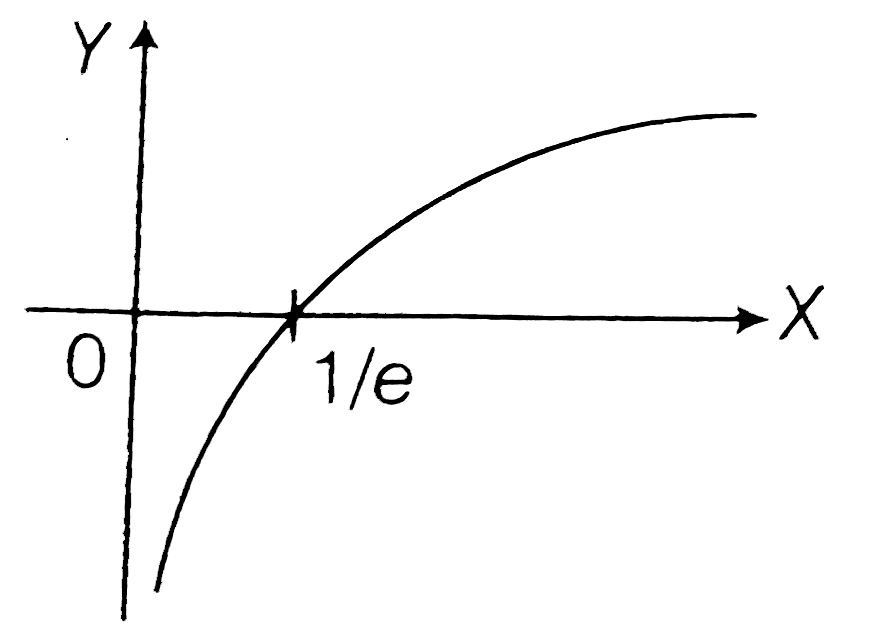
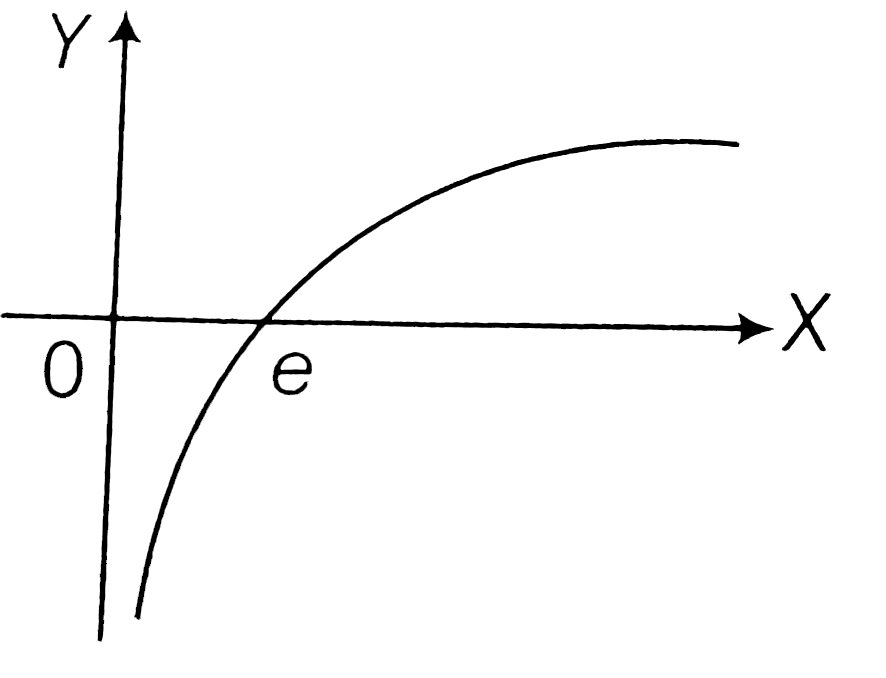
Which of the following could be the sketch graph of `y = (d(xlnx))/dx`

A

B

C

D

Text Solution

AI Generated Solution

The correct Answer is:

To solve the problem of finding the sketch graph of \( y = \frac{d}{dx}(x \ln x) \), we will follow these steps: ### Step 1: Differentiate the function We start with the function \( y = x \ln x \). To find \( \frac{dy}{dx} \), we will use the product rule of differentiation. The product rule states that if you have two functions \( u \) and \( v \), then: \[ \frac{d}{dx}(uv) = u \frac{dv}{dx} + v \frac{du}{dx} \] Here, let: - \( u = x \) (which implies \( \frac{du}{dx} = 1 \)) - \( v = \ln x \) (which implies \( \frac{dv}{dx} = \frac{1}{x} \)) Applying the product rule: \[ \frac{dy}{dx} = x \cdot \frac{1}{x} + \ln x \cdot 1 \] This simplifies to: \[ \frac{dy}{dx} = 1 + \ln x \] ### Step 2: Analyze the derivative Now we have \( y = 1 + \ln x \). We need to analyze this function to understand its behavior. 1. **Domain**: The function \( \ln x \) is defined for \( x > 0 \). 2. **Intercept**: To find where \( y = 0 \): \[ 1 + \ln x = 0 \implies \ln x = -1 \implies x = e^{-1} = \frac{1}{e} \] This means the graph intersects the x-axis at \( x = \frac{1}{e} \). ### Step 3: Behavior of the function - As \( x \to 0^+ \), \( \ln x \to -\infty \) and hence \( y \to -\infty \). - At \( x = 1 \), \( \ln 1 = 0 \) so \( y = 1 \). - As \( x \to \infty \), \( \ln x \to \infty \) and hence \( y \to \infty \). ### Step 4: Sketch the graph From the analysis: - The graph starts from \( -\infty \) as \( x \) approaches \( 0 \). - It crosses the x-axis at \( x = \frac{1}{e} \). - It passes through the point \( (1, 1) \). - The graph approaches \( \infty \) as \( x \) increases. Thus, the sketch of the graph of \( y = 1 + \ln x \) will look like this: 1. It will start from the bottom left (negative infinity). 2. It will cross the x-axis at \( x = \frac{1}{e} \). 3. It will rise and pass through the point \( (1, 1) \). 4. It will continue to rise towards infinity as \( x \) increases. ### Final Answer The sketch graph of \( y = \frac{d}{dx}(x \ln x) = 1 + \ln x \) is a curve that starts from \( -\infty \), crosses the x-axis at \( x = \frac{1}{e} \), passes through \( (1, 1) \), and rises towards \( +\infty \).
Promotional Banner

Topper's Solved these Questions

  • DIFFERENTIATION

    ARIHANT MATHS ENGLISH|Exercise Exercise (Statement I And Ii Type Questions)|10 Videos
  • DIFFERENTIATION

    ARIHANT MATHS ENGLISH|Exercise Exercise (Passage Based Questions)|16 Videos
  • DIFFERENTIATION

    ARIHANT MATHS ENGLISH|Exercise SOLVED EXAMPLES|7 Videos
  • DIFFERENTIAL EQUATION

    ARIHANT MATHS ENGLISH|Exercise Exercise (Questions Asked In Previous 13 Years Exam)|26 Videos
  • DY / DX AS A RATE MEASURER AND TANGENTS, NORMALS

    ARIHANT MATHS ENGLISH|Exercise Exercise (Questions Asked In Previous 13 Years Exam)|7 Videos

Similar Questions

Explore conceptually related problems

Which of the following could be the graph of y=3^(-2x) ?

Which of the following could be the graph of 2x+3y+12=0 ?

Which of the following could be the graph of 2x+3y+12=0 ?

If p(x)=|2-x|+(1)/(2) , which of the following could be the graph of y = p (x) ?

If k is a positive constant such that 0 lt k lt 1 , which of the following could be the graph of y-x=k(x+y) ?

The graph of the function f is shown above. Which of the following could represent the graph of y=|f(x)| ?

Sketch the graph of y=3x

The graph of y=f(x) is shown below. Which of the following could represents the graph of y=f(x-2)+1 ?

If the accomanying figure above shows the graph of function f, which of the following could represent the graph of y=f(x+1) ?

If function f has exactly two distinct real zeros, which of the following graphs could be the complete graph of f (x) ?

ARIHANT MATHS ENGLISH-DIFFERENTIATION -Exercise (More Than One Correct Option Type Questions)
  1. If y=(secx-tanx)/(secx+tanx), then (dy)/(dx) equals.

    Text Solution

    |

  2. If y=(x^4+x^2+1)/(x^2+x+1) then (dy)/(dx)=a x+b , find a and b

    Text Solution

    |

  3. Which of the following could be the sketch graph of y = (d(xlnx))/dx

    Text Solution

    |

  4. Let f(x)=x+3ln(x-2)&g(x)=x+5ln(x-1), then the set of x satisfying the ...

    Text Solution

    |

  5. If cos^(-1) ((x^(2) -y^(2))/( x^(2)+y^(2)))=a ,then (dy)/(dx) =

    Text Solution

    |

  6. Iff(x)=|x|^(|sinx|),thenf'((pi)/(4)) equals

    Text Solution

    |

  7. y=x/(a+x/(b+x/(a+x/(b+...oo)))), (dy)/(dx)=b/(a(b+2y))

    Text Solution

    |

  8. If y=x^(x^(2)), then (dy)/(dx) equals

    Text Solution

    |

  9. "If "xsqrt(1+y)+ysqrt(1+x)=0," prove that "(dy)/(dx)=-(1)/((x+1)^(2)).

    Text Solution

    |

  10. If x^2e^y+2xye^x+13=0 then (dy)/(dx)=

    Text Solution

    |

  11. If x=e^(y+e^(y+e^(y+...oo))),xgt0, then (dy)/(dx) is equal to

    Text Solution

    |

  12. Let g be the inverse function of f and f'(x)=(x^(10))/(1+x^(2)). If g(...

    Text Solution

    |

  13. If f and g are the function whose graphs are as shown, let u(x)=f(g(x)...

    Text Solution

    |

  14. f'(x) = g(x) and g'(x) =-f(x) for all real x and f(5)=2=f'(5) then f^2...

    Text Solution

    |

  15. If y=(f(0)f(0)f)(x)andf(0)=0,f'(0)=2 then y'(0) is equal to

    Text Solution

    |

  16. If y^2=P(x) is a polynomial of degree 3, then 2(d/(dx))(y^2dot(d^2y)/(...

    Text Solution

    |

  17. If y=f(x)andx=g(y) are inverse functions of each other, then

    Text Solution

    |

  18. If y is a function of x then (d^2y)/(dx^2)+y \ dy/dx=0. If x is a func...

    Text Solution

    |

  19. Leg g(x)=ln(f(x)), whre f(x) is a twice differentiable positive functi...

    Text Solution

    |

  20. If the functions f(x)=x^(3)+e^(x//2) " and " g(x)=f^(-1)(x), the value...

    Text Solution

    |
