Home
Class 12
MATHS
Which one of the following curves repres...

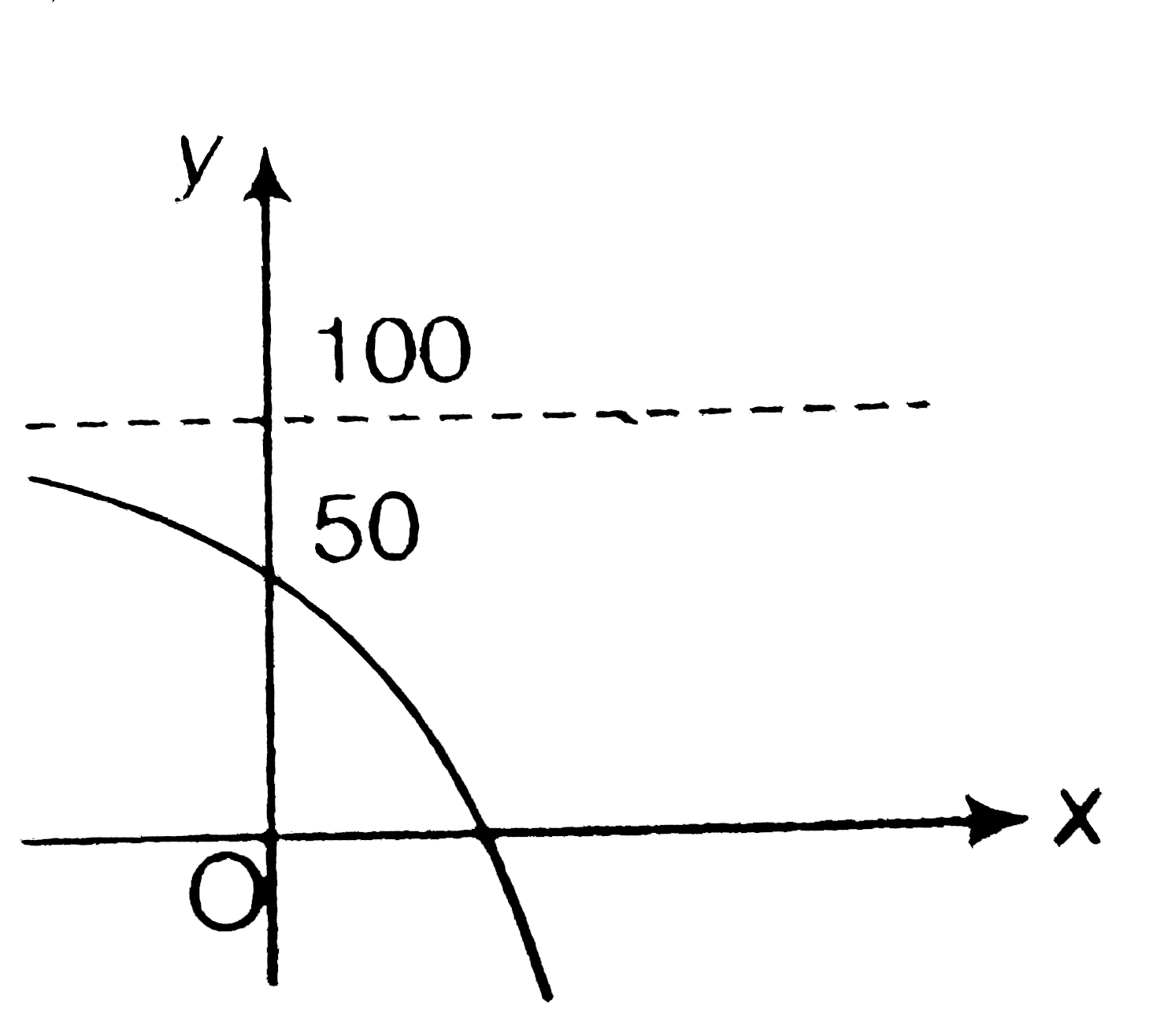
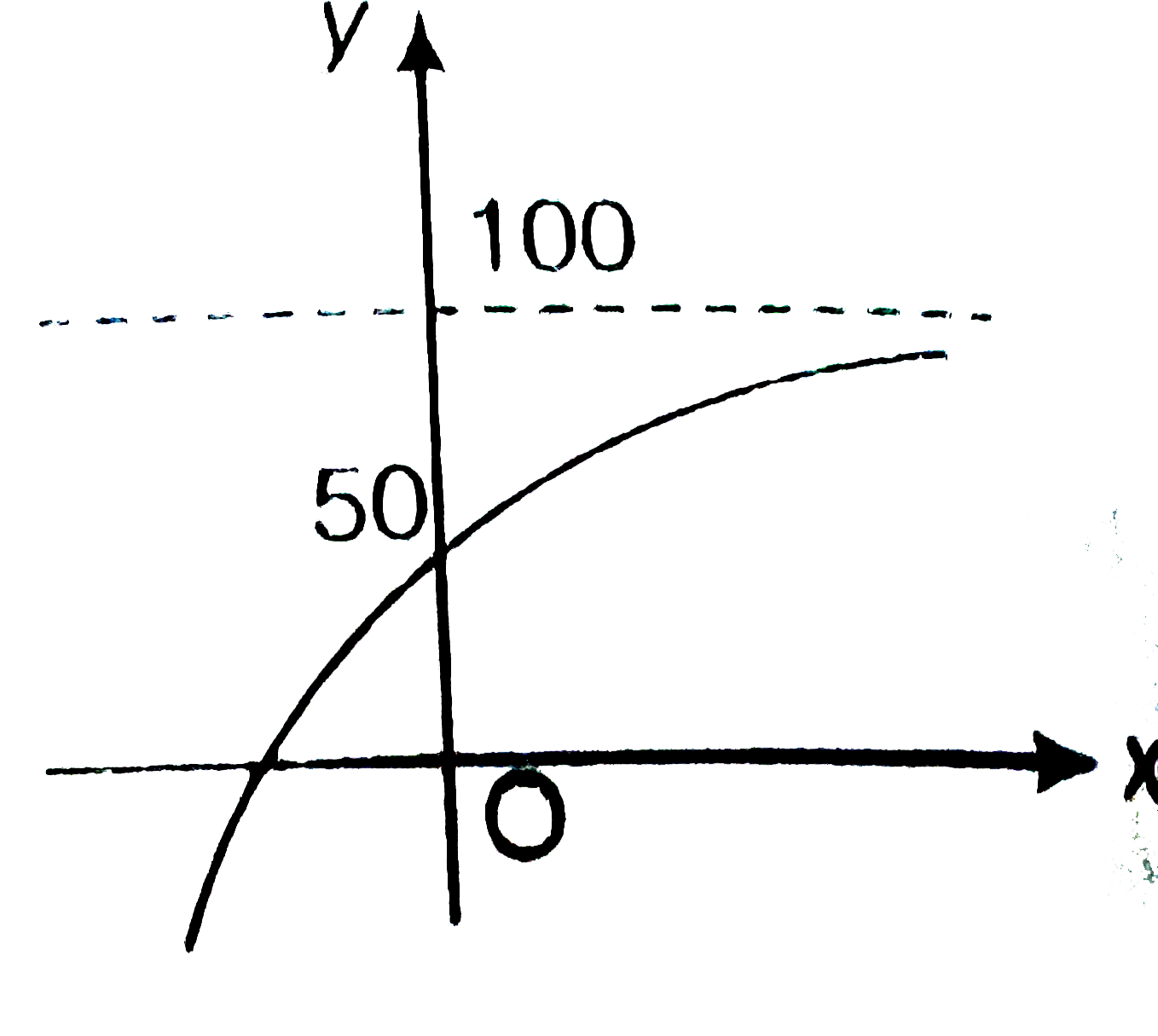
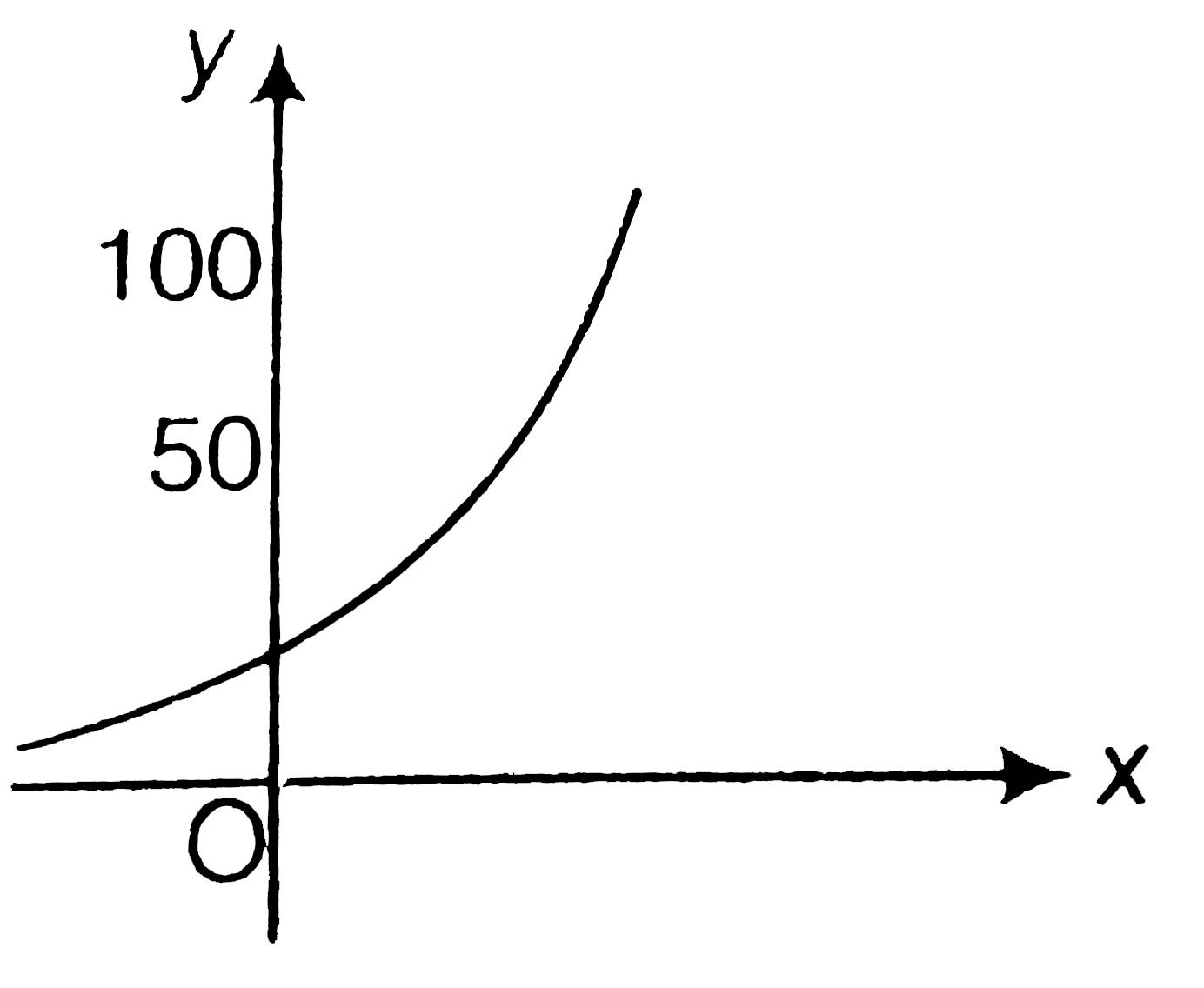
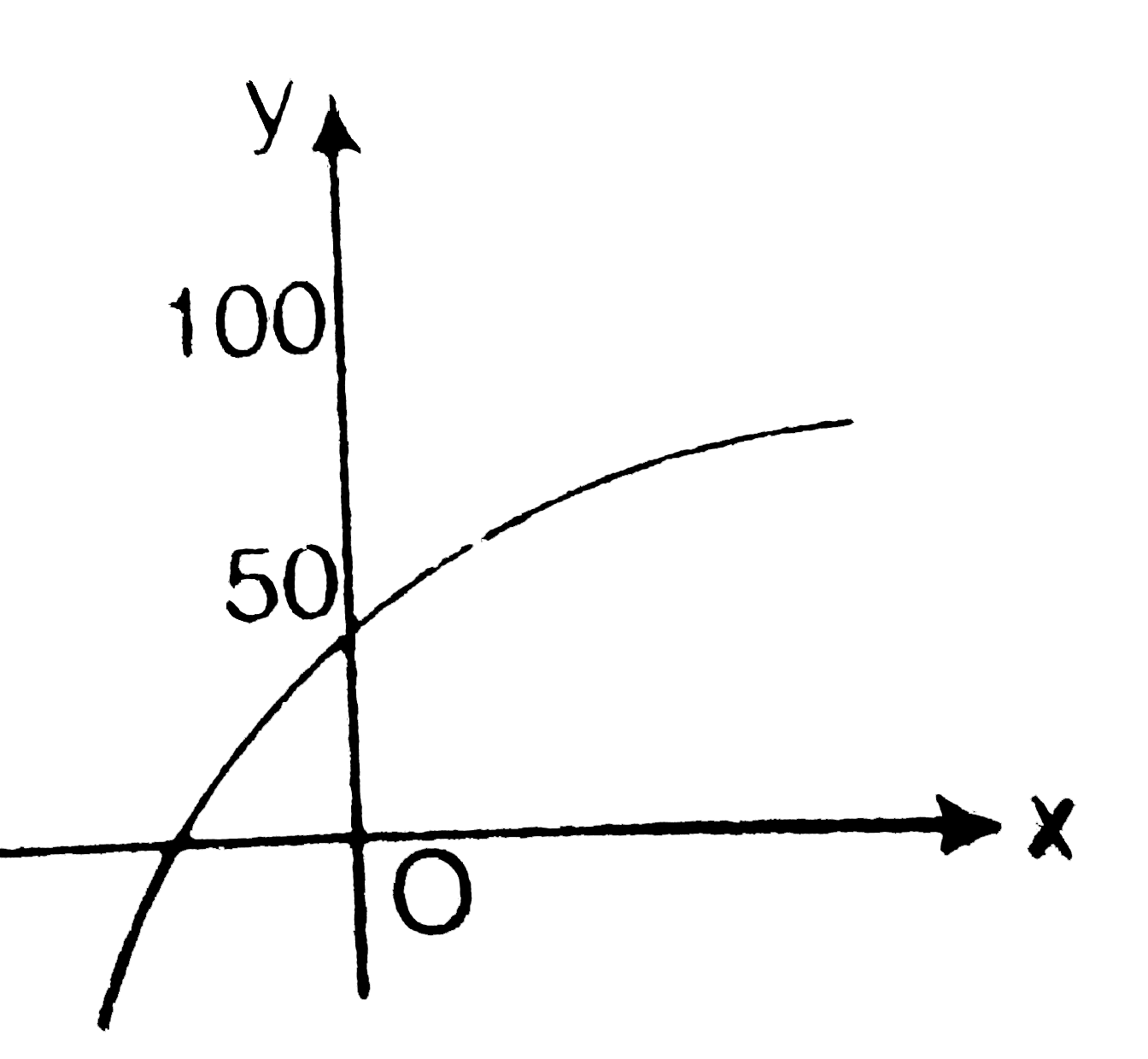
Which one of the following curves represents the solution of the initial value problem `dy/dx= 100-y`, where `y (0) = 50`

A

B

C

D

Text Solution

AI Generated Solution

The correct Answer is:

To solve the initial value problem given by the differential equation \( \frac{dy}{dx} = 100 - y \) with the initial condition \( y(0) = 50 \), we can follow these steps: ### Step 1: Rewrite the Differential Equation We start with the equation: \[ \frac{dy}{dx} = 100 - y \] We can rearrange this to isolate \( dy \) on one side: \[ dy = (100 - y)dx \] ### Step 2: Separate Variables Next, we separate the variables by moving all terms involving \( y \) to one side and \( x \) to the other: \[ \frac{dy}{100 - y} = dx \] ### Step 3: Integrate Both Sides Now we integrate both sides. The left side requires a logarithmic integration: \[ \int \frac{dy}{100 - y} = \int dx \] The left side integrates to: \[ -\ln |100 - y| = x + C \] where \( C \) is the constant of integration. ### Step 4: Solve for \( y \) To solve for \( y \), we first exponentiate both sides to eliminate the logarithm: \[ |100 - y| = e^{-x - C} \] This can be rewritten as: \[ 100 - y = \pm e^{-x - C} \] For simplicity, we can let \( k = e^{-C} \) (a positive constant), giving us: \[ 100 - y = ke^{-x} \] Thus, we can express \( y \) as: \[ y = 100 - ke^{-x} \] ### Step 5: Apply Initial Condition Now, we apply the initial condition \( y(0) = 50 \): \[ 50 = 100 - ke^{0} \] This simplifies to: \[ 50 = 100 - k \implies k = 50 \] ### Step 6: Write the Final Solution Substituting \( k \) back into the equation for \( y \): \[ y = 100 - 50e^{-x} \] ### Step 7: Conclusion Thus, the solution to the initial value problem is: \[ y = 100 - 50e^{-x} \]
Promotional Banner

Topper's Solved these Questions

  • DIFFERENTIAL EQUATION

    ARIHANT MATHS ENGLISH|Exercise Exercise (More Than One Correct Option Type Questions)|13 Videos
  • DIFFERENTIAL EQUATION

    ARIHANT MATHS ENGLISH|Exercise Exercise (Statement I And Ii Type Questions)|9 Videos
  • DIFFERENTIAL EQUATION

    ARIHANT MATHS ENGLISH|Exercise Exercise For Session 5|8 Videos
  • DETERMINANTS

    ARIHANT MATHS ENGLISH|Exercise Exercise (Questions Asked In Previous 13 Years Exam)|18 Videos
  • DIFFERENTIATION

    ARIHANT MATHS ENGLISH|Exercise Exercise For Session 10|4 Videos

Similar Questions

Explore conceptually related problems

Solve the initial value problem e^((dy//dx))=x+1; y(0)=5.

Solve the initial value problem e^((dy//dx))=x+1; y(0)=5.

Solve the initial value problem: (x+1)(dy)/(dx)=2e^(-y)-1,\ y(0)=0

Solve the initial value problem: cos(x+y)dy=dx ,y(0)=0.

Solve the following initial value problem: (dy)/(dx)=2e^x y^3,\ y(0)=1/2

Solve the initial value problem: dy=e^(2x+y)dx ,y(0)=0.

Solve the initial value problem: dy=cos x\ (2-y\ cosec x)dx

Solve the following initial value problem: x y(dy)/(dx)=y+2,\ y(2)=0

Solve the following initial value problem: (dy)/(dx)=ytanx ,\ y(0)=1

Solve the following initial value problem: (dy)/(dx)=1+x+y^2+xy^2 when y=0, x=0 .

ARIHANT MATHS ENGLISH-DIFFERENTIAL EQUATION -Exercise (Single Option Correct Type Questions)
  1. If the differential equation of the family of curve given by y=Ax+Be^(...

    Text Solution

    |

  2. about to only mathematics

    Text Solution

    |

  3. The x-intercept of the tangent to a curve is equal to the ordinate of ...

    Text Solution

    |

  4. A function y = f(x) satisfies the condition f'(x) sin x + f(x) cos x=...

    Text Solution

    |

  5. A curve is such that the area of the region bounded by the co-ordinate...

    Text Solution

    |

  6. The value of the constant 'm' and 'c' for which y = mx + c is a soluti...

    Text Solution

    |

  7. Find the real value of m for which the substitution y=u^m will transfo...

    Text Solution

    |

  8. The solution of the differential equation, x^(2)dy/dxcos""(1)/(x)-ysi...

    Text Solution

    |

  9. A wet porous subtance in the open air loses its moisture at a rate pro...

    Text Solution

    |

  10. A curve C passes through origin and has the property that at each poin...

    Text Solution

    |

  11. A function y=f(x) satisfies (x+1)f^(')(x)-2(x^(2)+x)f(x) = e^(x^(2))/(...

    Text Solution

    |

  12. The curve with the property that the projection of the ordinate on the...

    Text Solution

    |

  13. The differential equation corresponding to the family of curves y=e^x ...

    Text Solution

    |

  14. The equation to the orthogonal trajectories of the system of parabolas...

    Text Solution

    |

  15. A function satisfying int0^1f(tx)dt=nf(x), where x>0 is

    Text Solution

    |

  16. The substituion y=z^(alpha) transforms the differential equation (x^(2...

    Text Solution

    |

  17. A curve passing through (2,3) and satisfying the differential equation...

    Text Solution

    |

  18. Which one of the following curves represents the solution of the initi...

    Text Solution

    |
