

Home
Class 7
PHYSICS
Look at the figure of a ball resting on ...

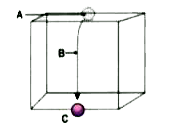
Look at the figure of a ball resting on top of a wall. At A, it's energy is 50 J. It falls down, at B its PE is 30 J.

Which law helped us to calculate the energies above?

Promotional Banner

Topper's Solved these Questions

  • MODEL TEST PAPER 1

    ICSE|Exercise SECTION II|43 Videos
  • LIGHT ENERGY

    ICSE|Exercise EXERCISE (PICTURE STUDY) |10 Videos
  • MODEL TEST PAPER 2

    ICSE|Exercise SECTION II|40 Videos

Similar Questions

Explore conceptually related problems

Look at the figure of a ball resting on top of a wall. At A, it's energy is 50 J. It falls down, at B its PE is 30 J. What is the KE at the point B.

Look at the figure of a ball resting on top of a wall. At A, it's energy is 50 J. It falls down, at B its PE is 30 J. Write the value of PE and KE at point A.

Look at the figure of a ball resting on top of a wall. At A, it's energy is 50 J. It falls down, at B its PE is 30 J. What will be the total energy at point C?

Look at the figure of a ball resting on top of a wall. At A, it's energy is 50 J. It falls down, at B its PE is 30 J. What kind of energy does the ball have just before touching the ground? What is the value of this energy?

4500 J of energy is used to raise an object with a mass of 50 kg to a height h. Calculate h.

A car resting on top of a hill at point I (Fig. C) has a PE of 16000 J. a. Calculate its kinetic energy at II, if its PE at that point is 9000 J. b. What will be its KE as it reaches the final point lll down the hill? c. What will be its PE at the point III? d. What will be its mechanical energy at points I, II, and III? e. Which law helped you to arrive at

Look at the figure given below and answer the following questions: If the car is at rest at W and has a maximum PE of 6000 J What will be its KE at X, if PE = 0?

In a cyclic process shown in the figure an ideal gas is adiabatically taken from B to A , the work done on the gas during the process B to A is 30,J when the gas is taken from A to B the heat absorbed by the gas is 20 J Then change in internal energy of the gas in the process A to B is :

In a cyclic process shown in the figure an ideal gas is adiabatically taken from B to A , the work done on the gas during the process B to A is 30,J when the gas is taken from A to B the heat absorbed by the gas is 20 J Then change in internal energy of the gas in the process A to B is :

In a cyclic process shown in the figure an ideal gas is adiabatically taken from B to A , the work done on the gas during the process B to A is 30,J when the gas is taken from A to B the heat absorbed by the gas is 20 J Then change in internal energy of the gas in the process A to B is :

ICSE-MODEL TEST PAPER 1-SECTION II
  1. Look at the figure of a ball resting on top of a wall. At A, it's ener...

    Text Solution

    |

  2. Look at the figure of a ball resting on top of a wall. At A, it's ener...

    Text Solution

    |

  3. Look at the figure of a ball resting on top of a wall. At A, it's ener...

    Text Solution

    |

  4. State the two laws of reflection.

    Text Solution

    |

  5. If the angle of incidence is 32^@, then what will the angle between in...

    Text Solution

    |

  6. Distinguish between Regular and diffused reflection .

    Text Solution

    |

  7. Name two devices that use plane mirrors.

    Text Solution

    |

  8. Name secondary colours of light? How are they formed?

    Text Solution

    |

  9. How is melting different from solidification?

    Text Solution

    |

  10. What kind of phase change do mothballs go through when they are kept i...

    Text Solution

    |

  11. The temperature of an object is 80^@F. What will be its temperature in...

    Text Solution

    |

  12. Name the mode of transfer of heat in the liquid

    Text Solution

    |

  13. Name the mode of transfer of heat in the vacuum

    Text Solution

    |

  14. The bottom of a cooking utensil is painted black. Give the reason.

    Text Solution

    |

  15. Look at the figure and answer the questions What would happen if ...

    Text Solution

    |

  16. Look at the figure and answer the questions When is the ticking s...

    Text Solution

    |

  17. Define the term amplitude of a wave. Write its S.I. unit.

    Text Solution

    |

  18. Define amplitude of a vibrating body. What is its SI unit?

    Text Solution

    |

  19. What is the frequency of a body that produces 50 vibrations in two sec...

    Text Solution

    |

  20. How is a primary cell different from a secondary cell?

    Text Solution

    |