Home
Class 11
PHYSICS
A small block is shot into each of the f...

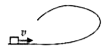
A small block is shot into each of the four track as shown in Fig 15.7.1. Each of the track rises to the same height. The speed with which the block enters the track is the same in all cases. At the highest point of the track, the normal reaction is maximum in

A

B

C

D

Text Solution

AI Generated Solution

The correct Answer is:

To solve the problem of determining which track has the maximum normal reaction at the highest point, we can follow these steps: ### Step-by-Step Solution: 1. **Understanding the Forces at the Highest Point**: At the highest point of the track, the forces acting on the block are: - The gravitational force (weight) acting downward, \( mg \). - The normal reaction force \( N \) acting downward. 2. **Centripetal Force Requirement**: For the block to move in a circular path, there must be a net inward (centripetal) force. This force is provided by the normal force and the weight of the block. The centripetal force required is given by: \[ F_c = \frac{mv^2}{r} \] where \( m \) is the mass of the block, \( v \) is the speed of the block, and \( r \) is the radius of curvature of the track at that point. 3. **Setting Up the Equation**: At the highest point, the centripetal force is provided by the normal force and the weight of the block: \[ \frac{mv^2}{r} = N + mg \] Rearranging gives us the expression for the normal force: \[ N = \frac{mv^2}{r} - mg \] 4. **Maximizing the Normal Force**: To maximize the normal force \( N \), we need to minimize the radius \( r \) of the track. The smaller the radius, the larger the value of \( \frac{mv^2}{r} \) will be, thus increasing \( N \). 5. **Comparing Different Tracks**: Since all tracks rise to the same height and the speed of the block entering each track is the same, we need to analyze the radius of curvature for each track. The track with the smallest radius of curvature will yield the maximum normal reaction. 6. **Conclusion**: Based on the analysis, the track with the smallest radius of curvature will have the maximum normal reaction at the highest point. ### Final Answer: The maximum normal reaction occurs in the track with the smallest radius of curvature.

To solve the problem of determining which track has the maximum normal reaction at the highest point, we can follow these steps: ### Step-by-Step Solution: 1. **Understanding the Forces at the Highest Point**: At the highest point of the track, the forces acting on the block are: - The gravitational force (weight) acting downward, \( mg \). - The normal reaction force \( N \) acting downward. ...
Promotional Banner

Topper's Solved these Questions

  • COMPETITION CARE UNIT

    ICSE|Exercise UNIFORM CIRCULAR MOTION (ROTATIONAL MOTION AND MOMENT OF INERTIA ) |25 Videos
  • COMPETITION CARE UNIT

    ICSE|Exercise GRAVITATION |25 Videos
  • COMPETITION CARE UNIT

    ICSE|Exercise MOTION IN FLUIDS |25 Videos
  • CIRCULAR MOTION

    ICSE|Exercise MODULE 2 (FROM ROTATIONAL KINETIC ENERGY , WORK ,POWER)|24 Videos
  • DIMENSIONS

    ICSE|Exercise SELECTED PROBLEMS (FROM CONVERSIONS OF ONE SYSTEMS OF UNITS INTO ANOTHER)|9 Videos

Similar Questions

Explore conceptually related problems

A ball of mass 100 g is made to loop-the-loop in a vertical circle as shown in Fig. 7.1.29. The radius of the circle is 0.5 m (i)-What is the critical velocity at the highest point of the track ? (ii) If the velocity of the ball at the highest point of the track is twice the critical velocity what is the force exerted by the ball against track?

A block is released from A on a frictionless track as shown in Fig. 7.2.6. What is the magnitude of radial acceleration and the total acceleration of the block at B ?

A small ball is rolled with speed u from piont A along a smooth circular track as shown in figure. If x=3R , then Determine the required speed u so that the ball returns to A, the point of projection after passing through C, the highest point.

A flexible track is fixed in two alternative arrangements, as shown in the figure. A toy car is released at rest and slides down the track air resistance can be ignored. The length of the track used is the same in each case and the height through which it falls from the bench to the floor is the same. codes:

A small block of mass m is pushed on a smooth track from position A with a velocity 2sqrt5 times the minimum velocity required to reach point D. The block will leave the contact with track at the point where normal force between them becomes zero. Find where the maximum contact force occurs between the block and the track.

Block of mass m are released from rest and they slide down the inclined surface as shown in figure. Show that the work done by the frictional forces on the blocks are same in all the cases. Also calculate the speeds with which the blocks reach point B. The coefficient of friction for all the surface is mu_k .

A small ball is rolled with speed u from piont A along a smooth circular track as shown in figure. If x=3R , then What is the minimum value of x for which the ball can reach the point of projection after reaching C?

A small block of mass m is pushed on a smooth track from position A with a velocity 2sqrt5 times the minimum velocity required to reach point D. The block will leave the contact with track at the point where normal force between them becomes zero. At what angle theta with horizontal does the block gets separated from the track?

A small block of mass m is pushed on a smooth track from position A with a velocity 2sqrt5 times the minimum velocity required to reach point D. The block will leave the contact with track at the point where normal force between them becomes zero. At what angle theta with horizontal does the block gets separated from the track?

A block f mas 1 kg is placed at the point A of a rough track shown in figure. If slightly pushed towards right, it stos at the point B of the track. Calculate the work done by the frictional force on the block during its transit from A to B.

ICSE-COMPETITION CARE UNIT-UNIFORM CIRCULAR MOTION
  1. A particle is moving in a circle with uniform speed. IT has constant

    Text Solution

    |

  2. A car moving on a horizontal road may be thrown out of the road in tak...

    Text Solution

    |

  3. A particle is taken round a circle by the application of force. The wo...

    Text Solution

    |

  4. The ride is circus rides along a circular track in a vertical plane. T...

    Text Solution

    |

  5. A particle is moving in a circular path with a constant speed. If thet...

    Text Solution

    |

  6. A particle 'P' is moving in a circle of radius 'a' with a uniform spee...

    Text Solution

    |

  7. A car sometimes overturns while taking a turn. When it overturns, it i...

    Text Solution

    |

  8. Keeping the banking angle same, to increase the maximum speed with whi...

    Text Solution

    |

  9. For traffic moving at 60 km/hour along a circular track of radius 0.1 ...

    Text Solution

    |

  10. A 1 kg stone at the end of 1 m long string is whirled in a vertical ci...

    Text Solution

    |

  11. A car when passes through a convex bridge with velocity v exerts a for...

    Text Solution

    |

  12. Two particles of equal masses are revolving in circular paths of radii...

    Text Solution

    |

  13. A particle of mass M is moving in a horizontal circle fo radius R with...

    Text Solution

    |

  14. A car is moving in a circular horizontal track of radius 10 m with a c...

    Text Solution

    |

  15. The driver of a car travelling at velocity v suddenly sees a braood w...

    Text Solution

    |

  16. A particle of mass m is moving in a circular path of constant radius r...

    Text Solution

    |

  17. A small block is shot into each of the four track as shown in Fig 15.7...

    Text Solution

    |

  18. A car has linear velocity v on a circular road of radius r. IF r it i...

    Text Solution

    |

  19. A simple pendulum is oscillating without damping. When the displacemen...

    Text Solution

    |

  20. A particle of charge q and mass m moves in a circular orbit of radius...

    Text Solution

    |
