Home
Class 12
CHEMISTRY
Polar covalent molecules exhibit dipole ...

Polar covalent molecules exhibit dipole moment. Dipole moment is equal to the product of charge separation , q and the bond length d for the bond. Unit of dipole moment is debye. One debye is equal to `10^(-18)` esu cm.
Dipole moments is a vector quantity. It has both magnitude and direction. Hence, dipole moment of a molecule depends upon the relative orientation of the bond dipoles, but not on the polarity of bonds alone. A symmetrical structure shows zero dipole moment. Thus, dipole moment helps to predict the geometry of a molecules. Dipole moment values can be distinguish between cis- and trans- isomers, ortho, meta and pare-forms of a substance, etc.
Q. Which of the following statement is correct regarding `C_(2)H_(2)F_(2)` molecule?

A

One isomer is polar, one is non-polar

B

Two isomers are polar, one is non-polar

C

Two isomers are planar, one is non-planar

D

Two isomers are only possible and planar

Text Solution

Verified by Experts

The correct Answer is:
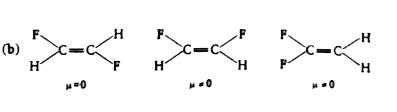
B

Promotional Banner

Topper's Solved these Questions

  • CHEMICAL BONDING (ADVANCED)

    VK JAISWAL ENGLISH|Exercise ONE OR MORE ANSWER IS/ARE CORRECT|78 Videos
  • CHEMICAL BONDING (ADVANCED)

    VK JAISWAL ENGLISH|Exercise MATCH THE COLUMN|21 Videos
  • CHEMICAL BONDING (ADVANCED)

    VK JAISWAL ENGLISH|Exercise Level 2|150 Videos
  • CHEMICAL BONDING (BASIC)

    VK JAISWAL ENGLISH|Exercise SUBJECTIVE PROBLEMS|54 Videos

Similar Questions

Explore conceptually related problems

Polar covalent molecules exhibit dipole moment. Dipole moment is equal to the product of charge separation , q and the bond length d for the bond. Unit of dipole moment is debye. One debye is equal to 10^(-18) esu cm. Dipole moments is a vector quantity. It has both magnitude and direction. Hence, dipole moment of a molecule depends upon the relative orientation of the bond dipoles, but not on the polarity of bonds alone. A symmetrical structure shows zero dipole moment. Thus, dipole moment helps to predict the geometry of a molecules. Dipole moment values can be distinguish between cis- and trans- isomers, ortho, meta and pare-forms of a substance, etc. Q. Which is a polar molecule?

Polar covalent molecules exhibit dipole moment. Dipole moment is equal to the product of charge separation , q and the bond length d for the bond. Unit of dipole moment is debye. One debye is equal to 10^(-18) esu cm. Dipole moments is a vector quantity. It has both magnitude and direction. Hence, dipole moment of a molecule depends upon the relative orientation of the bond dipoles, but not on the polarity of bonds alone. A symmetrical structure shows zero dipole moment. Thus, dipole moment helps to predict the geometry of a molecules. Dipole moment values can be distinguish between cis- and trans- isomers, ortho, meta and pare-forms of a substance, etc. Q. Which is a polar molecule?

Polar covalent molecules exhibit dipole moment. Dipole moment is equal to the product of charge separation , q and the bond length d for the bond. Unit of dipole moment is debye. One debye is equal to 10^(-18) esu cm. Dipole moments is a vector quantity. It has both magnitude and direction. Hence, dipole moment of a molecule depends upon the relative orientation of the bond dipoles, but not on the polarity of bonds alone. A symmetrical structure shows zero dipole moment. Thus, dipole moment helps to predict the geometry of a molecules. Dipole moment values can be distinguish between cis- and trans- isomers, ortho, meta and pare-forms of a substance, etc. Q. mu of the AX_(4) type of molecule is zero. The geometry of it can be :

Polar covalent molecules exhibit dipole moment. Dipole moment is equal to the product of charge separation , q and the bond length d for the bond. Unit of dipole moment is debye. One debye is equal to 10^(-18) esu cm. Dipole moments is a vector quantity. It has both magnitude and direction. Hence, dipole moment of a molecule depends upon the relative orientation of the bond dipoles, but not on the polarity of bonds alone. A symmetrical structure shows zero dipole moment. Thus, dipole moment helps to predict the geometry of a molecules. Dipole moment values can be distinguish between cis- and trans- isomers, ortho, meta and pare-forms of a substance, etc. Q. Arrange the following compounds in increasing order of dipole moments, toluene (I), o-dichlorobenzene (II), m-dichlorobenzene (III) and p-dichlorobenzene (IV) :

Polar covalent molecules exhibit dipole moment. Dipole moment is equal to the product of charge separation , q and the bond length d for the bond. Unit of dipole moment is debye. One debye is equal to 10^(-18) esu cm. Dipole moments is a vector quantity. It has both magnitude and direction. Hence, dipole moment of a molecule depends upon the relative orientation of the bond dipoles, but not on the polarity of bonds alone. A symmetrical structure shows zero dipole moment. Thus, dipole moment helps to predict the geometry of a molecules. Dipole moment values can be distinguish between cis- and trans- isomers, ortho, meta and pare-forms of a substance, etc. Q. Arrange the following compounds in increasing order of dipole moments, toluene (I), o-dichlorobenzene (II), m-dichlorobenzene (III) and p-dichlorobenzene (IV) :

Polar covalent molecules exhibit dipole moment. Dipole moment is equal to the product of charge separation , q and the bond length d for the bond. Unit of dipole moment is debye. One debye is equal to 10^(-18) esu cm. Dipole moments is a vector quantity. It has both magnitude and direction. Hence, dipole moment of a molecule depends upon the relative orientation of the bond dipoles, but not on the polarity of bonds alone. A symmetrical structure shows zero dipole moment. Thus, dipole moment helps to predict the geometry of a molecules. Dipole moment values can be distinguish between cis- and trans- isomers, ortho, meta and pare-forms of a substance, etc. Q. A diatomic molecule has a dipole moment of 1.2D. If the bond length is 1.0times10^(-8) cm, what fraction of charge does exist each atom?

The unit of dipole moment is

A molecule possessing dipole moment is

Unit of magnetic dipole moment is

Zero dipole moment is present in

VK JAISWAL ENGLISH-CHEMICAL BONDING (ADVANCED)-Level 3
  1. Polar covalent molecules exhibit dipole moment. Dipole moment is equal...

    Text Solution

    |

  2. Polar covalent molecules exhibit dipole moment. Dipole moment is equal...

    Text Solution

    |

  3. Polar covalent molecules exhibit dipole moment. Dipole moment is equal...

    Text Solution

    |

  4. In general boiling point of covalent compounds is affect due to incre...

    Text Solution

    |

  5. In general boiling point of covalent compounds is affect due to incre...

    Text Solution

    |

  6. In general boiling point of covalent compounds is affect due to incre...

    Text Solution

    |

  7. The molecule in which an atom is associated with more than 8 electrons...

    Text Solution

    |

  8. The molecule in which an atom is associated with more than 8 electrons...

    Text Solution

    |

  9. The molecule in which an atom is associated with more than 8 electrons...

    Text Solution

    |

  10. Colour of compounds occurs due to phenomenon of polarisation, charge t...

    Text Solution

    |

  11. Hydrogen bond is the given to the relatively weak secondry interaction...

    Text Solution

    |

  12. Hydrogen bond is the given to the relatively weak secondry interaction...

    Text Solution

    |

  13. The intermolecular forces of attraction (i.e., H-bonding and van der w...

    Text Solution

    |

  14. The intermolecular forces of attraction (i.e., H-bonding and van der w...

    Text Solution

    |

  15. The intermolecular forces of attraction (i.e., H-bonding and van der w...

    Text Solution

    |

  16. In all expected compounds each central atom only uses its s and p-orbi...

    Text Solution

    |

  17. The comcept of redistribution of energy in different orbitals of an at...

    Text Solution

    |

  18. The comcept of redistribution of energy in different orbitals of an at...

    Text Solution

    |

  19. The comcept of redistribution of energy in different orbitals of an at...

    Text Solution

    |

  20. Drago suggested an emprical rule which is compatible with the energeti...

    Text Solution

    |

