Home
Class 12
CHEMISTRY
Consider following four compounds: (i)...

Consider following four compounds:
(i) `C_(x) O_(y)`
(ii) `C_(x)O_(y+1)`
(iii) `C_(x+2)O_(y+1)` and (iv) `C_(x+11)O_(y+8)`,
if "x=y=1", then calculate the vlaue of |p-q|, where p and q are total number of `sp^(2)` and hybridized carbon atoms respectively in given four compounds.

Text Solution

Verified by Experts

The correct Answer is:
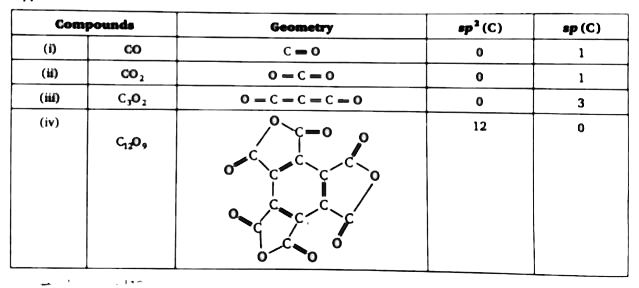
`7`


`implies |p-q|=|12-5|=7`
Promotional Banner

Topper's Solved these Questions

  • CHEMICAL BONDING (ADVANCED)

    VK JAISWAL ENGLISH|Exercise ASSERTION-REASON TYPE QUESTIONS|57 Videos
  • CHEMICAL BONDING (BASIC)

    VK JAISWAL ENGLISH|Exercise SUBJECTIVE PROBLEMS|54 Videos

Similar Questions

Explore conceptually related problems

Consider the following silicates (a) BaTi(Si_(2)O_(9)) (b) ZnCa_(2)Si_(2)O_(7) Then calculate X+Y, where X and Y are total number of monovalent and divalent oxygen atoms in both silicates respectively.

Consider the following silicates (a) BaTi(Si_(3)O_(9)) (b) ZnCa_(2)Si_(2)O_(7) Then calculate X+Y, where X and Y are total number of monovalent and divalent oxygen atoms in both silicates respectively.

Consider following compounds, (i) H_(3)X-HCS (ii) H_(3)Y-NCS (iii) (H_(3)Y)_(2)O (iv) (H_(2)X)_(2)O The incorrect statement regarding given compounds is :

Find the product. (i) (5-2x)(3+x) (ii) (x+7y)(7x-y) (iii) (a^2+b)(a+b^2) (iv) (p^2-q^2)(2p+q)

Total number of covalent bonds in C_(3)O_(2) is x and y is the number of sp - hybridised atom. Find the sum of x+y ?

Consider the following reaction x MnO_(4)^(-) + C_(2)O_(4)^(2-) + zH^(+) rarr x Mn^(2+) + 2y CO_(2) + (z)/(2)H_(2)O The value of x, y and z in the reaction are respectively

Calculate vlaue of |x+y-z| for the followng sillicate [Si_(x)O_(y+z)]^(z-) anion.

If a ,b ,c are in G.P. and x ,y are the arithmetic means of a ,ba n db ,c respectively, then prove that a/x+c/y=2a n d1/x+1/y=2/b

An organic compound C_(6)H_(12)(X) on reduction gives C_(6)H_(14)(Y) . X on ozonolysis gives two aldehydes C_(2)H_(4)O(I) and C_(4)H_(8)O(II) . Identify the compounds X, Y and aldehydes (I) and (II).

Find the point of intersection of the following pair of lines : (i) 9x-10y=12 and 2x-5=0 (ii) y=m_(1)x+c_(1) and y=m_(2)x+c_(2) (iii) x+y=8 and x-y=2

VK JAISWAL ENGLISH-CHEMICAL BONDING (ADVANCED)-SUBJECTIVE PROBLEMS
  1. When B(2)H(4) is allowed to react with following lewis bases, then how...

    Text Solution

    |

  2. Consider the following elements A, B, C and D and their outer electron...

    Text Solution

    |

  3. Consider following four compounds: (i) C(x) O(y) (ii) C(x)O(y+1) ...

    Text Solution

    |

  4. Calculate expression (x+y+z) for diatomic molecules. where x=Total n...

    Text Solution

    |

  5. If Hund rule violate, then find the total number of species among foll...

    Text Solution

    |

  6. Consider the following table Than calculate value of experssion...

    Text Solution

    |

  7. Total number of species among following, in which bond angle is equal...

    Text Solution

    |

  8. Total number of unpaired electrons(s) present in both cationic and an...

    Text Solution

    |

  9. Total number of species which has/ have symmetrical electronic distrib...

    Text Solution

    |

  10. Total number of molecules, in which each covalent bond is comprised of...

    Text Solution

    |

  11. Total number of angle in SeCl(4) which are less than 90^(@).

    Text Solution

    |

  12. Consider the following species O(Me)(2), N(SiH(3))(3), CO, O(SiH(3))(2...

    Text Solution

    |

  13. Total number of molecules which can form H-bond among themselves. Si...

    Text Solution

    |

  14. Consider two covalent compounds AL(n(1)) and BL(n(2)), if central atom...

    Text Solution

    |

  15. Calculate the I-I distance in (Å) for given compound H(2)C(2) I(2) if ...

    Text Solution

    |

  16. There are some arrangements of atomic orbitals which are given below: ...

    Text Solution

    |

  17. Number of hybrid orbital C atoms which have 33% p-character in C(CN)(4...

    Text Solution

    |

  18. Max. no. of equal P-O bonds in P(2)O(7)^(4-) ion is :

    Text Solution

    |

  19. Consider the following species: (i) CH(3)^(+) (ii) (C(3)H(5))(3)Al...

    Text Solution

    |

  20. Calculate value of |x-y|, here x and y are the total number of bonds i...

    Text Solution

    |

