Home
Class 12
CHEMISTRY
There are some species given below. (i)O...

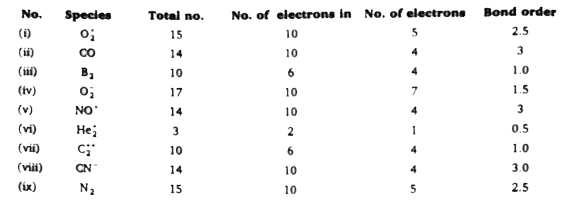
There are some species given below. (i)`O_(2)^(+)` (ii)`CO` (iii)`B_(2)` (iv)`O_(2)^(-)` (v)`NO^(+)` (vi)`He_(2)^(+)` (vii)`C_(2)^(2+)` (vii)` CN^(-)` (ix)` N_(2)^(-)`
total number of species which have fractional bond order.

Text Solution

Verified by Experts

The correct Answer is:
`4`

`to` molecular orbital configuration for upto 14 electrons
`sigma_(1s)ltoverset("*")(sigma_(1s))ltsigma_(2s)ltoverset("*")(sigma_(2s))ltpi_(2px)pi_(2py)ltsigma_(2px)ltoverset("*")(pi_(2px))=overset("*")(pi_(2py))ltoverset("*")(simga_(2px))`
For more than 14 electrons `sigma_(1s)ltoverset("*")(sigma_(1s))ltsigma_(2s)ltoverset("*")(sigma_(2s))ltpi_(2px)=pi_(2py))ltoverset("*")(pi_(2px))=overset("*")(pi_(2py))ltoverset("*")(pi_(2px))`
Bond order `=(1)/(2)` number of electron in [Bonding M.O.-Antibonding M.O.]
Promotional Banner

Topper's Solved these Questions

  • CHEMICAL BONDING (ADVANCED)

    VK JAISWAL ENGLISH|Exercise ASSERTION-REASON TYPE QUESTIONS|57 Videos
  • CHEMICAL BONDING (BASIC)

    VK JAISWAL ENGLISH|Exercise SUBJECTIVE PROBLEMS|54 Videos

Similar Questions

Explore conceptually related problems

There are some species given below :- {:((a)O_(2)^(+),,,,(b)CO),((c)B_(2),,,,(d)O_(2)^(+)),((e)NO^(+),,,,(f)He_(2)^(+)),((g)C_(2)^(+2),,,,(h)CN^(-)),((i)N_(2)^(-),,,,):} Total no. of species which have their fractional bond order.

Consider the following species: (i) CH_(3)^(+) (ii) (C_(3)H_(5))_(3)Al (iii) HCHO (iv) CH_(4) (v) (C_(2)H_(5))_(3)N (vI) TiCl_(4) (vii) CO_(2) (viii) SiCl_(4) (ix) BF_(3) the find out total number of species which can act as Lewis acid.

Among the following, total no. of planar species is : (i) SF_(4) " " (ii) BrF_(3) " " (iii) XeF_(2) " " (iv) IF_(5) (v) SbF_(4)^(-) " " (vi) SF_(5)^(-) " " (vii) SeF_(3)^(+) " " (viii) CH_(3)^(+) (ix) PCl_(4)^(+)

Correct set of species with zero dipole moment is : (i) CO_(2) " " (ii) COCl_(2) " " (iii) CH_(2)Cl_(2) " " (iv) BCl_(3)

Correct set of species with zero dipole moment is : (i) CO_(2) " " (ii) COCl_(2) " " (iii) CH_(2)Cl_(2) " " (iv) BCl_(3)

How many of the following oxides of nitrogen are paramangnetic ? (i) N_(2)O (ii) NO (iii) N_(2)O_(3) (iv) NO_(2) (v) N_(2)O_(4) (vi) N_(2)O_(5) (vii) NO_(2)^(o+) (viii) NO_(2)^(Theta) (ix) NO_(3)^(Theta) .

The correct order of bond order values among the following (i) NO^(-) (ii) NO^(+) (iii) NO (iv) NO^(2+) (v) NO^(2-)

How many of the following compounds have sp^(3) hybridisation (i) SO_(4)^(2-) (ii) SO_(5)^(2-) (iii) PO_(4)^(3-) (iv) PO_(5)^(3-) (v) I_(3)^(Theta) (iv) CO_(3)^(2-) (vii) CO_(4)^(2-) .

How many of the following species have bond order of 2.5 ? N_(2)^(o+) (ii) N_(2)^(Theta) (iii) O_(2)^(o+) (iv) O_(2)^(Theta) (v) NO (vi) CN .

The number of paramagentic species among the following is O_(2), CO, N_(2), C_(2), CsO_(2), BaO_(2), CO_(2)

VK JAISWAL ENGLISH-CHEMICAL BONDING (ADVANCED)-SUBJECTIVE PROBLEMS
  1. Consider the following three compounds (i)AX(2n)^(n-), (ii)AX(3n) and...

    Text Solution

    |

  2. Consider the following compounds (1)H(3)CF (2)H(2)CF(2) (3) CH(4) ...

    Text Solution

    |

  3. There are some species given below. (i)O(2)^(+) (ii)CO (iii)B(2) ...

    Text Solution

    |

  4. Following compounds A and B have similar structure with delocalization...

    Text Solution

    |

  5. The hybridization of central atoms of compounds A, B, C and D are sp^(...

    Text Solution

    |

  6. In compound PCl(x)F(5-x), possible values of x are 0 to 5, then calcul...

    Text Solution

    |

  7. There are two groups of compounds A and B. Groups A contains three com...

    Text Solution

    |

  8. Consider the following three compounds (i)AX(2n)^(n-), (ii)AX(3n) and...

    Text Solution

    |

  9. When B(2)H(4) is allowed to react with following lewis bases, then how...

    Text Solution

    |

  10. Consider the following elements A, B, C and D and their outer electron...

    Text Solution

    |

  11. Consider following four compounds: (i) C(x) O(y) (ii) C(x)O(y+1) ...

    Text Solution

    |

  12. Calculate expression (x+y+z) for diatomic molecules. where x=Total n...

    Text Solution

    |

  13. If Hund rule violate, then find the total number of species among foll...

    Text Solution

    |

  14. Consider the following table Than calculate value of experssion...

    Text Solution

    |

  15. Total number of species among following, in which bond angle is equal...

    Text Solution

    |

  16. Total number of unpaired electrons(s) present in both cationic and an...

    Text Solution

    |

  17. Total number of species which has/ have symmetrical electronic distrib...

    Text Solution

    |

  18. Total number of molecules, in which each covalent bond is comprised of...

    Text Solution

    |

  19. Total number of angle in SeCl(4) which are less than 90^(@).

    Text Solution

    |

  20. Consider the following species O(Me)(2), N(SiH(3))(3), CO, O(SiH(3))(2...

    Text Solution

    |

