Home
Class 12
CHEMISTRY
The ellingham diagram for zinc, magnesiu...

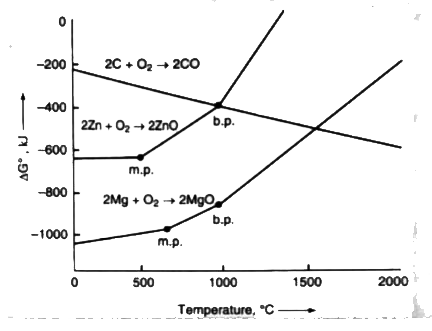
The ellingham diagram for zinc, magnesium and carbon coverting into correspondingoxides is shown below.

At `1100^(@)C`, which reaction is spontaneous to a maximum extent ?

A

`MgO+C to Mg+CO`

B

`ZnO+C to Zn+CO`

C

`MgO+Zn to Mg +ZnO`

D

`ZnO+Mg to MgO +Zn`

Text Solution

Verified by Experts

The correct Answer is:

D
Promotional Banner

Topper's Solved these Questions

  • METALLURGY

    VK JAISWAL ENGLISH|Exercise Level 3 (Passive 3)|6 Videos
  • METALLURGY

    VK JAISWAL ENGLISH|Exercise Level 3 (Passive 4)|4 Videos
  • METALLURGY

    VK JAISWAL ENGLISH|Exercise Level 3 (Passive 1)|8 Videos
  • ENVIRONMENTAL CHEMISTRY

    VK JAISWAL ENGLISH|Exercise ASSERTION-REASON TYPE QUESTIONS|14 Videos
  • p-BLOCK ELEMENTS

    VK JAISWAL ENGLISH|Exercise SUBJECTIVE PROBLEMS|35 Videos

Similar Questions

Explore conceptually related problems

The ellingham diagram for zinc, magnesium and carbon coverting into correspondingoxides is shown below. To make the following reduction process spontaneous, temperature should be : ZnO+C to Zn+CO

The ellingham diagram for zinc, magnesium and carbon coverting into correspondingoxides is shown below. To make the following reduction process spontaneous, temperature should be : ZnO+C to Zn+CO

The ellingham diagram for zinc, magnesium and carbon coverting into correspondingoxides is shown below. At what temperature, zinc and carbon have equal affinity for oxygen ?

The ellingham diagram for zinc, magnesium and carbon coverting into correspondingoxides is shown below. At what temperature, zinc and carbon have equal affinity for oxygen ?

Questions given below are based on the given diagram for extractive metallurgy. (iv) At 1100^@C , which reaction is spontaneous to a maximum extent ?

The Ellingham diagram for a number of metallic sulphides is shown below. Which sulphide occurs to minimum extent in nature ?

The Ellingham diagram for a number of metallic sulphides is shown below. Formation of which of the sulphides is most spontaneous ?

The Ellingham diagram for a number of metallic sulphides is reproduced below. Answer the questions given below : (i) Formation of which of the sulphidesis not spontaneous ?

The Ellingham diagram for a number of metallic sulphides is shown below. Which of the following sulphides can not be reduced to metal by H_(2) at about 1000^(@)C ?
