Home
Class 12
CHEMISTRY
Consider the following reversible chemi...

Consider the following reversible chemical reactions :
`A_(2)(g)+B_(2)(g)overset(K_(1))(hArr)2AB(g)....(1)`
`6AB(g) overset(K_(2))(hArr)3A_(2)(g)+3B_(2)(g).....(2)`
The relation between `K_(1)` and `K_(2)` is :

A

`K_(a)gtK'_(a)`

B

`CHF_(3)` act as a stronger bronsted acid than `CHCl_(3)`

C

`C Cl_(3)^(-)` is more stable than `CF_(3)^(-)`

D

`C Cl_(3)^(-)` is weaker lewis base than `CF_(3)^(-)`

Text Solution

Verified by Experts

The correct Answer is:
C, D

`K._(a)gtK_(a)`
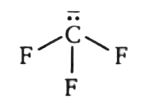
`CHF_(3)overset(K_(a)) to CF_(3)^(-)+H^(+)`
stabilized by inductive effect of F-atoms
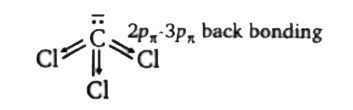
`CHCl_(3)overset(K._(a))CCl_(3)^(-)+H^(+)`
Due to combined effect in inductive effect of Cl-atom and `2p_(pi)-3d_(pi)` back bonding, lone pair at C-atom (negative charge) in `CCl_(4)^(-)` is more delocalized than in `CF_(3)^(-)` is more stable than `CF_(3)^(-) and CCl_(3)^(-)` is weaker lewis base than `CF_(3)^(-)`
Promotional Banner

Topper's Solved these Questions

  • CHEMICAL BONDING (ADVANCED)

    VK JAISWAL ENGLISH|Exercise MATCH THE COLUMN|21 Videos
  • CHEMICAL BONDING (ADVANCED)

    VK JAISWAL ENGLISH|Exercise ASSERTION-REASON TYPE QUESTIONS|57 Videos
  • CHEMICAL BONDING (ADVANCED)

    VK JAISWAL ENGLISH|Exercise Level 3|77 Videos
  • CHEMICAL BONDING (BASIC)

    VK JAISWAL ENGLISH|Exercise SUBJECTIVE PROBLEMS|54 Videos

Similar Questions

Explore conceptually related problems

Consider the following equilibrium: SO_(2)(g)+(1)/(2)O_(2)(g)overset(K_(1))(hArr)SO_(3)(g), 2SO_(3)(g) overset(K_(2))(hArr) 2SO_(2)(g) + O_(2) (g) What is the relation between K_(1) and K_(2) ?

Equilibrium constants K_(1) and K_(2) for the following equilibria NO(g) +1//2O_(2)(g) overset(K_(1))(hArr) NO_(2)(g) and 2NO_(2)(g) overset(K_(2))(hArr)2NO(g)+O_(2)(g) are related as

In the reversible reaction, 2HI(g) hArr H_(2)(g)+I_(2)(g), K_(p) is

Write the relation between K_(p)and K_(c) for the following reactions (i) N_(2)(g)+3H_(2)(g)hArr2H_(2)(g)+O_(2)(g) (ii) 2H_(2)O(g)hArr2H_(2)(g)+O_(2)(g)

For the Chemical reaction A_(2(g)) + B_(2(g)) hArr 2 AB(g) the amount of AB at equilibrium is affected by

Write the relation between K_(p) " and " K_(c) for the reaction: N_(2)(g) +3H_(2) (g) hArr 2NH_(3)(g)

The K_c for given reaction will be A_2 (g) +2B (g) hArr C(g) +2D(s)

Consider the following reactions: i. CO(g)+H_(2)O(g) hArr CO_(2)(g)+H_(2)(g), K_(1) ii. CH_(4)(g)+H_(2)O(g) hArr CO(g)+3H_(2)(g), K_(2) iii. CH_(4)(g)+2H_(2)O(g) hArr CO_(2)(g)+4H_(2)(g), K_(3) Which of the following is/are incorrect?

consider the following gaseous equilibrium with equilibrium constant K_(1) and K_(2) respectively SO_(3)(g)hArrSO_(2)(g)+ 1//2O_(2) 2SO_(3)(g)hArr2SO_(2)(g)+O_(2)(g) The equilibrium constants are related as

consider the following gaseous equilibrium with equilibrium constant K_(1) and K_(2) respectively SO_(2)(g)+ 1//2O_(2)hArrSO_(3)(g) 2SO_(3)(g)hArr2SO_(2)(g)+O_(2)(g) The equilibrium constants are related as

VK JAISWAL ENGLISH-CHEMICAL BONDING (ADVANCED)-ONE OR MORE ANSWER IS/ARE CORRECT
  1. Corrrect order of bond angle in the given compounds is/are:

    Text Solution

    |

  2. The correct statement(s) is /are :

    Text Solution

    |

  3. Consider the following reversible chemical reactions : A(2)(g)+B(2)...

    Text Solution

    |

  4. In which of the following molecules mu(exp) (observed dipole moment) i...

    Text Solution

    |

  5. Correct statement (s) regarding As(CH(3))F(2)Cl(2) molecule is/are:

    Text Solution

    |

  6. Which of the following species are involved

    Text Solution

    |

  7. Which of the following statements is correct?

    Text Solution

    |

  8. Which of the following species is/are not know?

    Text Solution

    |

  9. Select correct order between following compounds:

    Text Solution

    |

  10. Which of the following is (are) V-shaped?

    Text Solution

    |

  11. Which of the following equlibria would have highest and lowest value o...

    Text Solution

    |

  12. Which of the following process is/are assciated with change of hybridi...

    Text Solution

    |

  13. Which of the following are true?

    Text Solution

    |

  14. Which of the following statement is incorrect?

    Text Solution

    |

  15. Which of the following statements are not correct?

    Text Solution

    |

  16. In the structure of H(2)CSF(4), which of the following statement is/ar...

    Text Solution

    |

  17. In which compound compounds vacant hybride orbitals take part in bondi...

    Text Solution

    |

  18. Which of the following is true for N(2)O?

    Text Solution

    |

  19. Silane is more reactive than CH(4) towards Nu^(-) substitution due to...

    Text Solution

    |

  20. Which of the following statement(s) is/are not correct for following...

    Text Solution

    |

