Home
Class 12
CHEMISTRY
The ellingham diagram for zinc, magnesiu...

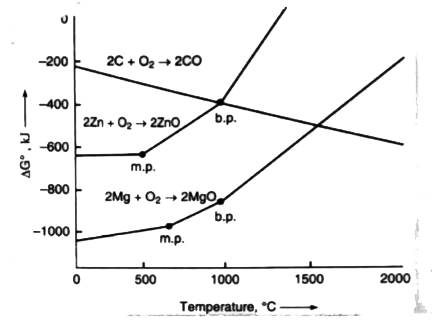
The ellingham diagram for zinc, magnesium and carbon coverting into correspondingoxides is shown below.

To make the following reduction process spontaneous, temperature should be :
`ZnO+C to Zn+CO`

A

`1000^(@)C`

B

`gt 1100^(@)C`

C

`lt 500^(@)C`

D

`lt 1000^(@)C`

Text Solution

Verified by Experts

The correct Answer is:

B
Promotional Banner

Topper's Solved these Questions

  • METALLURGY

    VK JAISWAL ENGLISH|Exercise Level 3 (Passive 3)|6 Videos
  • METALLURGY

    VK JAISWAL ENGLISH|Exercise Level 3 (Passive 4)|4 Videos
  • METALLURGY

    VK JAISWAL ENGLISH|Exercise Level 3 (Passive 1)|8 Videos
  • ENVIRONMENTAL CHEMISTRY

    VK JAISWAL ENGLISH|Exercise ASSERTION-REASON TYPE QUESTIONS|14 Videos
  • p-BLOCK ELEMENTS

    VK JAISWAL ENGLISH|Exercise SUBJECTIVE PROBLEMS|35 Videos

Similar Questions

Explore conceptually related problems

The ellingham diagram for zinc, magnesium and carbon coverting into correspondingoxides is shown below. At 1100^(@)C , which reaction is spontaneous to a maximum extent ?

The ellingham diagram for zinc, magnesium and carbon coverting into correspondingoxides is shown below. At 1100^(@)C , which reaction is spontaneous to a maximum extent ?

The ellingham diagram for zinc, magnesium and carbon coverting into correspondingoxides is shown below. At what temperature, zinc and carbon have equal affinity for oxygen ?

The ellingham diagram for zinc, magnesium and carbon coverting into correspondingoxides is shown below. At what temperature, zinc and carbon have equal affinity for oxygen ?

Questions given below are based on the given diagram for extractive metallurgy. (iii) The make the following process spontaneous, temperature should be : ZnO + C rarr Zn + CO .

The Ellingham diagram for a number of metallic sulphides is shown below. Which of the following sulphides can not be reduced to metal by H_(2) at about 1000^(@)C ?

Metals are extracted from their ores by a wide variety of techniques. The most common ores are oxides. Most metals are obtained by direct treatment of theirs ores with chemical agents, but the extraction of certain others require electrolysis. An example of the former type of process is the extraction of iron from its oxide, described by the following equation : Fe_(2) O_(3) + 3C rarr 2Fe + 3CO The relative ease of extraction of a metal from its oxide can be estimated using the Ellingham diagram, as shown in the figure. The diagram plots the free energies of formation of various oxides per mole of consumed oxygen as a function of absolute temperature. Which of the following best explains why the free energy of formation of Fe_(2)O_(3) becomes less negative as the temperature is increased.

For a given thermodynamic process, the P – V diagram is as shown below: Which of the following is the V – T diagram for the process? A to B : isobaric B to C : adiabatic C to A : isothermal

Reduction of Fe_(2)O_(3) with CO is done below 710^@C . Delta_(f) G^(Ө) is negative at this temperature , this process is spontaneous.

Assertion : Reduction of ZnO with carbon is done at 1100^(@)C . Reason : At this temperature, DeltaG^(@) is negative and the process is spontaneous.
