Home
Class 11
PHYSICS
An experiment on the take off performanc...

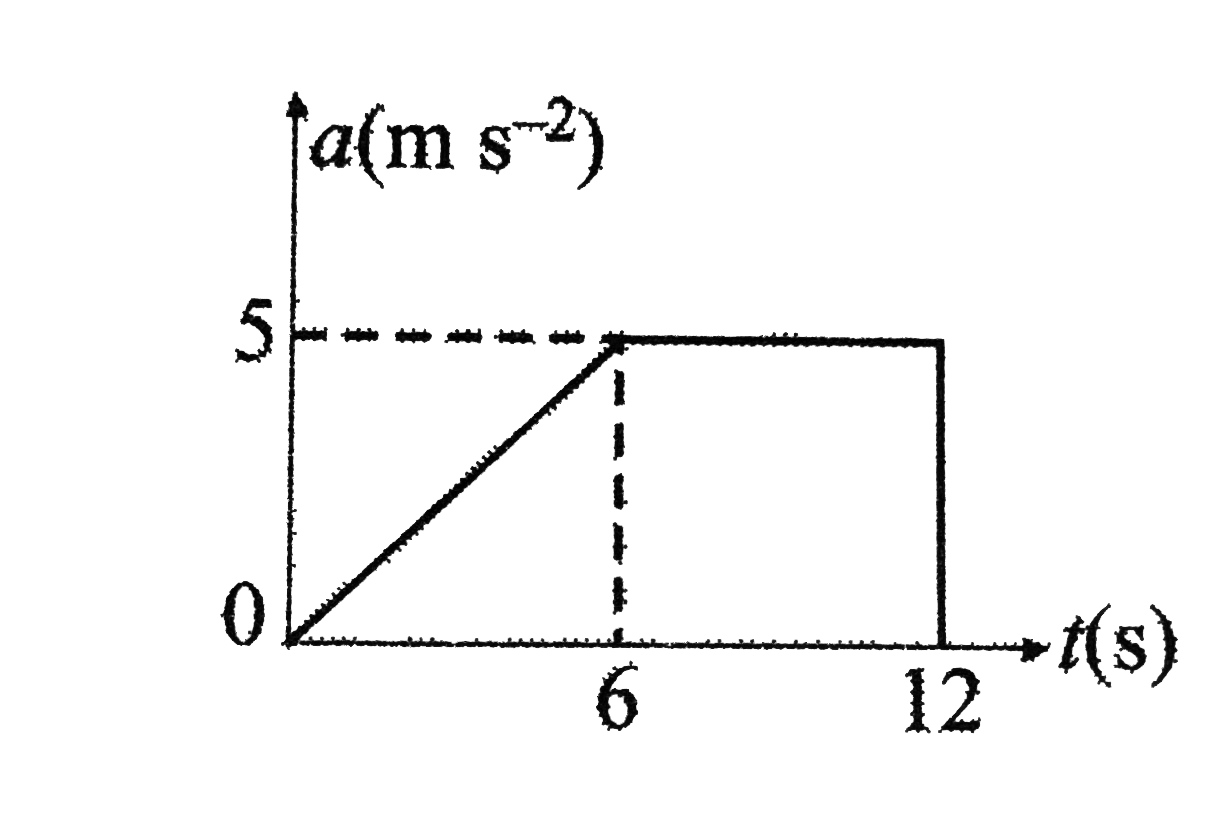
An experiment on the take off performance of an aeroplane shows that the acceleration vaies as shown in (figure) and that it takes `12s` to take off from a rest position.
a. Write the acceleration vs. time, velocity vs. time and position vs. time relations for complete journey.
b. Plot velocity vs. time relation for the motion.
c. Find the distance along the run way covered by the aeroplane.

Text Solution

Verified by Experts
For time `t=0` to `6s`
We can write equation for this motion, it is `y=mx` type line where m is the slope of the line.
Here, `a=((5-0))/((6-0))*timplies a=5/6t(ms^-2)` …(i)
`(For 0letlt6s)`
From `6s` to `12s` acceleration is constant, we can write equation for this motion, it is `y=const ant`.
Hence `a=5(ms^-2)` `(For 6letlt12s)`
For time `t=0` to `6s`
From Eq. (i) `a=(dv)/(dt)=5/6timpliesdv=5/6tdt`
Integrating both sides, we get `underset0oversetvintdv=5/6underset0oversettinttdt`
`[v]_0^v=5/6[t^2/2]_0^t` or `(v-0)=5/12(t^2-0)` or `v=5/12t^2`
Here velocity at `t=6s` is `v_(t=6s)=5/12xx6^2=15ms^-1`
For time `t=0` to `6s`
The acceleration is constant.
`a=5(ms^-2)` or `(dv)/(dt)=5` or `dv=5dt`
Integrating both sides, `underset15oversetvintdv=underset6oversettint5*dt`
`[v]_15^v=5[t]_6^t`
`v-15=5[t-6]`
`impliesv=5t-15`
Velocity-time relation will be a straight line of type `y=mx+c`.
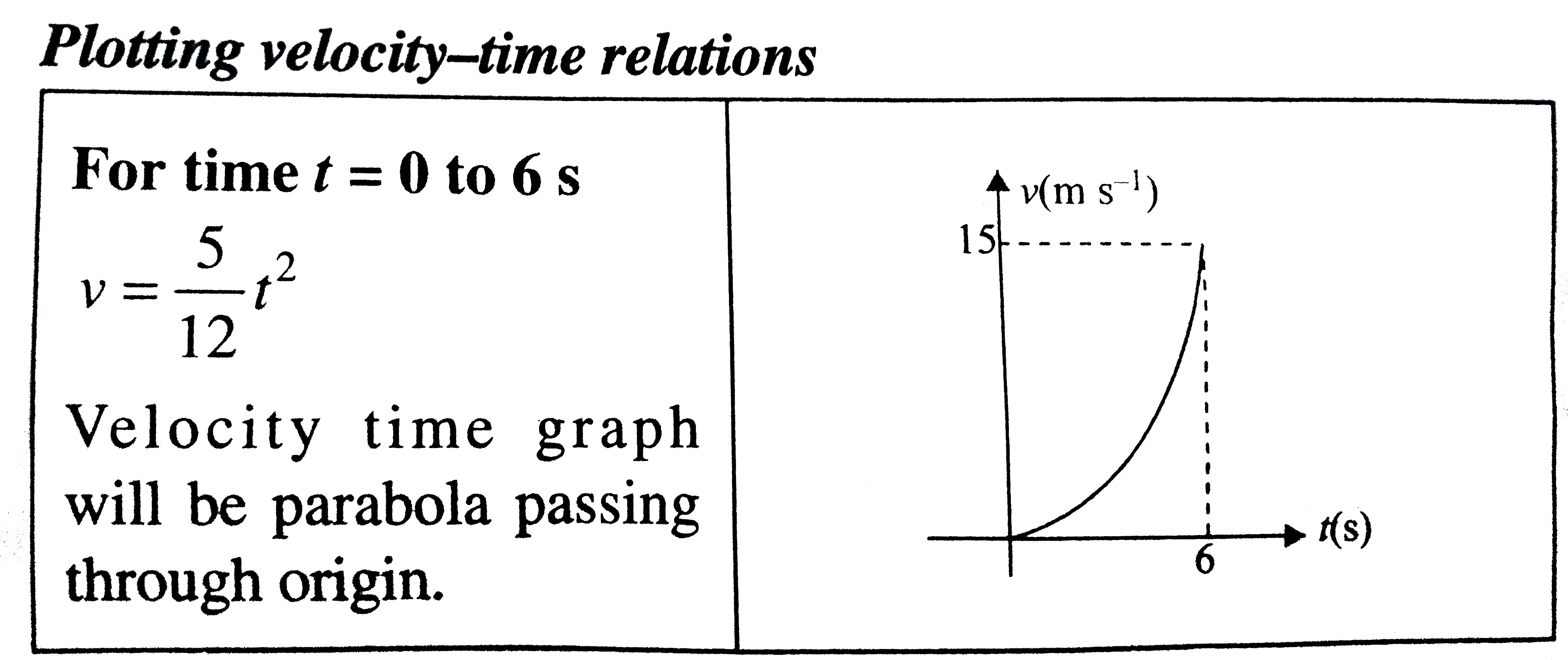
Plotting velocity-time relations
For time `t=0` to `6s`
`v=5/12t^2`
Velocity time graph will be parabola passing through origin.

Position time relations
For time `t=0` to `6s`
As we know `v=(dx)/(dt)=5/12t^2`
Hence, `5/12t^2=(dx)/(dt)impliesdx=5/12int t^2dt`
Integrating both sides, `underset (0) oversetx int dx=5/12underset (0) overset (t) int t^2dt`
`(x-0)=5/12[t^3/3]_0^timpliesx=5/36t^3`
Position or the distance travelled from 0 to 6s
`x_((t=6sec))=5/36xx(6)^3=30m`
For time `t=6s` to `12s`
`v=5t-15implies(dx)/(dt)=5t-5`
or `dx=(5t-15)dt`
Integrating both sides
`underset(30)overset(x)intdx=underset6oversettint(5t-15)dt`
`[x]_30^x=5underset6oversettinttdt-15underset6oversettintdt`
`(x-30)=5[t^2/2]_6^t-15[t]_6^t`
`x-30=5/2[t^2-6^2]-15[t-6]`
`x=5/2t^2-15t+30`
At `t=12s`,
`x_((t=12s))=5/2(12)^2-15xx12+30=210m`
Promotional Banner

Topper's Solved these Questions

  • BASIC MATHEMATICS

    CENGAGE PHYSICS ENGLISH|Exercise Exercise 2.1|2 Videos
  • BASIC MATHEMATICS

    CENGAGE PHYSICS ENGLISH|Exercise Exercise 2.2|3 Videos
  • BASIC MATHEMATICS

    CENGAGE PHYSICS ENGLISH|Exercise Exercise 2.6|20 Videos
  • ARCHIVES 2 VOLUME 6

    CENGAGE PHYSICS ENGLISH|Exercise Integer|4 Videos
  • CALORIMETRY

    CENGAGE PHYSICS ENGLISH|Exercise Solved Example|13 Videos

Similar Questions

Explore conceptually related problems

For an airplane to take-off it accelerates according to the graph shown and takes 12 s to take -off from the rest position .The distance travelled by the airplane in 6sec is

Speed vs Velocity

Position-time graph for motion with zero acceleration is

Position - time graph for motion with negative acceleration is

For the acceleration - time (a - t) graph shown in figure, the change in velocity of particle from t = 0 to t = 6 s is

The acceleration of a cart started at t=0 varies with time as shown in figure. Find the distance travelled in 30 seconds and draw the position time graph.

The velocity of a car as a function of time is shown in Fig. Find the distance travelled by the car in 8 s and its acceleration.

The acceleration of a'particle starting from rest, varies with time according to the relation a=kt+c . The velocity of the particle after time t will be :

For the motion with uniform velocity, how is the distance travelled related to the time ?

The dependence of the acceleration of a body with time is shown in Figure. At t=0 , the velocity of the body is -3m//s and position is x=0 m .

