Home
Class 11
PHYSICS
The speed of a car increases uniformly f...

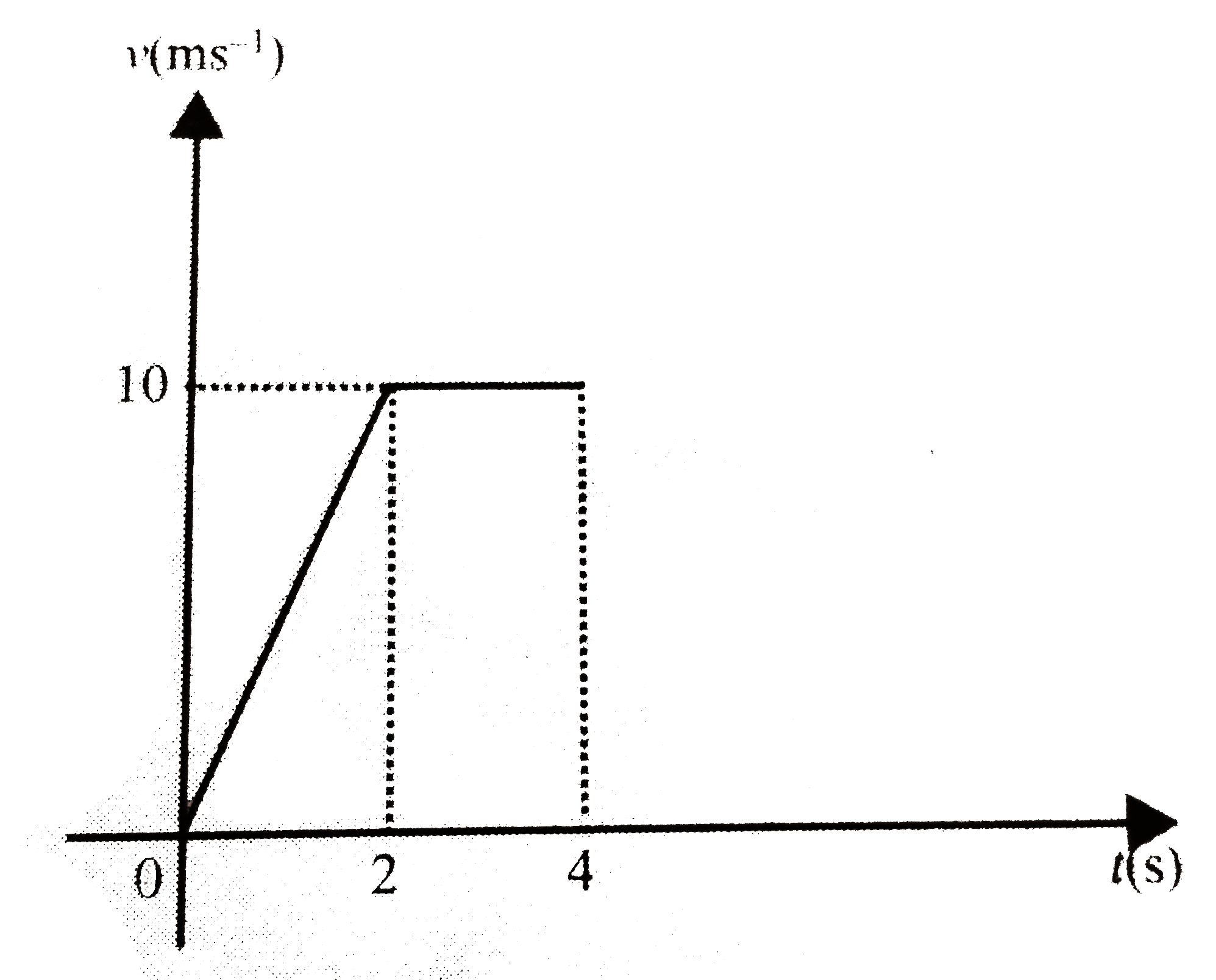
The speed of a car increases uniformly from zero to `10ms^-1` in `2s` and then remains constant (figure)

a. Find the distance travelled by the car in the first two seconds.
b. Find the distance travelled by the car in the next two seconds.
c. Find the total distance travelled in `4s`.

Text Solution

Verified by Experts

a. Distance=area`=1/2xx2xx10=10m`
b. Distance =area=`2xx10=20m`
c. Total distance `=10+20=30m`
Promotional Banner

Topper's Solved these Questions

  • BASIC MATHEMATICS

    CENGAGE PHYSICS ENGLISH|Exercise Exercise 2.5|2 Videos
  • ARCHIVES 2 VOLUME 6

    CENGAGE PHYSICS ENGLISH|Exercise Integer|4 Videos
  • CALORIMETRY

    CENGAGE PHYSICS ENGLISH|Exercise Solved Example|13 Videos

Similar Questions

Explore conceptually related problems

A car travels for 20 min with a constant speed of 54 km h^(-1) Find the distance travelled by the car.

A body ,starting from rest and moving with constant acceleration,covers 10m in the first second.Find the distance travelled by it in the next second.

The speed of a car as a function of time is shown in figure. Find the distance travelled by the car in 8 seconds and its acceleration.

From the velocity time plot shown in figure find the distance travelled by the particle dureing the first 40 seconds. Also find the average velocity during this period.

The velocity of a car as a function of time is shown in Fig. Find the distance travelled by the car in 8 s and its acceleration.

The diameter of a wheel of a car is 63 cm. Find the distance travelled by the car during the period, the wheel makes 1000 revolutions.

If the distance travelled by a freely falling body in the last second of its journey is equal to the distance travelled in the first 2s, the time of descent of the body is

Speed time graph of a particle shown in figure. Find distance travelled by particle in 5 second .

A body starts from rest and accelerates with 4 "m/s"^2 for 5 seconds. Find the distance travelled with 5 seconds.

The period of a particle in SHM is 8 s . At t = 0 it is in its equilibrium position. (a) Compare the distance travelled in the first 4s and the second 4s . (b) Compare the distance travelled in the first 2s and the second 2s .

CENGAGE PHYSICS ENGLISH-BASIC MATHEMATICS-Exercise 2.6
  1. The displacement of a particle is given by y=(6t^2+3t+4)m, where t is ...

    Text Solution

    |

  2. The velocity of a particle is given by v=12+3(t+7t^2). What is the acc...

    Text Solution

    |

  3. A particle starts from origin with uniform acceleration. Its displacem...

    Text Solution

    |

  4. The acceleration of a particle is given by a=t^3-3t^2+5, where a is in...

    Text Solution

    |

  5. A particle starts moving along the x-axis from t=0, its position varyi...

    Text Solution

    |

  6. A particle moves along the x-axis obeying the equation x=t(t-1)(t-2), ...

    Text Solution

    |

  7. The speed of a car increases uniformly from zero to 10ms^-1 in 2s and ...

    Text Solution

    |

  8. A car accelerates from rest with 2ms^-2 for 2s and then decelerates co...

    Text Solution

    |

  9. A stationary particle of mass m=1.5kg is acted upon by a variable forc...

    Text Solution

    |

  10. The displacement of a body at any time t after starting is given by s=...

    Text Solution

    |

  11. A particle moves along a straight line such that its displacement at a...

    Text Solution

    |

  12. The displacement x of a particle moving in one dimension under the act...

    Text Solution

    |

  13. The position x of a particle varies with time t according to the relat...

    Text Solution

    |

  14. The displacement of a particle along the x-axis is given by x=3+8t+7t^...

    Text Solution

    |

  15. The acceleration a in ms^-2 of a particle is given by a=3t^2+2t+2, whe...

    Text Solution

    |

  16. The displacement x of a particle along the x-axis at time t is given b...

    Text Solution

    |

  17. A particle moves along a straight line such that its displacement at a...

    Text Solution

    |

  18. The acceleration of a bus is given by ax(t)=at, where a=1.2ms^-2. If...

    Text Solution

    |

  19. The acceleration of a motorcycle is given by ax(t)=At-Bt^2, where A=1....

    Text Solution

    |

  20. The acceleration of a particle varies with time t seconds according to...

    Text Solution

    |
