Home
Class 11
PHYSICS
A particle slides with a speed of 3m s^(...

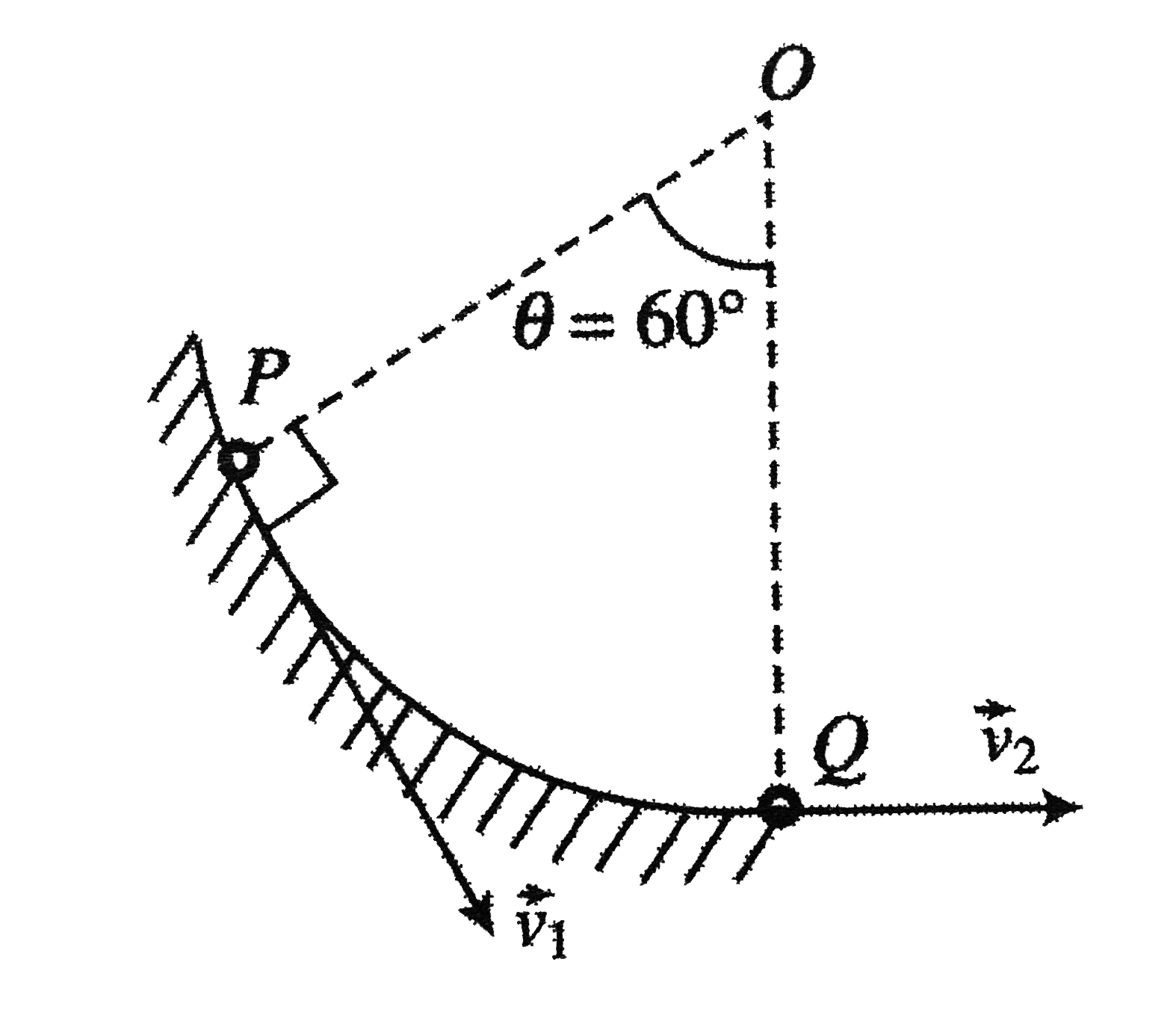
A particle slides with a speed of `3m s^(-1)` at P. When it reaches `Q`,it acquires a speed of `4m s^(-1)` after describing an angle of `60^(@)` at `O` as shown in figure .Find the changes in the velocity of the particle between `P` and `Q`. Assume that the path followed by the particle is circular from `P` to `Q`

Text Solution

Verified by Experts
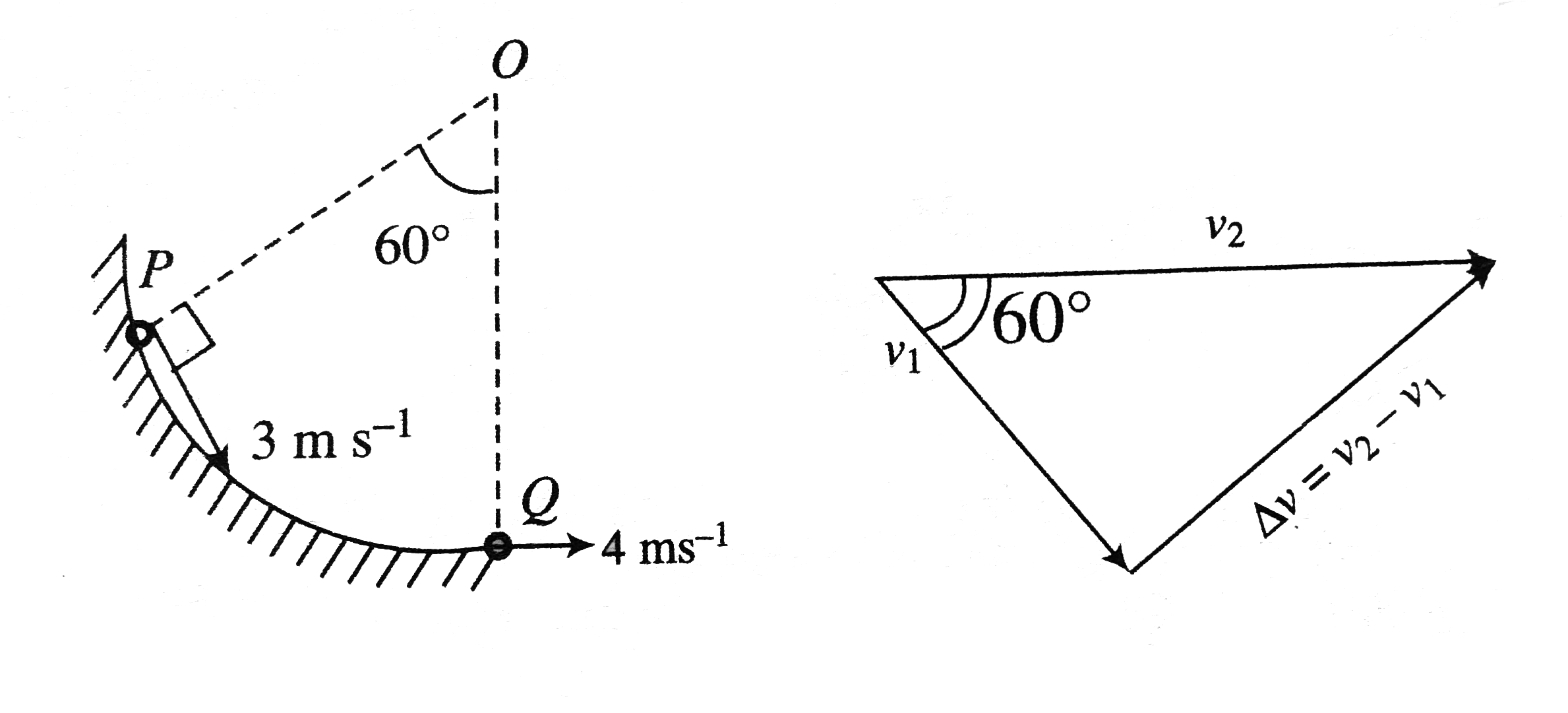
As the particle moves from P to Q, its speed increases from `v_(1)=3m s^(-1)` to `v_(2)=4m s^(-1)` and the angle described by the velocity vector is equal to `theta=60^(@)`.Then the change in velocity is given as
`Deltav=sqrt(v_(1)^(2)+v_(2)^(2)-2v_(1)v_(2)cos theta)`
Substituting, `v_(1)=3m s^(-1),v_(2)=4m s^(-1) ` and `theta=60^(@)` in the above expression ,we have
`Deltav=sqrt(3^(2)+4^(2)-2.3.4cos60^(@))`
This yield `Deltav=sqrt(13m)s^(-1)` and the change in velocity is directed as shown in figure
.
Promotional Banner

Topper's Solved these Questions

  • VECTORS

    CENGAGE PHYSICS ENGLISH|Exercise Exercise 3.1|19 Videos
  • VECTORS

    CENGAGE PHYSICS ENGLISH|Exercise Exercise 3.2|13 Videos
  • TRAVELLING WAVES

    CENGAGE PHYSICS ENGLISH|Exercise Integer|9 Videos
  • WORK, POWER & ENERGY

    CENGAGE PHYSICS ENGLISH|Exercise Archives (integer)|4 Videos

Similar Questions

Explore conceptually related problems

Find the horizontal velocity of the particle when it reach the point Q. Assume the block to be frictionless. Take g=9.8 m//s^(2) .

A particle is moving on a circular path with constant speed v then the change in its velocity after it has described an angle of 60^(@) will be

A time varying force acts on a particle of mass 5 kg as shown in figure . Find the speed of the particle, in m/s , after 10 s , if particle was intially at rest .

A particle is moving in a circle of radius r with speed v as shown in the figure. The magnitude of change in velocity in moving from P to Q is

A particle is moving in a circle of radius r with speed v as shown in the figure. The magnitude of change in velocity in moving from P to Q is

A particle is moving on a circular path with constant speed v. The magnitude of the change in its velocity after it has described an angle of 90^(@) is :

A large , heavy box is sliding without friction down a smooth plane of inclination theta . From a point P on the bottom of the box , a particle is projected inside the box . The initial speed of the particle with respect to the box is u , and the direction of projection makes an angle alpha with the bottom as shown in Figure . Find the distance along the bottom of the box between the point of projection p and the point Q where the particle lands . ( Assume that the particle does not hit any other surface of the box . Neglect air resistance .

A particle is moving on a circular path of radius r with uniform speed v. What is the displacement of the particle after it has described an angle of 60^(@) ?

A particle is projected with speed 20m s^(-1) at an angle 30^@ With horizontal. After how much time the angle between velocity and acceleration will be 90^@

A particle is projected at an angle of 60^(@) above the horizontal with a speed of 10m//s . After some time the direction of its velocity makes an angle of 30^(@) above the horizontal. The speed of the particle at this instant is

