Home
Class 11
PHYSICS
A force if 15N acts on a box as shown in...

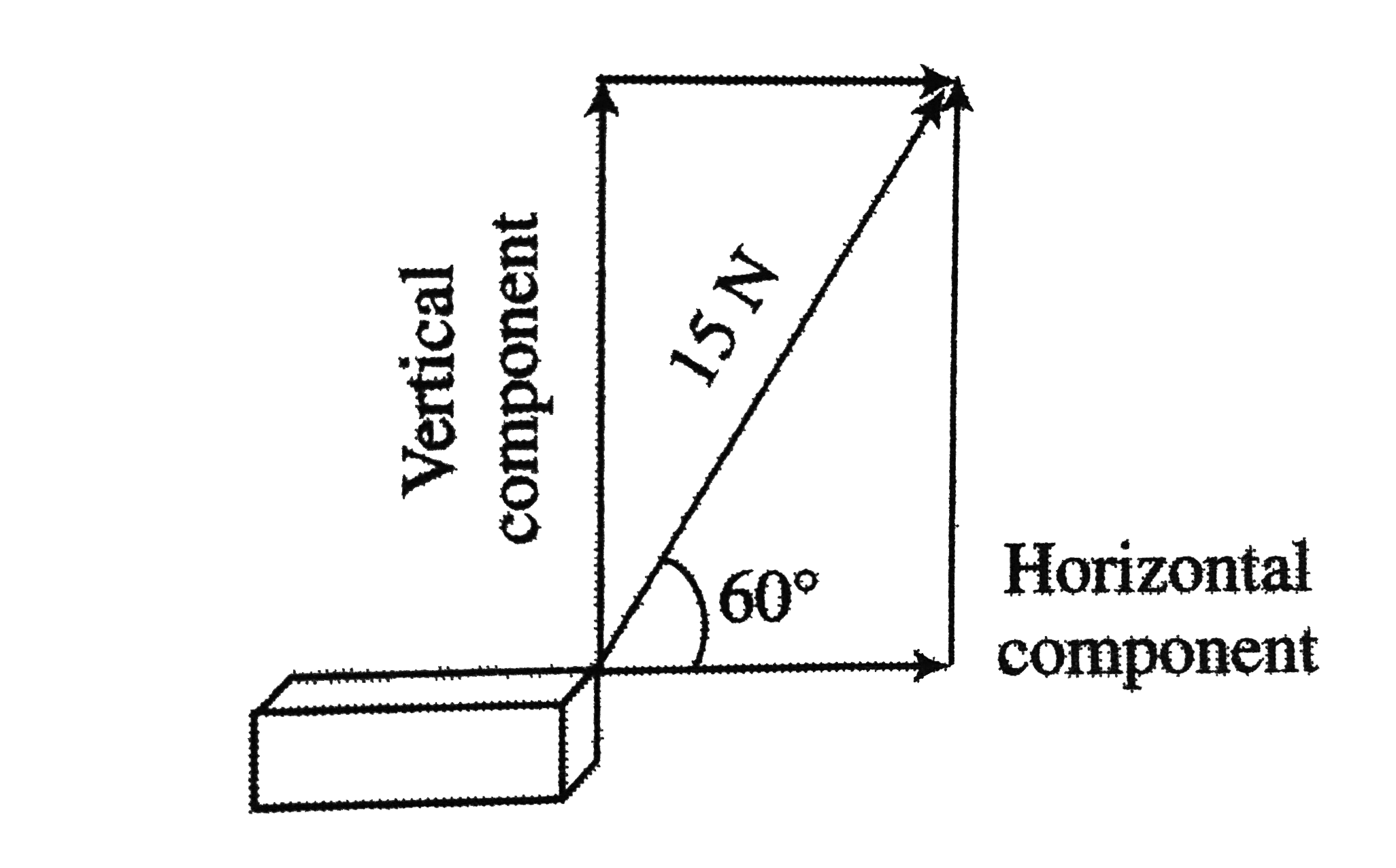
A force if `15N` acts on a box as shown in (figure).What are the horizontal component and vertical components of force?

Text Solution

Verified by Experts

Horizontal component`F_(x)=15cos60^(@)=7.5N`
Vertical component `F_(y)=15sin60^(@)=12.99N`.
Promotional Banner

Topper's Solved these Questions

  • VECTORS

    CENGAGE PHYSICS ENGLISH|Exercise Exercise 3.1|19 Videos
  • VECTORS

    CENGAGE PHYSICS ENGLISH|Exercise Exercise 3.2|13 Videos
  • TRAVELLING WAVES

    CENGAGE PHYSICS ENGLISH|Exercise Integer|9 Videos
  • WORK, POWER & ENERGY

    CENGAGE PHYSICS ENGLISH|Exercise Archives (integer)|4 Videos

Similar Questions

Explore conceptually related problems

A child pulls a box with a force of 200 N at an angle of 60^(@) above the horizontal. Then the horizontal and vertical components of the force are-

The horizontal beam in figure weighs 150 N , and its centre of gravity is at its centre. Find The horizontal and vertical components of the force exerted on the beam at the wall,

A force acts on a body at a certain angle with the horizontal such that the vertical component is twice the horizontal component . What is the inclination of the force ?

What is the angle of dip at a place where horizontal and vertical components of earth's field are equal?

What is the angle of dip at a place where the horizontal component (B_(H)) and vertical component (B_(v)) of earth.s magnetic field are equal:

A force F is acted on a body as shown in the figure. Find the impulse of the force in first four seconds.

A wedge of mass M resting on a horizontal frictionless surface is acted upon by a force F in the horizontal direction as shown in figure. Find the net horizontal force acting on the shaded portion of the wedge.

A wedge of mass M resting on a horizontal frictionless surface is acted upon by a force F in the horizontal direction as shown in figure. Find the net horizontal force acting on the shaded portion of the wedge.

Four forces are acting on a body as shown in figure. The magnitude of resultant of the forces is

A man pushes a cylinder of mass m_1 with the help of a plank of mass m_2 as shown in figure. There in no slipping at any contact. The horizontal component of the force applied by the man is F. (a) the acceleration fo the plank and the center of mass of the cylinder, and (b) the magnitudes and direction of frictional force at contact points.
