Home
Class 11
PHYSICS
A person in a wheelchair is moving up a ...

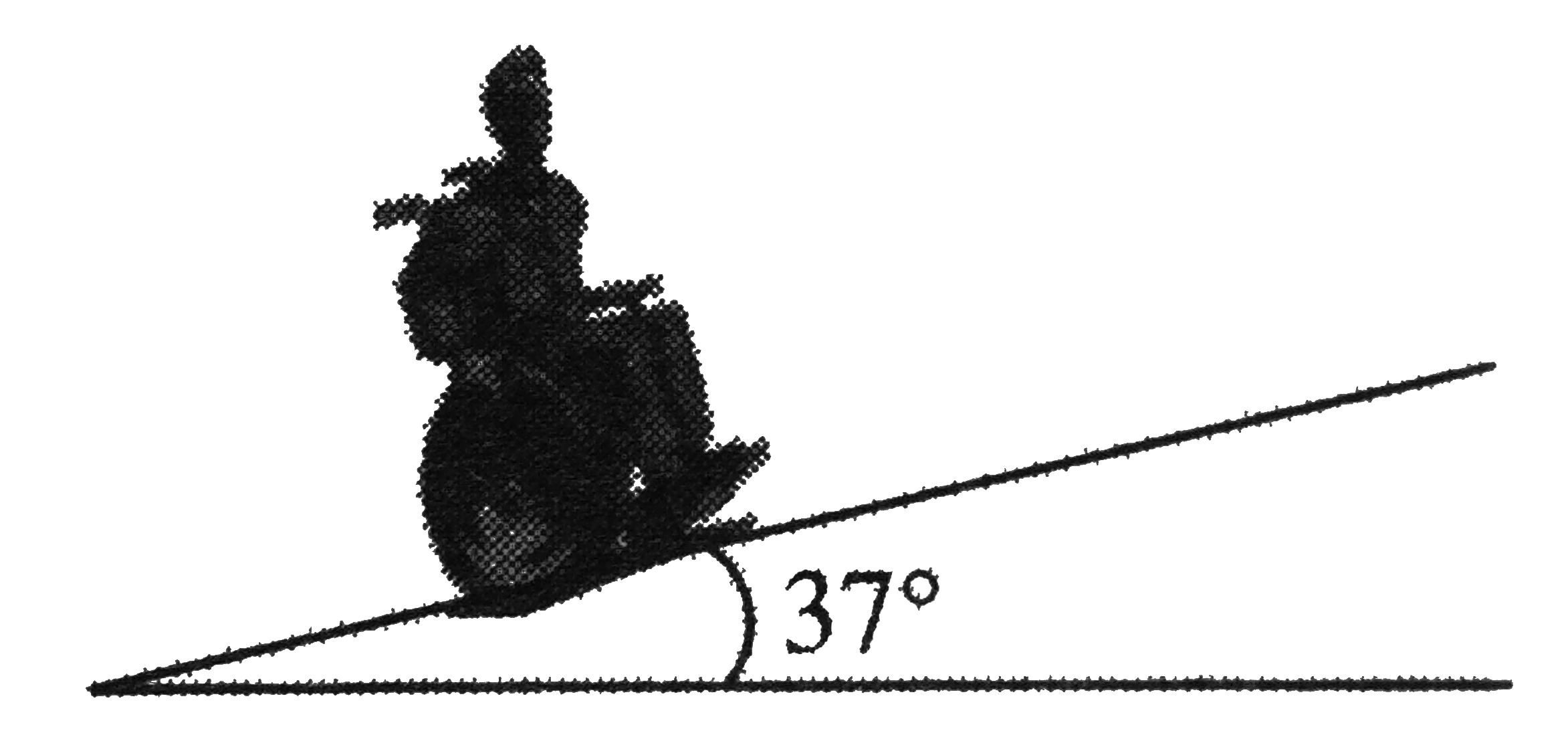
A person in a wheelchair is moving up a ramp at constant speed.Their total weight is `900N`. The ramp makes an angle of `37^(@)` with the horizontal. Calculate the component of its weight parallel and perpendicular to ramp.

Text Solution

Verified by Experts
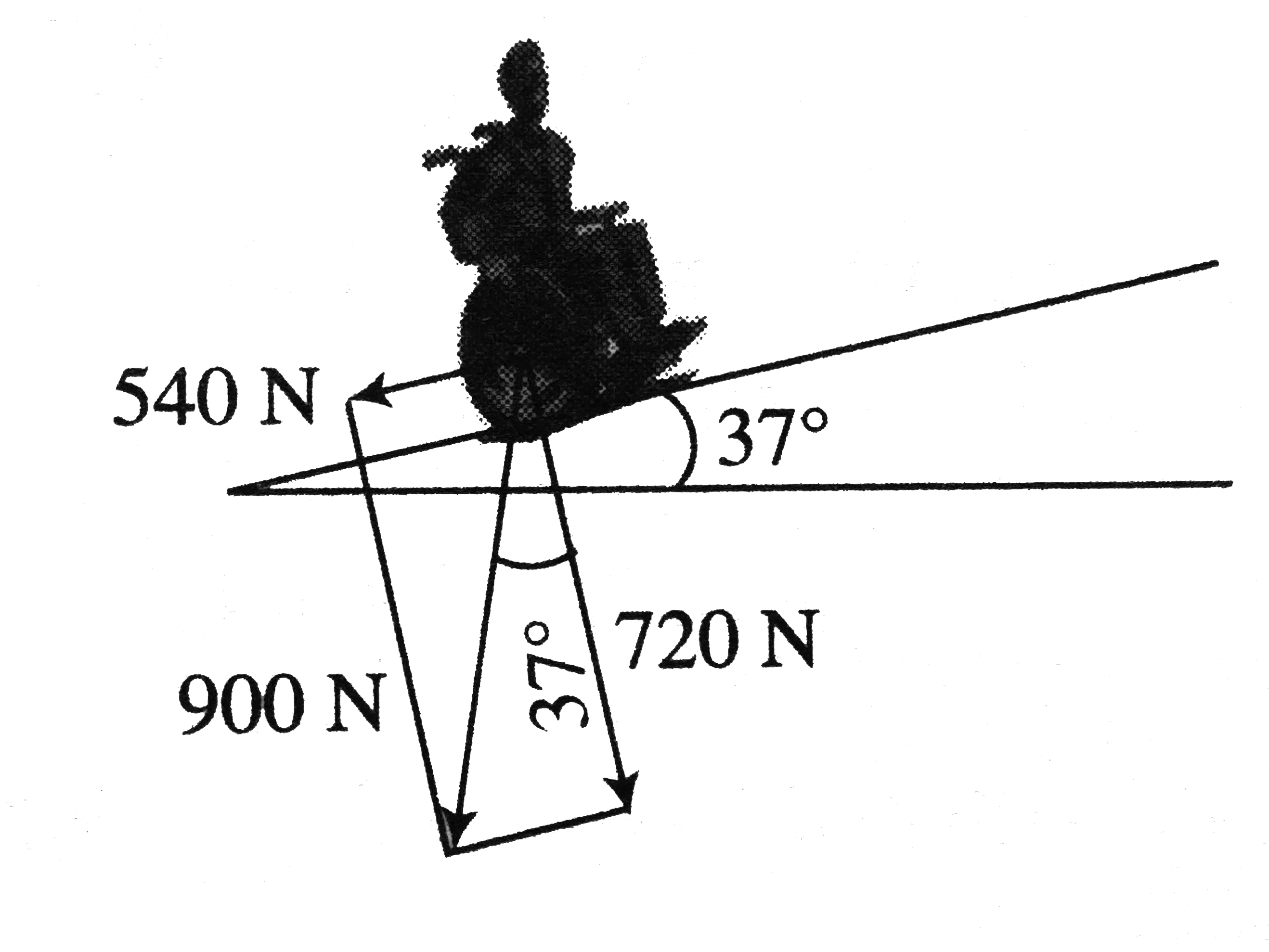
Component of weight parallel to ramp
`W_(||)=900 sin 37^(@)=540N`
Component of weight perpendicular to ramp
`W_(_|_)=900cos37^(@)=720N`

Promotional Banner

Topper's Solved these Questions

  • VECTORS

    CENGAGE PHYSICS ENGLISH|Exercise Exercise 3.1|19 Videos
  • VECTORS

    CENGAGE PHYSICS ENGLISH|Exercise Exercise 3.2|13 Videos
  • TRAVELLING WAVES

    CENGAGE PHYSICS ENGLISH|Exercise Integer|9 Videos
  • WORK, POWER & ENERGY

    CENGAGE PHYSICS ENGLISH|Exercise Archives (integer)|4 Videos

Similar Questions

Explore conceptually related problems

A car weighing 100kg is on a slope that makes an angle 30° with the horizontal. The component of car's weight parallel to the slope is (g =10ms^(-2))

A mass of 2 kg lies on a plane making an anged 30^(0) to the horizontal. Resolve its weight along and perpendicular to the plane. Assume g=10 ms^(-2) .

A block of weight 200N is pulled along a rough horizontal surface at constant speed by a force 100N acting at an angle 30^(@) above the horizontal. The coefficient of friction between the block and the surface is

When a man moves down the inclined plane with a constant speed 5 ms^-1 which makes an angle of 37^@ with the horizontal, he finds that the rain is falling vertically downward. When he moves up the same inclined plane with the same speed, he finds that the rain makes an angle theta = tan^-1 (7/8) with the horizontal. The speed of the rain is

A particle is prjected up an inclined with initial speed v=20m//s at an angle theta=30^(@) with the plane. The component of its velocity perpendicular to the plane when it strikes the plane is:

A particle is prjected up an inclined with initial speed v=20m//s at an angle theta=30^(@) with the plane. The component of its velocity perpendicular to the plane when it strikes the plane is:

On end of a light spring of natural length d and spring constant k is fixed on a rigid wall and the other is attached to a smooth ring of mass m which can slide without friction on a vertical rod fixed at a distance d from the wall. Initially the spring makes an angle of 37^@ with the horizontal. as shown in figure. When the system is released from rest, find the speed of the ring when the spring becomes horizontal. (sin 37^@=3/5) .

One end of a light spring of natural length d and spring constant k is fixed on a rigid wall and the other is attached to a smooth ring of mass m which can slide without friction on a vertical rod fixed at a distance d from the wall. Initially the spring makes an angle of 37^(@) with the horizontal as shown in fig. When the system is released from rest, find the speed of the ring when the spring becomes horizontal. [ sin 37^(@) = 3/5]

One end of a light spring of natural length 4m and spring constant 170 N/m is fixed on a rigid wall and the other is fixed to a smooth ring of mass (1)/(2) kg which can slide without friction in a verical rod fixed at a distance 4 m from the wall. Initially the spring makes an angle of 37^(@) with the horizontal as shown in figure. When the system is released from rest, find the speed of the ring when the spring becomes horizontal.

A man pushes a 80 N crate a distance of 5.0 m upward along a frictionless slope that makes an angle of 30^@ with the horizontal. The force he exerts is parallel to the slope. If the speed of the crate increases at a rate of 1.5 then the work done by the man is :

