Home
Class 11
PHYSICS
A bird flies due east through a distance...

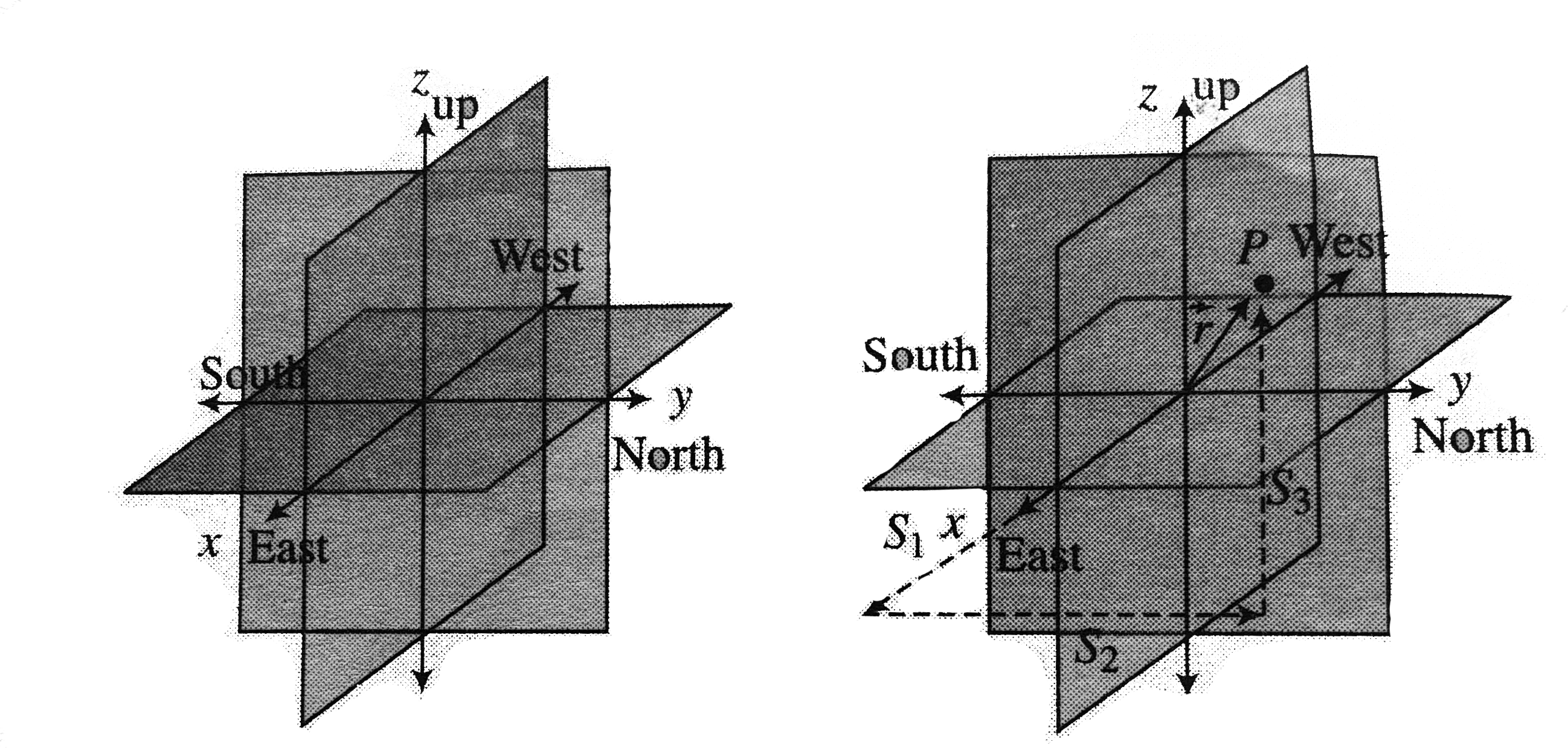
A bird flies due east through a distance of `100m`, then heading due north by a distance of `50m`, it flies vertically up through a distance of `20m`. Find the position of the bird relative to its initial position.

Text Solution

Verified by Experts

Displacement along east direction , `vec(s)_(1)=100hat(i)`
Displacement along north direction , `vec(s)_(2)=50hat(j)`
Displacement in upward direction, `vec(s)_(3)=20hat(k)`
The final position `vec(r )` of the bird is followed by three successive displacement `vec(s)_(1)`, `vec(s)_(2)` and `vec(s)_(3)`
`vec(r)=vec(s)_(3)+vec(s)_(3)+vec(s)_(3)=100 hat(i)+50 hat(j)+20 hat(k)`
Then , `|vec(r)|=sqrt(100^(2)+50^(2)+20^(2))=10sqrt(129)m`
Promotional Banner

Topper's Solved these Questions

  • VECTORS

    CENGAGE PHYSICS ENGLISH|Exercise Exercise 3.1|19 Videos
  • VECTORS

    CENGAGE PHYSICS ENGLISH|Exercise Exercise 3.2|13 Videos
  • TRAVELLING WAVES

    CENGAGE PHYSICS ENGLISH|Exercise Integer|9 Videos
  • WORK, POWER & ENERGY

    CENGAGE PHYSICS ENGLISH|Exercise Archives (integer)|4 Videos

Similar Questions

Explore conceptually related problems

A man carries a load of 5 kg on his head through a distance of 10 m. the minimum amount of work is done when he

A block slides on ice with a velocity of 5m//s comes to rest after moving through a distance of 13.5m . Find the coefficient of friction ?

A man goes 10m due east and then 24 m due north. Find the distance from the starting point.

A Body moves 6m north, 8m east and 10m vertically upwards, what is its resultant displacement from initial position

A man goes 10 m due east and than 24 m due north. Find the distance from the starting point.

A man carries a load on his head through a distance of 5 m. The maximum amount of work is done when he

A stone is dropped from the top of a tower of height 100 m. The stone penetrates in the sand on the ground through a distance of 2m. Calculate the retardation of the stone.

A car travles 6km towards north at an angle of 45^(@) to the east and then travles distance of 4km towards north at an angle of 135^(@) to east (figure). How far is the point from the starting point? What angle does the straight line joining its initial and final position makes with the east?

A car travles 6km towards north at an angle of 45^(@) to the east and then travles distance of 4km towards north at an angle of 135^(@) to east (figure). How far is the point from the starting point? What angle does the straight line joining its initial and final position makes with the east?

A person moves towards East for 3 m, then towards North for 4 m and then moves vertically up by 5 m. What is his distance now from the starting point ?
