Home
Class 11
PHYSICS
A truck travelling due to north at 20m s...

A truck travelling due to north at `20m s^(-1)` turns west and travels at the same speed. Find the change in its velocity.

Text Solution

Verified by Experts
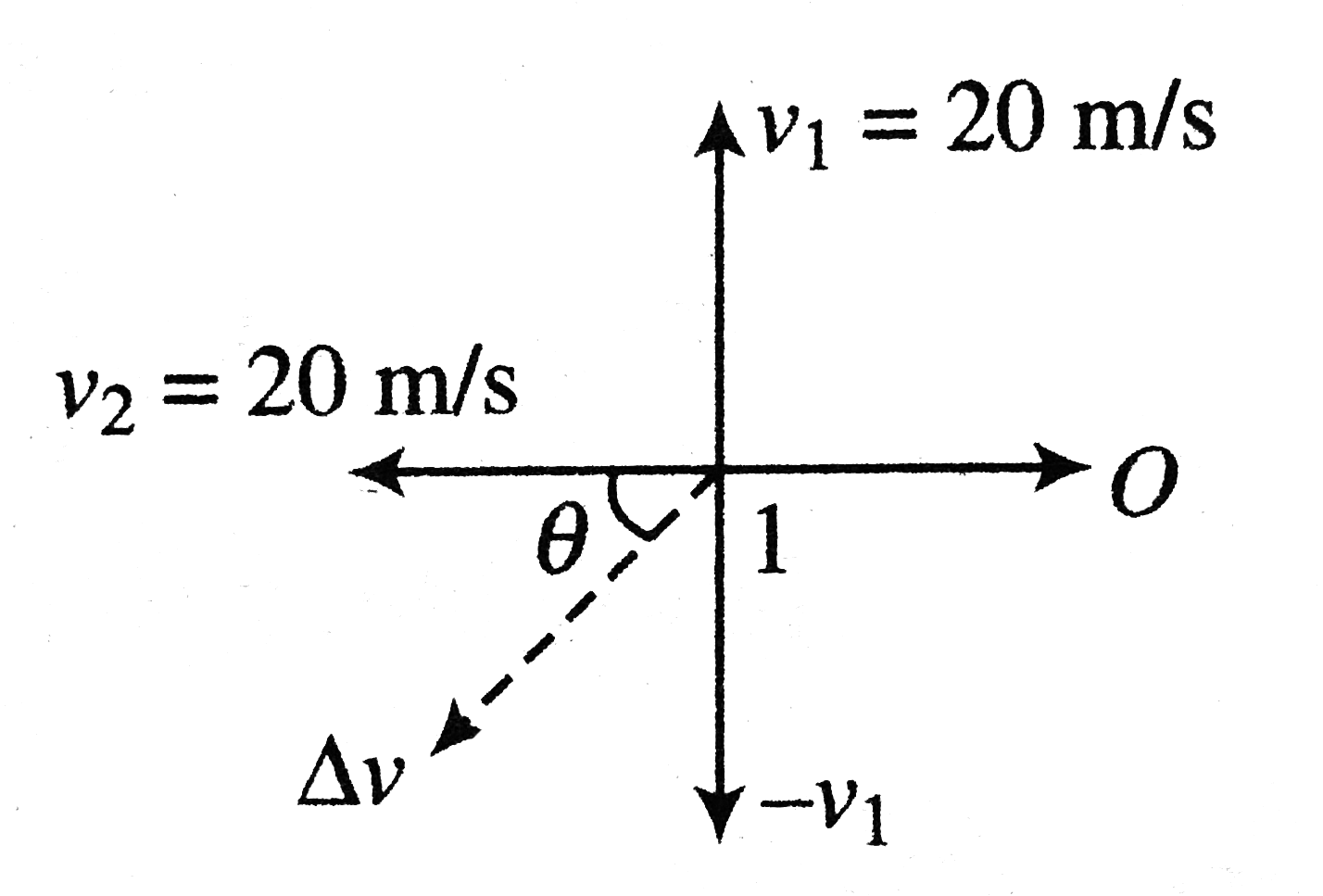
From (figure) `vec(v)_(1)=20hat(j)` and `vec(v)_(2)=-20hat(i)`.
`Deltavec(v)=vec(v)_(2)-vec(v)_(1)=-20(hat(i)+hat(j))`
`|Deltavec(v)=20sqrt(2)`
and dirction `theta^(-1)=45^(@)`,i.e.,S-W
Promotional Banner

Topper's Solved these Questions

  • VECTORS

    CENGAGE PHYSICS ENGLISH|Exercise Exercise 3.2|13 Videos
  • VECTORS

    CENGAGE PHYSICS ENGLISH|Exercise Exercise Subjective|28 Videos
  • VECTORS

    CENGAGE PHYSICS ENGLISH|Exercise Exercise Multiple Correct|5 Videos
  • TRAVELLING WAVES

    CENGAGE PHYSICS ENGLISH|Exercise Integer|9 Videos
  • WORK, POWER & ENERGY

    CENGAGE PHYSICS ENGLISH|Exercise Archives (integer)|4 Videos

Similar Questions

Explore conceptually related problems

A truck travelling due North at 50 km h^(-1) turns West and travels at the same speed. What is the change in velocity ?

A truck travelling due north at 20 m/s turns east and travels at the same speed. What is the change in velocity :

A motor car is going due north at a speed of 50 km/h. It makes a 90^0 left turn without changing the speed. The change in the velocity of the car is about

A car travels with a uniform velocity of 20 m s^(-1) for 5 s. The brakes are then applied and the car is uniformly retarded. It comes to rest in further 8 s. Draw a graph of velocity against time. Use this graph to find : (i) the distance travelled in first 5 s, (ii) the distance travelled after the brakes are applied, (iii) total distance travelled, and (iv) acceleration during the first 5 s and last 8 s.

A car travels due east on a level road for 30 km . It then turns due north at an intersection and travels 40 km before stopping. Find the resultant displacement of the car.

A car travels with a uniform velocity of 25 m s^(-1) for 5 s. The brakes are then applied and the car is uniformly retarded and comes to rest in further 10 s. Find : (i) the distance which the car travels before the brakes are applied, (ii) the retardation,and (iii) the distance travelled by the car after applying the brakes.

A car moving at a constant speed of 36kmph moves north wards for 20 minutes then due to west with the same speed for 8 minutes. What is the average velocity of the car during this run in kmph

A bird files due north at velocity 20 ms^(-1) for 15s it rests for 5s and then files due south at velocity 24 ms^(-1) for 10s. For the whole trip find the average speed and magnitude of average velocity

A boat is travelling with a speed of "27 km h"^(-1) due east. An observer is situated at 30 m south of the line of travel. The angular velocity of the boat relative to be the observer in the position shown will be

A train, travelling at a uniform speed for 360 km, would have taken 48 minutes less to travel the same distance if its speed were 5 km/h more. Find the original speed of the train.

CENGAGE PHYSICS ENGLISH-VECTORS-Exercise 3.1
  1. A car travles 6km towards north at an angle of 45^(@) to the east and ...

    Text Solution

    |

  2. There are two forces vector,one of 5N and other of 2N. At what angle s...

    Text Solution

    |

  3. Given that vec(A)+vec(B)+vec(C )=vec(0). Out of three vectors, two are...

    Text Solution

    |

  4. If vec(A)=4hat(i)-3hat(j) and vec(B)=6hat(i)+8hat(j),then find the mag...

    Text Solution

    |

  5. A truck travelling due to north at 20m s^(-1) turns west and travels a...

    Text Solution

    |

  6. If the sum of two unit vectors is a unit vector, then the magnitude of...

    Text Solution

    |

  7. The sum of the magnitudes of wto forces acting at a point is 18 and th...

    Text Solution

    |

  8. Two forces F(1)=1N and F(2)=2N act along the lines x=0 and y=0, respec...

    Text Solution

    |

  9. Let vec(A)=2hat(i)+hat(j),B=3hat(j)-hat(k) and vec(C )=6hat(i)-2hat(k)...

    Text Solution

    |

  10. A vector vec(a) is turned without a change in its length through a sma...

    Text Solution

    |

  11. An object of m kg with speed of v m s^(-1) strikes a wall at an angle ...

    Text Solution

    |

  12. If A=3hat(i)+4hat(j) and B=7hat(i)+24hat(j),find the vector having the...

    Text Solution

    |

  13. Vector vec(A) makes equal angles with x-,y-,and z-axis. Find the value...

    Text Solution

    |

  14. Find the vector that must be added to the vector hat(i)-3hat(j)+2hat(k...

    Text Solution

    |

  15. At what angle should the forces 2P and sqrt(2) act so that the resulta...

    Text Solution

    |

  16. Two forces, while acting on particle in opposite directions,have the r...

    Text Solution

    |

  17. Two forces each equal to F//2 act at right angle. Their effect may be ...

    Text Solution

    |

  18. The resultant of two forces has magnitude 20N. One of the forces is of...

    Text Solution

    |

  19. The resultant of vec(P) and vec(Q) is vec(R). If vec(Q) is doubled, ve...

    Text Solution

    |

