Home
Class 11
PHYSICS
A particle moving with uniform accelerat...

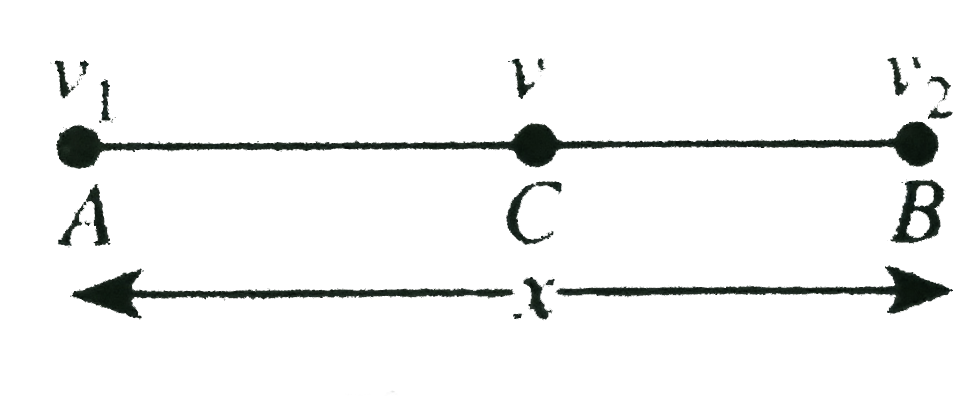
A particle moving with uniform acceleration from `A` to `B` along a straight line has velcities `v_(1)` and `v_(2)` at `A` and `B` respectively. If `C` is the mid-point between `A` and `B` then determine the velocity of the particle at `C` .
.

Text Solution

Verified by Experts

Let `v` be the velocity of the particle at `c`. Assume the acceleration of the particle to be `A` and distance between `A` and `B` be `x`. To find the velocity `c`, consider the motion from `A`and `C`:
Applying `v^(2)-u^(2)=2` as, we get `v^(2)-v_(1)^(2)=2a(x)/(2)`
`rArr v^(2)-v_(1)^(2)=ax`........ (i)
Appying the same equation from `C` to `B`. we get`
`V_(2)^(2)=2a(x)/(2) rArr v_(2)^(2)-v^(2)=ax` ......(ii)
From (i) and (ii), we get `v=sqrt(v_(1)^(2)+v_(2)^(2))/(2)`.
Promotional Banner

Topper's Solved these Questions

  • KINEMATICS-1

    CENGAGE PHYSICS ENGLISH|Exercise Solved Examples|9 Videos
  • KINEMATICS-1

    CENGAGE PHYSICS ENGLISH|Exercise Exercise 4.1|17 Videos
  • GRAVITATION

    CENGAGE PHYSICS ENGLISH|Exercise INTEGER_TYPE|1 Videos
  • KINEMATICS-2

    CENGAGE PHYSICS ENGLISH|Exercise Exercise Integer|9 Videos

Similar Questions

Explore conceptually related problems

A point moving with constant acceleration from A to B in the straight line AB has velocities u and v at A and B respectively. Find its velocity at C, the mid point of AB. Also show that if the time from A to C is twice that from C to B, then v =7 u .

A body is moving with constant acceleration, a= 5 m/s^2 from A to B in straight line AB. The velocity of particle at A and B are 5 m/s and 15 m/s respectively. The velocity at mid-point of AB is

A particle moving with a uniform acceleration along a straight line covers distances a and b in successive intervals of p and q second. The acceleration of the particle is

For a body moving with uniform acceleration along straight line, the variation of its velocity (v) with position (x) is best represented by

A particle is executing SHM along a straight line. Its velocities at distances x_(1) and x_(2) from the mean position are v_(1) and v_(2) , respectively. Its time period is

A particle is executing SHM along a straight line. Its velocities at distances x_(1) and x_(2) from the mean position are v_(1) and v_(2) , respectively. Its time period is

A particle moving along a straight line with uniform acceleration has velocities 7 m//s at A and 17 m//s at C. B is the mid point of AC. Then :-

A particle, moving with uniform acceleration along a straight line ABC, crosses point A at t = 0 with a velocity 12 m/s. B is 40 m from A and C is 64 m from A. The particle passes B at t = 4 s. (a) At what time, will the particle be C? (b) What is its velocity at C?

A particle starts from point A moves along a straight line path with an acceleration given by a = p - qx where p, q are connected and x is distance from point A . The particle stops at point B. The maximum velocity of the particle is

A particle moving with uniform acceleration along a straight line ABC rosses point A at t=0 with a velocity 12 m s^(-1) .B is 40 m away from A and C is 64 m away from A . The particle passes B at t=4 s . a. After what time will the particle be at C ? b. What is its velocity at C ? c. What does the particle reach A again? d. Locate the point where the particle reverses its direction of motion. e. Find the distance covered by the particle in the first 15 s .

