Home
Class 11
PHYSICS
On a two lane road, car A is travelling ...

On a two lane road, car A is travelling with a speed of `36 km h^(-1)`. Two cars B and C approach car A in opposite directions with a speed of `54 km h^(-1)` each. At a certain instant, when the distance AB is equal to AC, both being 1 km, B decides to overtake A before C does. What minimum acceleration of car B is required to avoid an accident?

Text Solution

Verified by Experts
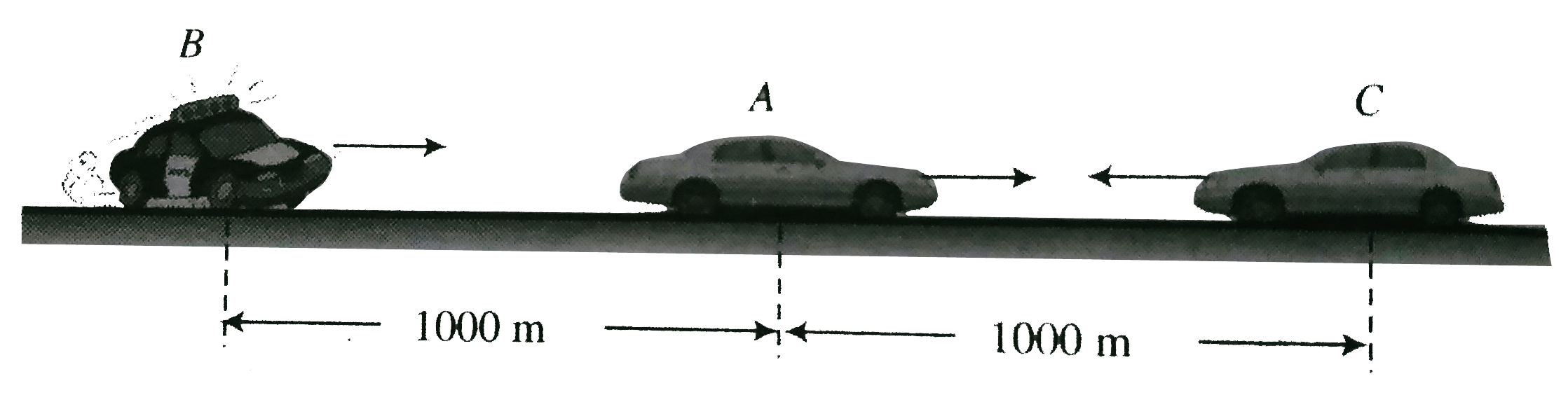
At the instant when car `B` decides to overtake car `A`, the velocities of cars are:
`v_(A) =36xx(5)/(18)=10 m s^(-1)`
`v_(B)=54xx(5)/(18)=15 m sw^(-1)`
and `v_(C)=-54xx(5)/(18)=-15 m s^(-1)`
.
velocity of car `B` relative to `A`,
`vec v_(BA)=vec v_(B) -vec v_(A) =15-10=5 m s^(-1)`
Velocity of car `C` relative to `A`,
`vec v_(CA)=vec v_(c) -vec v_(A) =15-10=25 m s^(-1)`
Time required by car `C` to just cross `A`
`=(1000)/((CA)=(1000)/(25)=40 S`
In order to avoid accident, car `B` must overtake `A` in this time.
So
`1000=v_(BA)t+(1)/(2)a_(BA)t^(2)`
`1000=x 40+(1)/(2) a_(BA)xx 40^(2)`
`a_(BA)=1 m s^(-2)`
Thus, the minimum acceleration that car `B` requires to avoid an.
Promotional Banner

Topper's Solved these Questions

  • KINEMATICS-1

    CENGAGE PHYSICS ENGLISH|Exercise Solved Examples|9 Videos
  • KINEMATICS-1

    CENGAGE PHYSICS ENGLISH|Exercise Exercise 4.1|17 Videos
  • GRAVITATION

    CENGAGE PHYSICS ENGLISH|Exercise INTEGER_TYPE|1 Videos
  • KINEMATICS-2

    CENGAGE PHYSICS ENGLISH|Exercise Exercise Integer|9 Videos

Similar Questions

Explore conceptually related problems

On a two lane road , car (A) is travelling with a speed of 36 km h^(-1) . Tho car B and C approach car (A) in opposite directions with a speed of 54 km h^(-1) each . At a certain instant , when the distance (AB) is equal to (AC), both being 1 km, (B) decides to overtake A before C does , What minimum accelration of car (B) is required to avoid and accident.

On a two lane road , car (A) is travelling with a speed of 36 km h^(-1) . Tho car B and C approach car (A) in opposite directions with a speed of 54 km h^(-1) each . At a certain instant , when the distance (AB) is equal to (AC), both being 1 km, (B) decides to overtake A before C does , What minimum accelration of car (B) is required to avoid and accident.

A car is travelling at a speed of 45 km /hr. How for will it travel in 48 mintues ?

A car is running at a speed of 15 km h^(-1) while another Similar car is moving at a speed of 45 km h^(-1) . Find the ratio of their kinetic energies.

A car is moving in a straight line with speed 18 km h^(-1) . It is stopped in 5 s by applying the brakes. Find the speed of car in m s^(-1) .

A car travels for 20 min with a constant speed of 54 km h^(-1) Find the distance travelled by the car.

A car travels with speed 30 km h^(-1) for 30 minutes and then with speed 40 km h^(-1) for one hour. Find the average speed of car

A car is moving towards east with a speed of 25 km h^-1 . To the driver of the car, a bus appears to move towards north with a speed of 25 sqrt(3) km h^-1 . What is the actual velocity of the bus ?

A car travels 100 km with a speed of 50 km h^(-1) and another 200 km with a speed of 20 km h^(-1)~ . Is the motion uniform ? Find the average speed of the car.

A car travels with speed 30 km h^(-1) for 30 minutes and then with speed 40 km h^(-1) for one hour. Find the total distance travelled by the car

