Home
Class 11
PHYSICS
Two particles A and B are thown vertical...

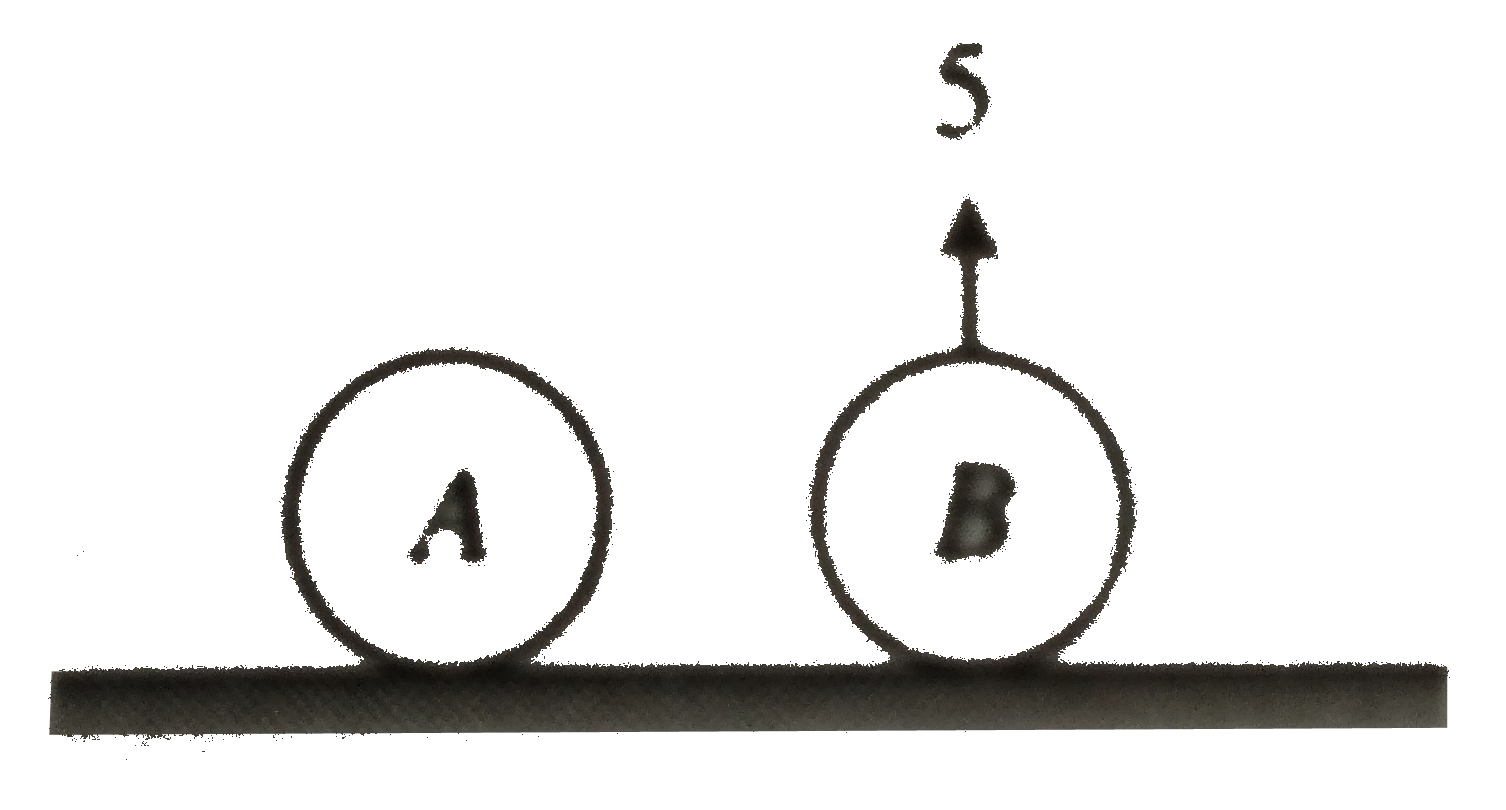
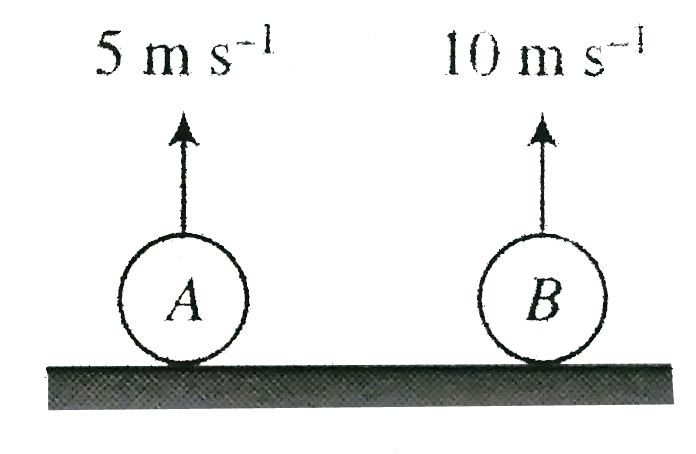
Two particles `A` and `B` are thown vertically upward with velocity, vertically upward with velocity, `5 m s^(-1)` and `10 m s^(-1)` respectively (g=10 m s^(-2)), Find separation between them after `1 s`.
.

Text Solution

Verified by Experts

Method -1: Position of `A` aftre `1` s
`Sa_(A)=ut-(1)/(2) g t^(2)`
`=5t-(1)/(2) xx10xx t^(2)=5xx1-5xx1^(2)=5-5=0`
i.e., the particle will return to ground at `t=1 s`
`S_(B)=ut-(1)/(2) g t^(2)=10xx1-(1)/(2)xx10xx1^(2)=10-5=5 m`
Hence, separation between `A` and `B`, `S_(B)-S_(A)=5 m`
Method-2: Relative velocity method:
`vec a_(BA)=vec v_(A)=10-5=5 m s^(-1)`
Hence, relative separation between particles
`becuase vec s_(BA) (in 1 s)=vec v_(BA)xxt=5xx1=5 m`
becuase Distance between `A` and `B` after `1 s =5 m`.
.
Promotional Banner

Topper's Solved these Questions

  • KINEMATICS-1

    CENGAGE PHYSICS ENGLISH|Exercise Solved Examples|9 Videos
  • KINEMATICS-1

    CENGAGE PHYSICS ENGLISH|Exercise Exercise 4.1|17 Videos
  • GRAVITATION

    CENGAGE PHYSICS ENGLISH|Exercise INTEGER_TYPE|1 Videos
  • KINEMATICS-2

    CENGAGE PHYSICS ENGLISH|Exercise Exercise Integer|9 Videos

Similar Questions

Explore conceptually related problems

A and B are thrown vertivally upward with velocity 5m/s and 10 m/s respectively (g=10 m//s^2 ) . Find separtion between them after one second .

A pebble thrown vertically upwards with an initial velocity 50 m s^(-1) comes to a stop in 5 s. Find the retardation.

Two particles are located on a horizontal plane at a distance 60 m . At t = 0 both the particles are simultaneously projected at angle 45^@ with velocities 2 ms^-1 and 14 m s^-1 , respectively. Find (a) Minimum separation between them during motion. (b) At what time is the separation between them minimum ? .

Light travels in two media A and B with speeds 1.8 × 10^(8) m s^(–1) and2.4 × 10^(8) m s^(–1) respectively. Then the critical angle between them is

Find the maximum height reached by a particle which is thrown vertically upwards with the velocity of 20 m//s (take g= 10 m//s^(2) ).

A particle is thrown vertically upward. Its velocity at half of the height is 10 m/s. Then the maximum height attained by it : - (g=10 m//s^2)

A pebble is thrown vertically upwards with a speed of 20 m s^(-1) . How high will it be after 2 s? (Take g = 10 m s^(-2) )

A ball is thrown vertically upward with a velocity of 20 m/s. Calculate the maximum height attain by the ball.

An object is thrwon vertically upwards with a velocity of 60 m/s. After what time it strike the ground ? Use g=10m//s^(2) .

A ball is thrown vertically upwards. It returns 6 s later. Calculate the initial velocity of the ball. (Take g = 10 "m s"^(-2) )