Home
Class 11
PHYSICS
A particle moves aling x-axis with an in...

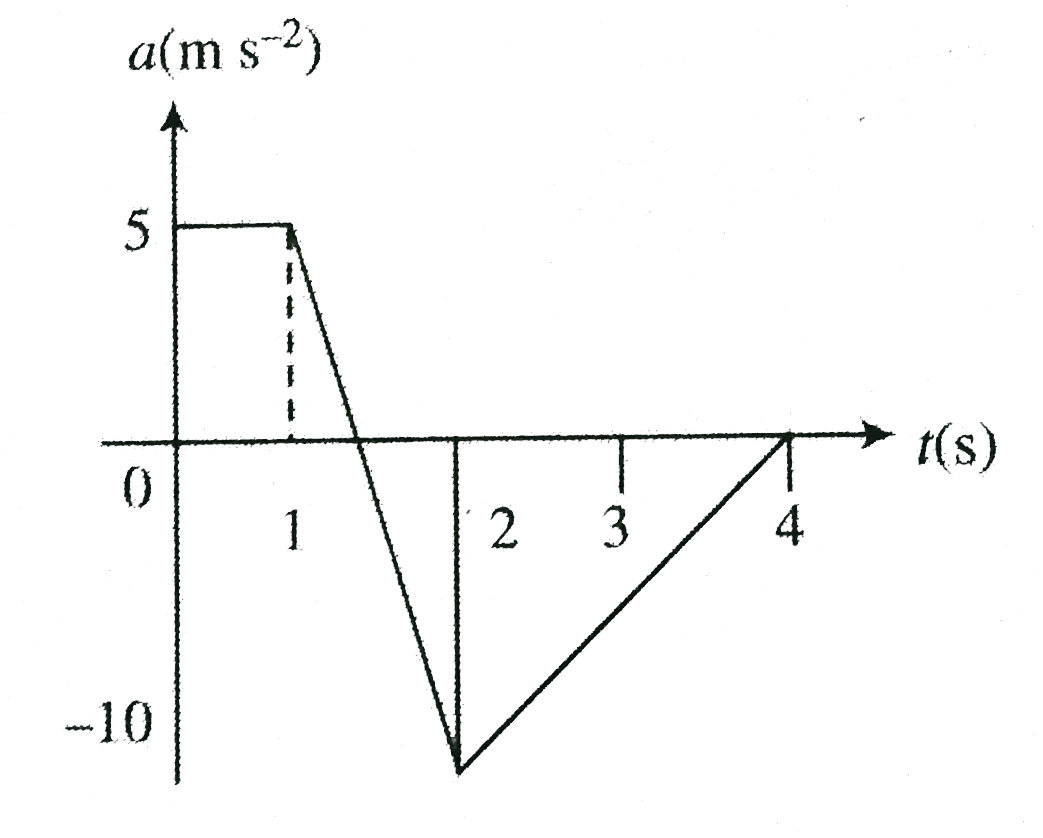
A particle moves aling x-axis with an initial speed `v_(0)=5 m s^(-1)`. If its acceleration varies with with time asshown in `a-t` graph in .
.
a. Find the time when the particle starts moving along - x direction

Text Solution

Verified by Experts

The velocity of the particle at `t=4 s` can given as
`vec v4=vec v_(0)+Delta vec v` …(i)
where ` Delta vec v-=A`
(=area under `a-t` graaph during four seconds )
Referring to `a-t` graph , we have
`A=A_(1) +A_(2)-A_(3)-A_(4)` ....(ii)
where `A_(1)=5xx1=5,A_(2) =(1)/(2) xx x xx5`,
`A_(3)=(1)/(2)xx(-1-x)xx10`, and `A_(4)=(1)/(2)xx2xx10=10`
We can find `x` as following:
Using properties of similar triangles, we have `(x)/(5)=(1-x)/(10)`
This yields `x=(1)/(2)`.
.
Substituting `x=(1)/(2) in A_(2) =(1)/(2)xx x xx5`
and `A_(3)=(1)/(2)(1-x)xx10`,
we have `A_(2) =-(5)/(6)` and `A_(3)=(10)/(3)`.
Then substitution `A_(1),A_(2),A_(3),` and `A_(4)` in (ii), we have `A=-7.5.`
Negative area tells us that change in velcity is along `-x` direction
`Delta vec v =-7.5 m s^(-1)`
Hence, substituting (i),
`vec v_(0)=5 m s^(-1)` and `Delta vec v=-7.5m s^(-1)`,
we have
`vec v _(4)=vec v_(0)+ Delta vec v=5-7.5=-2.5 m s^(-1)`.
Promotional Banner

Topper's Solved these Questions

  • KINEMATICS-1

    CENGAGE PHYSICS ENGLISH|Exercise Solved Examples|9 Videos
  • KINEMATICS-1

    CENGAGE PHYSICS ENGLISH|Exercise Exercise 4.1|17 Videos
  • GRAVITATION

    CENGAGE PHYSICS ENGLISH|Exercise INTEGER_TYPE|1 Videos
  • KINEMATICS-2

    CENGAGE PHYSICS ENGLISH|Exercise Exercise Integer|9 Videos

Similar Questions

Explore conceptually related problems

A particle moves vertically with an upwards initial speed v_0 = 10.5 ms^(-1). If its acceleration varies with time as shown in a-t graph in figure, find the velocity of the particles at t = 4s.

The position of a particle moving along x-axis varies eith time t as x=4t-t^(2)+1 . Find the time interval(s) during which the particle is moving along positive x-direction.

The fig. shows the v-t graph of a particle moving in straight line. Find the time when particle returns to the starting point.

A particle starts moving in a circular path of radius R with an initial speed v_(0) clockwise. If the angular acceleration is alpha rad//s^(2) anticlockwise, the time when the acceleration and the velocity vectors of the particle become parallel, is

A particle moves along x - axis in such a way that its x - co - ordinate varies with time according to the equation x=4-2t+t^(2) . The speed of the particle will vary with time as

A particle starts from rest. Its acceleration at time t=0 is 5 m//s^(2) which varies with time as shown in the figure. The maximum speed of the particle will be

A particle moves along X-axis in such a way that its coordinate X varies with time t according to the equation x = (2-5t +6t^(2))m . The initial velocity of the particle is

Velocity of particle moving along positive x-direction is v = (40-10t)m//s . Here,t is in seconds. At time t=0, tha x coordinate of particle is zero. Find the time when the particle is at a distance of 60 m from origin.

A particle moves along x-axis such that its position veries with time as x=50t-5t^2 . Select the correct alternative (s).

A particle move a distance x in time t according to equation x = (t + 5)^-1 . The acceleration of particle is alphaortional to.

