Home
Class 11
PHYSICS
A car starts moving rectilinearly first ...

A car starts moving rectilinearly first with acceleration `alpha=5 m s^(-2)` (the initial velocity is equal to zero), then uniformly, and finally, deceleration at the same rate `alpha` comea to a stop. The time of motion equals `t=25 s`. The average velocity during this time is equal to `
`=72 km h^(-1)` How long does the car move unitromly?

Text Solution

Verified by Experts
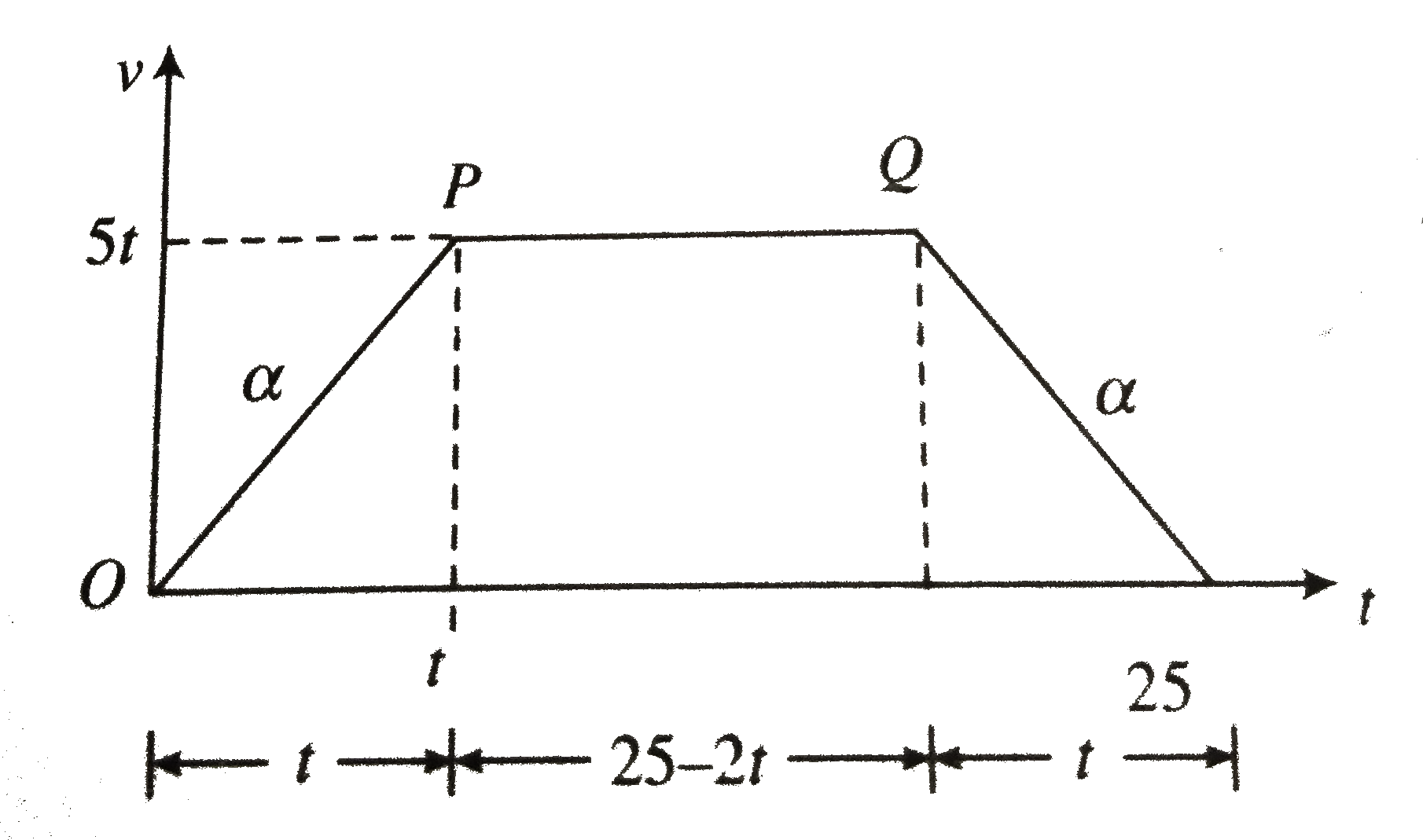
Let `t` be the time up to which the car accelerates or decelerates. The maximum velocity attained in this duration is `5_(t)`, The time upto which car moves uniformly`=25-2t`. The velocity-tme graph of the motion of car is drawn as shown as shown in
.
Given the average velocity is whole time of motion
`v_(av)=(72xx5)/(18)=20 m s^(-1)`
The average velocity from the graph can obtained as
`v_(av)=(Total displacement )/(Total time)`
`20=((1)/(2)xx[25+(25-2t)]xx5t)]xx5t)/(25)`=((1)/(2)xx[50-2t)]xx5t)/(25)`
`200=50 t-2t^(2)`
`rArr t^(2)-25t+100=0`
`rArr (t-20) (t-5) =0 rArrt=5 s` or `20 s`
But `t=20 s` is not possible .
Hence, `t=5 s`
The time up to which car moves uniformly
`=25-2t=25- 2xx5=15 s`.
Promotional Banner

Topper's Solved these Questions

  • KINEMATICS-1

    CENGAGE PHYSICS ENGLISH|Exercise Solved Examples|9 Videos
  • KINEMATICS-1

    CENGAGE PHYSICS ENGLISH|Exercise Exercise 4.1|17 Videos
  • GRAVITATION

    CENGAGE PHYSICS ENGLISH|Exercise INTEGER_TYPE|1 Videos
  • KINEMATICS-2

    CENGAGE PHYSICS ENGLISH|Exercise Exercise Integer|9 Videos

Similar Questions

Explore conceptually related problems

A car starts moving along a line, first with acceleration a=5 ms^(-2) starting from rest then uniformly and finally decelerating at the same rate a, comes to rest.The total time of motion is tau=25 s . The average velocity during the time is equal to lt v gt =72 km/hr.How long does the partial move uniformly ?

A car starts moving along a line, first with acceleration a=5m//s^(2) starting from rest then uniformly and finally decelerating at the same rate till it comes to rest. The total time of motion is 25s . The average speed during the time is 20m//s . The particle moves uniformly for (2.5x) second. Find the value of x .

A ball starts moving in a circular slot with angular acceleration alpha = 2 rad //s^2 at t=0 The angle between its velocity and acceleration varies with time as

A car starts from rest, attain a velocity of 36 km h^(-1) with an acceleration of 0.2 m s^(-2) , travels 9 km with this uniform velocity and then comes to halt with a uniform deaceleration of 0.1 m s^(-2) . The total time of travel of the car is

A body starts from rest and travels a distance S with unitorm acceleration, then moves uniformly a distance 2S uniformly , and finally cones to rest after moving further 5S under uniform retardation. The ratio of the average velocity to maximum velocity is.

The velocity-time graph of a particle moving along a straight line is shown is . The rate of acceleration and deceleration is constant and it is equal to 5 m s^(-2) . If the a average velocity during the motion is 20 m s^(-1) , Then . The value of t is.

A car initially at rest starts moving with a constant acceleration of 0.5 m s^(-2) and travels a distance of 25 m. Find : (i) its final velocity and (ii) the time taken.

A cockroach moves rectilinearly such that after sometime t_(0) let its (instantaneous) velocity be equal to its average velocity over that time. Referring to the S Delta t graph as shown in , for the motion of the cockroach, find the time t_(0) and the average velocity of the cockroach over the time t_(0) .

A car moves in a straight line, the car accelerates from rest with a constant acceleraation alpha on a straight foad. After gaining a velocity v , the car moves with that velocity for somerime. Then car decelerates with a retardation beta , If the total distance covered by the car is equal to s find the total time of its motion.

The velocity-time graph of a particle moving along a straight line is shown is Fing. The rate of acceleration and deceleration is constant and it is equal to 5 m s^(-2) . If the a average velocity during the motion is 20 m s^(-1) , Then . The distace travelled with uniform velcoty is .

