Home
Class 11
PHYSICS
A hot-air balloonist, rising vertically ...

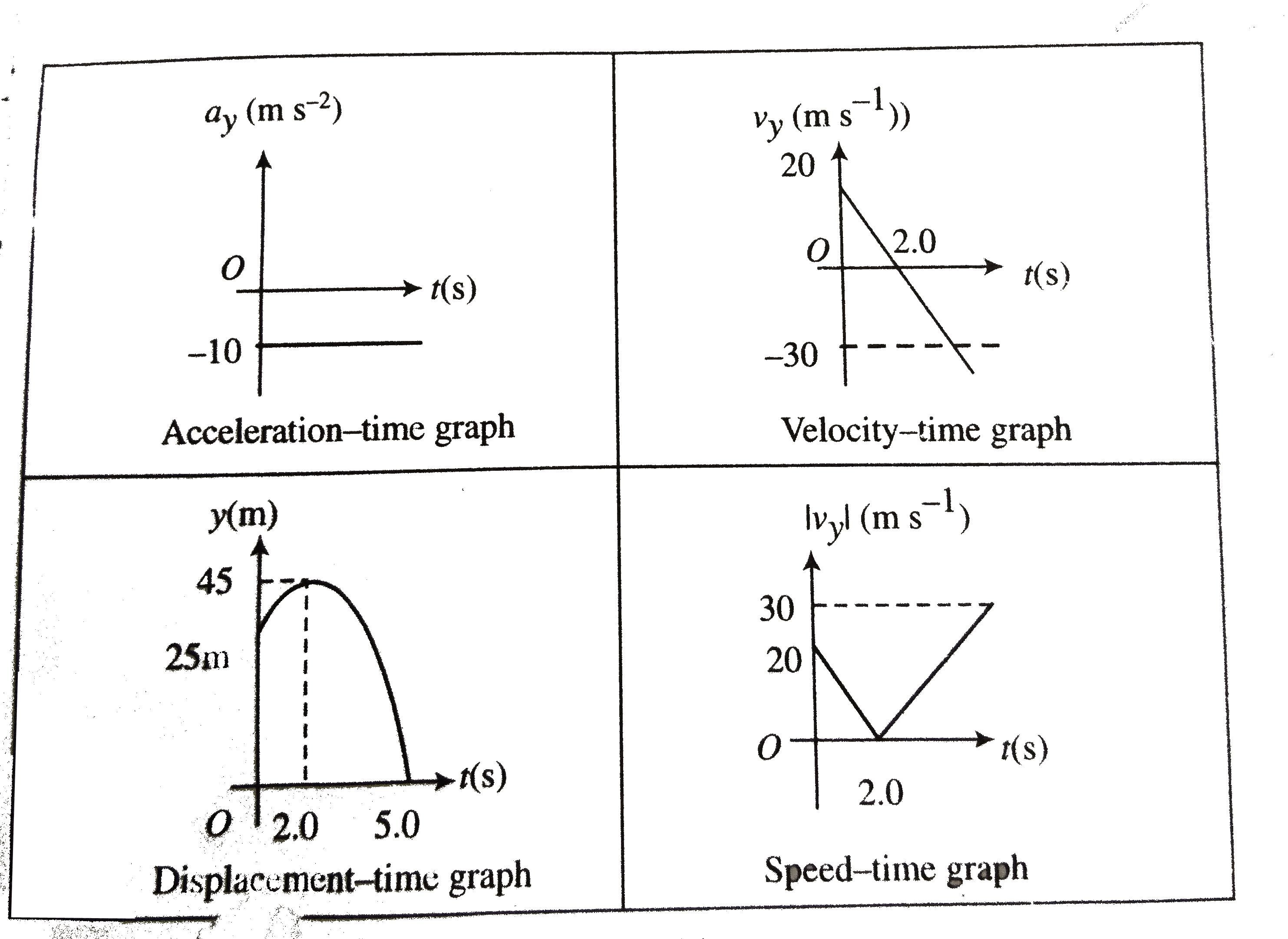
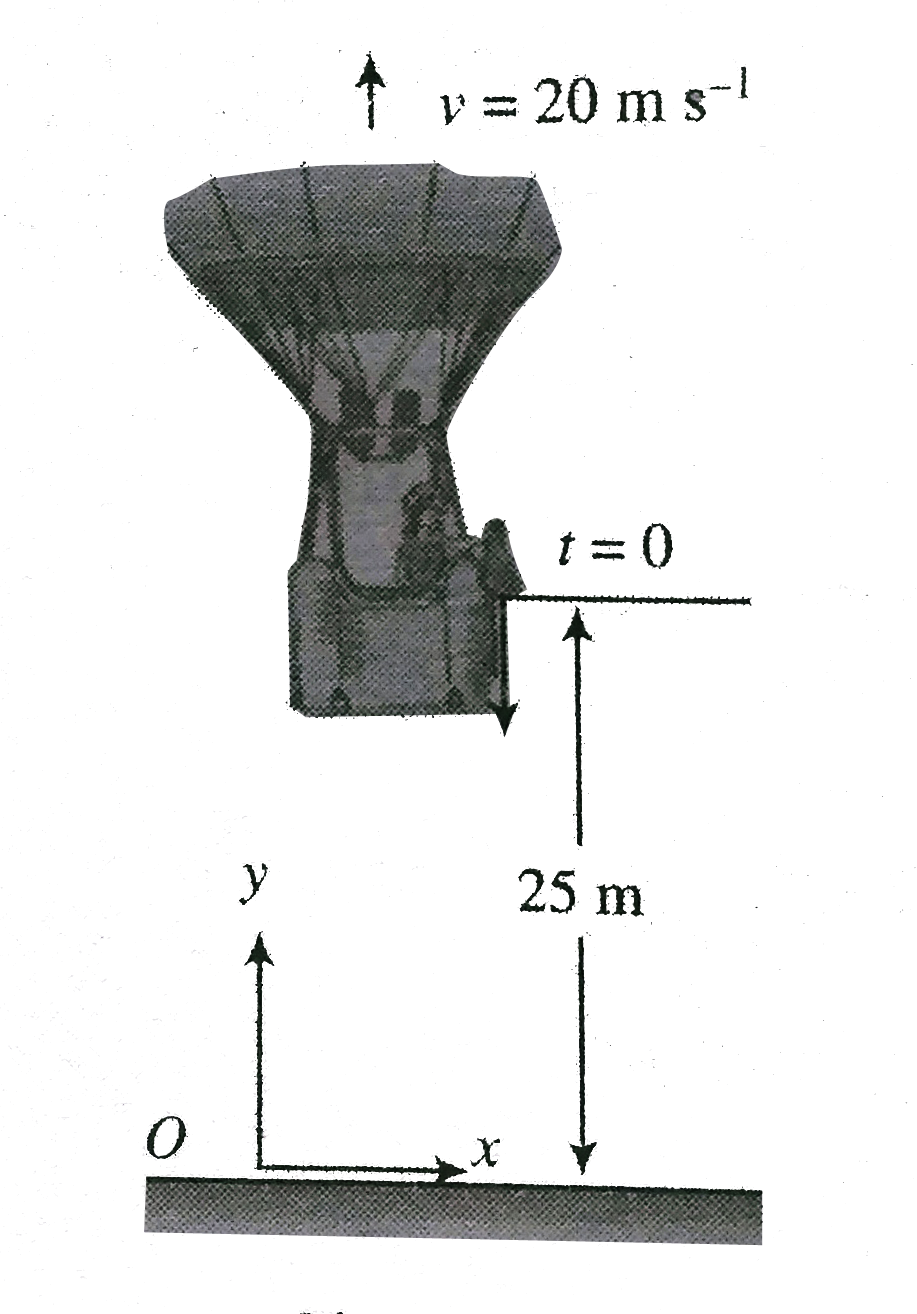
A hot-air balloonist, rising vertically with a constant velocity of magnitude `20 m s^(-1)`, releases a sandbag at an instant when the balloon is `25 m` above the ground . After it is released, the sandbag is in free fall. Sketch `a_(y)-t, v_(y)-t`, and `y-t` graphs for motion, taking origin at ground.
.

Text Solution

Verified by Experts

Apply constant acceleration equations to the vertical motion of the saandbag.
`y=y_(0)+v_(0y)t+(1)/(2)a_(y)t^(2)` …(i)
`v_(y)=v_(0y)+a_(y)t` …(ii)
Take +y` upward, `a_(y)=-10 m s^(1)`. `y_(0)=25 m`. The initial velocity of the sandbag equals the velocity of the ballooon, so `v_(0y)=+20 m s^(-2)`.
When the balloon reaches the fround, `y=0`. At its maximum height the sandbag has, `v_(y)=0`.
At maximum hight `0=20-10 t rArr t=2 s`
Position of the sand bag at maximum hithgt using(i)
`y=25+20xx2-(1)/(2)xx2^(2)=45 m`
The maximum height is `45 m` above the ground. For observer at fround the sand bat will go up and reach to its maximum hight `y_(max)=45 m` and then stop momentary and then start moving and after another `2` s it passes the point of droping. The and bag will reach fround where `y=0`.
Using (i)
`0=25+20t-5t^(2)`
`t^(2)-4t-5=0`
or `(t-5)(t+1)=0= rArrt=5 s`
The graphs of `a_(y). v_(y)`, and `y` versus `t` are given in . Take `y=0` at the grund. `
.
Promotional Banner

Topper's Solved these Questions

  • KINEMATICS-1

    CENGAGE PHYSICS ENGLISH|Exercise Solved Examples|9 Videos
  • KINEMATICS-1

    CENGAGE PHYSICS ENGLISH|Exercise Exercise 4.1|17 Videos
  • GRAVITATION

    CENGAGE PHYSICS ENGLISH|Exercise INTEGER_TYPE|1 Videos
  • KINEMATICS-2

    CENGAGE PHYSICS ENGLISH|Exercise Exercise Integer|9 Videos

Similar Questions

Explore conceptually related problems

A man in a balloon, rising vertically with an acceleration of 5 m//s^(2) , releases a ball 10 s after the balloon is let go from the ground. The greatest height above the ground reached by the ball is

A balloon starts rising from the ground with a constant acceleration of 1.25m//s^(2) . After 8 s, a stone is released from the balloon. Find the time taken by the stone to reach the ground. (Take g=10m//s^(2) )

At the instant, the traffic light turns green, a car that has been waiting at an intersection starts ahead with a constant acceleration of 3.20 ms^(-2) , At the some instant, a truck travelling with a constant speed of 20.0 ms^(-1) , overtakes and passes the car. a. At what distance from its starting point does the car overtake the truck? b. Calculate the speed of the car when it overtakes the truck. c. Sketch an x-t graph of themotion of both vehicles. Take x-0 at the intersection. d. Sketch a v_(x)-t graph of the motion of both vehicles.

A balloon starts rising from the ground with an acceleration of 1.25 m//s^(2) . A stone is released from the balloon after 10s. Determine (1) maximum height of ston from ground (2) time taken by stone to reach the ground

An observer having a gun observes a remotely controlled balloon. When he first noticed the balloon, it was at an altitude of 800m and moving vertically upward at a constant velocity of 5m//s . The horizontal displacement of balloon from the observer is 1600m . Shells fired from the gun have an initial velocity of 400 m//s at a fixed angle theta ( sin theta =3//5 and cos theta =4//5 ) . The observer having gun waits ( for some time after observing the balloon ) and fires so as to destroy the balloon. Assume g=10m//s^(2) . Neglect air resistance. The altitude of the collosion above ground level is

Raindrops are falling with velocity 10 sqrt2 m/s making and angle 45^(@) with the vertical. The drops appear to be falling vertically to a man running with constant velocity . The velocity of rain drops change such that the rain drops now appear to be falling vertically with sqrt3 times the velcoity it appeared earlier to the same person running with same velocity . The magnitude of velocity of man w.r.t ground is

A particle is released from a certain height H = 400m . Due to the wind, the particle gathers the horizontal velocity component v_x = ay "where a "= (sqrt5)s^(-1) and y is the vertical displacement of the particle from the point of release, then find (a) the horizontal drift of the particle when it strikes the ground , (b) the speed with which particle strikes the ground.

If the particle of mass m is moving with constant velocity v parallel to x-axis in x-y plane as shown in (figure), Find its angular momentum with respect of origin at any time t .

A trajectory of a fighter plane is given by the relation y = x + c (when and y represents horizontal and vertical axes). The plane is moving with a constant speed of 30sqrt2 m//s . A machine gun is mounted on the plane. When the plane is at a height of 240m from the ground, a bullet is fired from the machine-gun with a speed of 10 m/s with respect to the plane in the vertical upward direction. (a) Calculate the time after which it will hit the ground (b) Find the maximum height reached by the bullet.

A Bomber flying upward at an angle of 53^(@) with the vertical releases a bomb at an altitude of 800 m. The bomb strikes the ground 20 s after its release. Find : [Given sin 53^(@)=0.8, g=10 m//s^(2) ] (i) The velocity of the bomber at the time of release of the bomb. (ii) The maximum height attained by the bomb. (iii) The horizontal distance tranvelled by the bomb before it strikes the ground (iv) The velocity (magnitude & direction) of the bomb just when it strikes the ground.