Home
Class 11
PHYSICS
A ball (A) is thrown straight up from th...

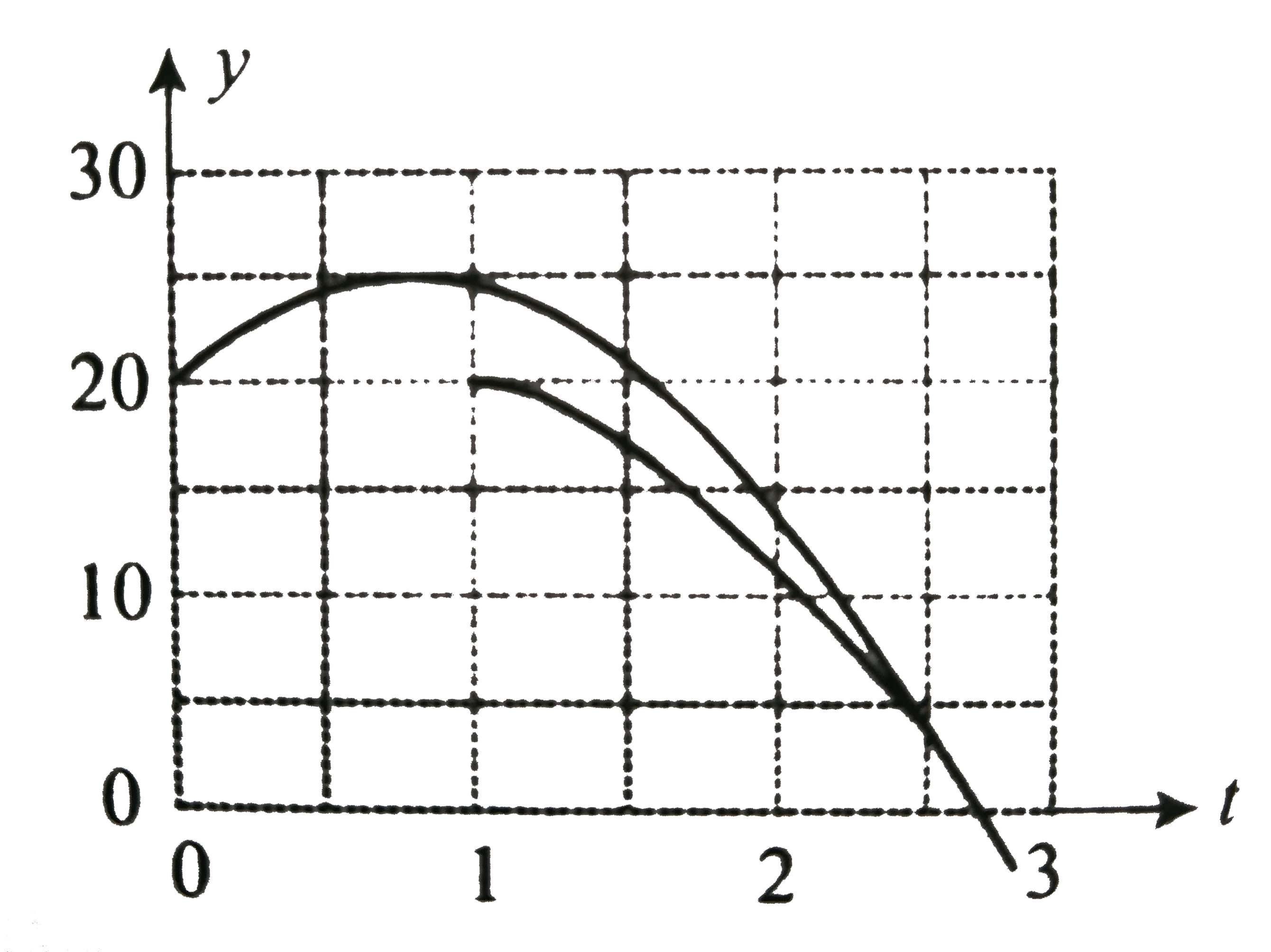
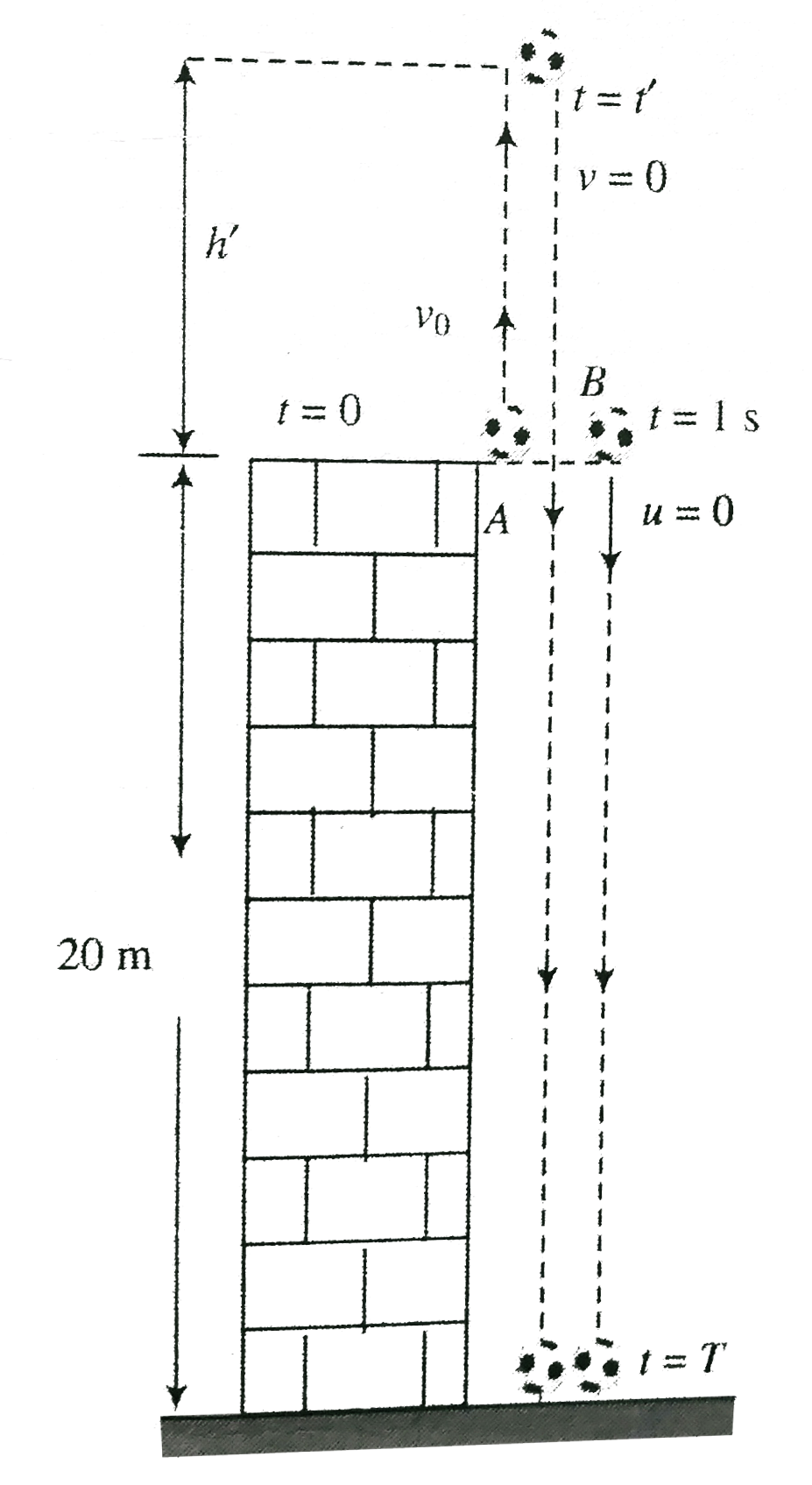
A ball (A) is thrown straight up from the edge of the roof of a building. Another ball (B) is dropped from the roof `1.00 s` later. You may ignore air resistance . (a) If the height of the building is `20.0 m`, what must the initial speed of ball A be if both are to hit the ground at the same time? (b) On the same graph sketch the position and velocity of each balls a function of time, measured from when the first ball is thrown and taken origin at ground.
.

Text Solution

Verified by Experts

For the purpose of doing all four farts with the least reperition of algebra, quantities will be dented symbolically. That is, let
`y_(1)=h+v_(0)t-(1)/(2)g t^(1)` and `y_(2)=h-(1)/(2)g(t-t_(0))^(2)`.
In this case, `t_(0)=1.00 s`. Setting `y_(1)=y_(2)=0`, expanding the binomial `(t-t_(0))^(2)`, which can be solved for `t`,
`t=((1)/(2)g t_(0)^(2))/(g t_(0)-v_(0)) =t_(0)/(2) (1)/((1-v_(0)/(g t_(0)))` Substiuting this into the expressinon for `y_(1)` and setting `y_(1)=0` and solving for `h` as a function of `v_(0)` yields after some algebra,
`h=(1)/(2) g t_(0)^(2)((1)/(2)g t_(0)-v_(0))^(2)/(g t_(0)-v_(0))^(2)`
a. Using the given value, `t_(0)=1.00 s` and `g=9.80 ms^(-2)`.
`h=20.0 m=(4.9 m) ((4.9 ms^(-1)-v_(0))/(9.8 ms^(-2)-v_(0)))`
This has two solutions, one of which is not physical [the first ball is still going up when the second is released, see part `C `]. The physical solution invlves taking the negative square root before solving for `v_(0)`, and yields `8.2 ms^(-1)`
.
b. The above expression gives
for (i) `0.411 m` and for (ii) `1.15 km`.
C. As `v_(0)` approaches `9.8 ms^(-1)`, the height `h` becomes infinite corresponding to a relative velocity at the second ball is throun that approaches zero, If `v_(0)le 9.8 ms^(-1)`, the first ball can never catch the second ball.
d. As `v_(0)` approaches `4.9 ms^(-1)` the height approaches zero. This corresponds to the first ball being closer and is released. If `v_(0) le 4.9 ms^(-1)`, the first ball will already have roof on the wau down nefore the second ball is released, and the second ball can catch up.
Promotional Banner

Topper's Solved these Questions

  • KINEMATICS-1

    CENGAGE PHYSICS ENGLISH|Exercise Exercise 4.3|15 Videos
  • KINEMATICS-1

    CENGAGE PHYSICS ENGLISH|Exercise Exercise 4.4|16 Videos
  • KINEMATICS-1

    CENGAGE PHYSICS ENGLISH|Exercise Exercise 4.1|17 Videos
  • GRAVITATION

    CENGAGE PHYSICS ENGLISH|Exercise INTEGER_TYPE|1 Videos
  • KINEMATICS-2

    CENGAGE PHYSICS ENGLISH|Exercise Exercise Integer|9 Videos

Similar Questions

Explore conceptually related problems

A ball is thrown vertically upward with a speed of 20 m/s. Draw a graph showing the velocity of the ball as a function of time as it goes up and then comes back.

The ball is dropped from a bridge 122.5 m above a river, After the ball has been falling for 2 s, a second ball is thrown straight down after it. What must its initial velocity be so that both hit the water at the same time ?

A ball dropped from the top of a building takes 0.5 sec to clear the window of 4.9 m height. What is the height of building above the window?

A ball A is thrown up vertically with a speed u and at the same instant another ball B is released from a height h . At time t , the speed A relative to B is

A ball is thrown upwards with a speed u from a height h above the ground.The time taken by the ball to hit the ground is

A ball is dropped from the top of a building the ball takes 0.5 s to fall past the 3 m length of a window at certain distance from the top of the building. Speed of the ball as it crosses the top edge of the window is (g=10 m//s^(2))

A ball is dropped from the top of a building. The ball takes 0.5s to fall the 3m length of a window some distance from the to of the building. If the speed of the ball at the top and at the bottom of the window are v_(T) and v_(T) respectively, then (g=9.8m//s^(2))

A ball A is projected from the ground such that its horizontal range is maximum. Another ball B is dropped from a height equal to the maximum range of A. The ratio of the time of flight of A to the time of fall of B is

A person standing near the edge of the top of a building throws two balls A and B. The ball A is thrown vertically upward and B is thrown vertically downward with the same speed. The ball A hits the ground with speed v_A and the ball B hits the ground wiht a speed v_B . We have

A ball is dropped from the top of a tower of height 78.4 m Another ball is thrown down with a certain velocity 2 sec later. If both the balls reach the ground simultaneously, the velocity of the second ball is