Home
Class 11
PHYSICS
Two particles are simultaneously release...

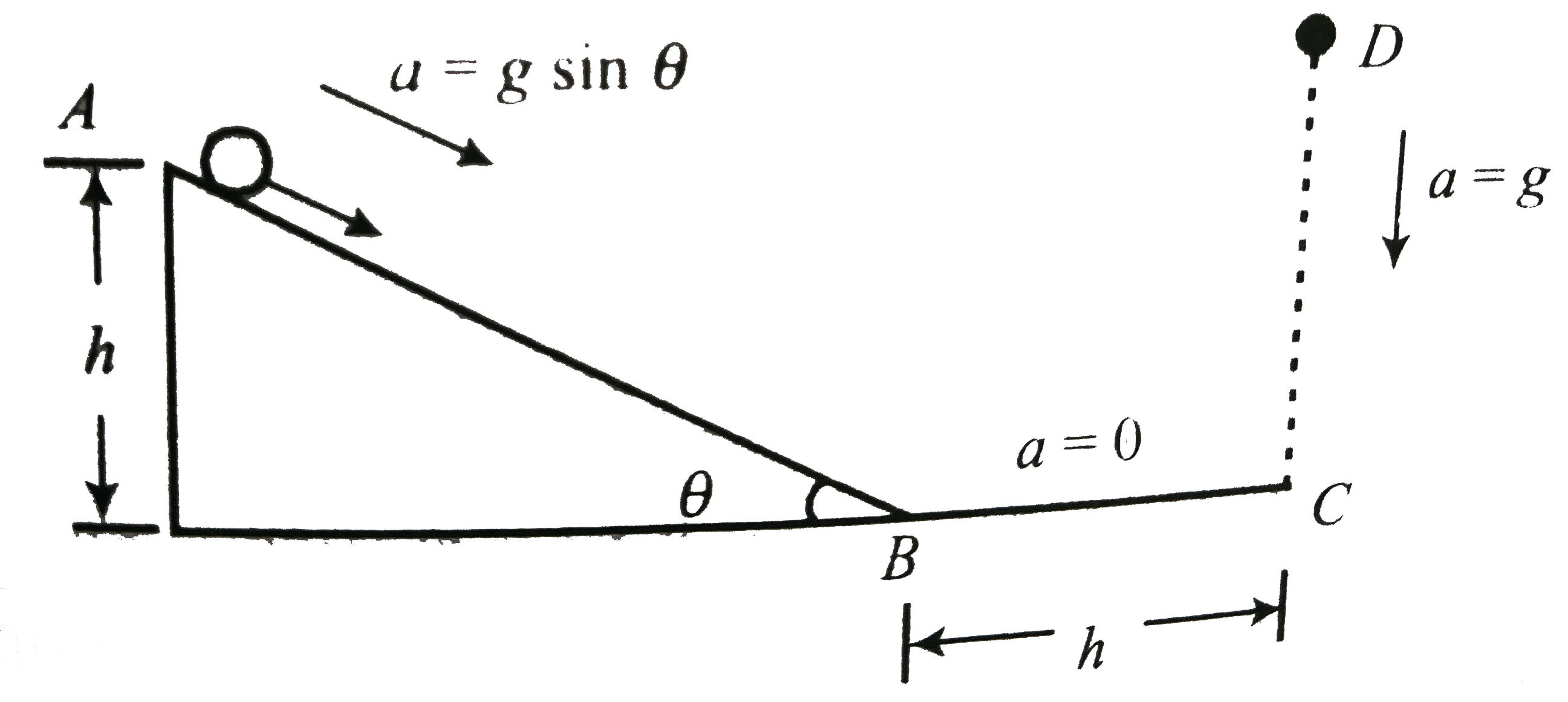
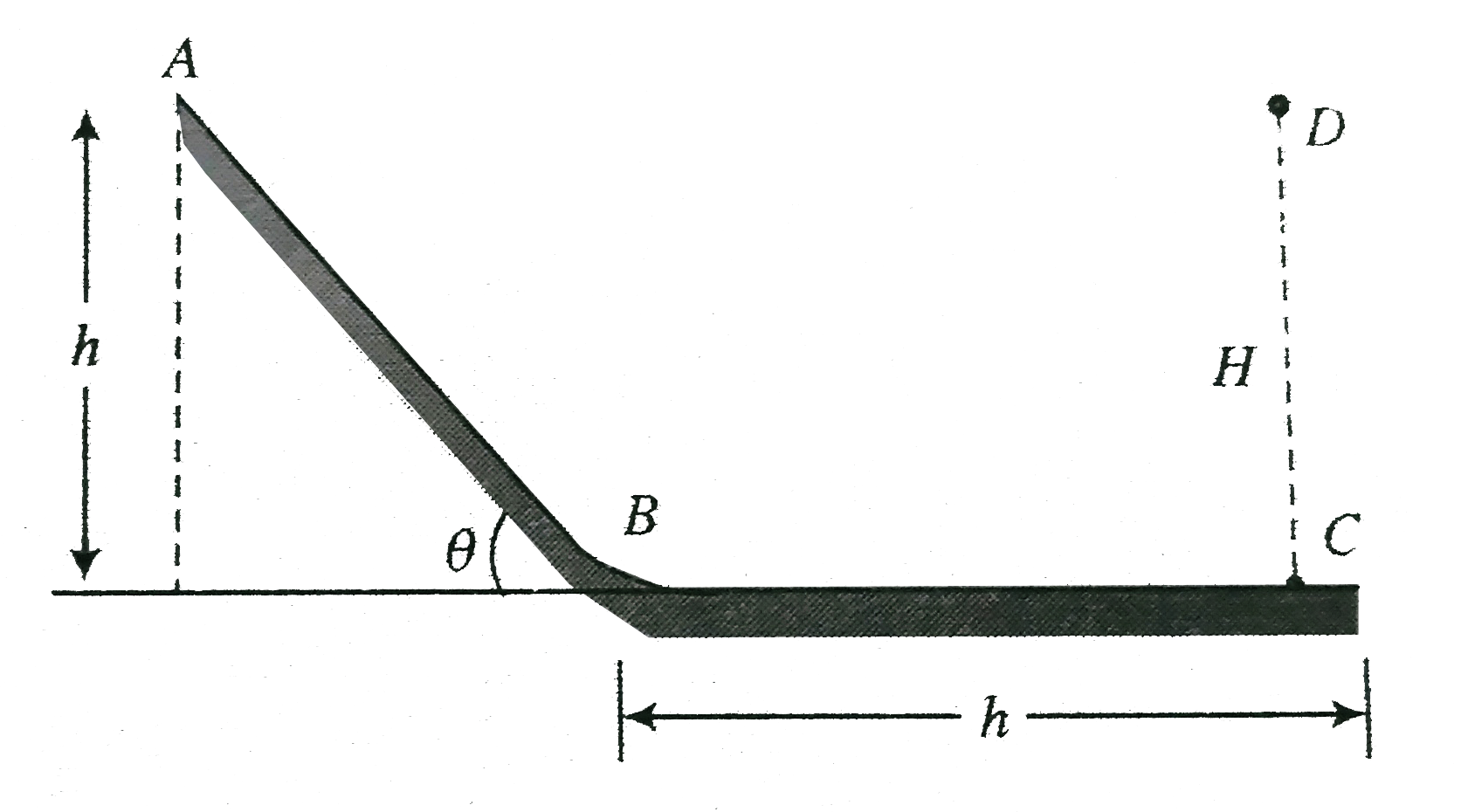
Two particles are simultaneously released from points `A and D` as shown is Fig.4.41. How shold the value of (H) be adjusted inorder that the two particles collide?
Neglect sissipative forces.
.

Text Solution

Verified by Experts

If both particles collide, the time of travel for both particles should be equal.
.
Path A-B : `T_(1)=t_(AB)+t_(BC)`
For Path AB : `S_(AB)=t_(AB)^(2) rArr (h)/(sin theta) =(1)/(2)g sin theta.t_(AB)^(2)`.
`t_(AB)=(1)/(sin theta)sqrt(2h)/(g)`
Velocity of the particle when it reaches `B`,
`v_(B)=0+(g sin theta).(1)/(sin theta) sqrt((2h)/(g))`
Path `AB`: As acceleration of the particles is zero, time to cover destance`BC`,
`t_(BC)=(BC)/(v_(B))=(h)/(sqrt2gh)=sqrt((h)/(2g))`
Hence, `T_(1)=(1)/(sin theta) sqrt(2h)/(g)+sqrt((h)/(2g))`
Path `DC`: The particle will free fall,
`H=(1)/(2)g t_(2)^(2) rArr T_(2) =aqrt(2H)/(g)`
For particle collide `T_(1)-T_(1)`, which gives
`H=(h)/(sin^(2) theta)(2+sin theta)^(2)`.
Promotional Banner

Topper's Solved these Questions

  • KINEMATICS-1

    CENGAGE PHYSICS ENGLISH|Exercise Exercise 4.3|15 Videos
  • KINEMATICS-1

    CENGAGE PHYSICS ENGLISH|Exercise Exercise 4.4|16 Videos
  • KINEMATICS-1

    CENGAGE PHYSICS ENGLISH|Exercise Exercise 4.1|17 Videos
  • GRAVITATION

    CENGAGE PHYSICS ENGLISH|Exercise INTEGER_TYPE|1 Videos
  • KINEMATICS-2

    CENGAGE PHYSICS ENGLISH|Exercise Exercise Integer|9 Videos

Similar Questions

Explore conceptually related problems

Two particles are projected from the two towers simultaneously, as shown in the figure. What should be value of 'd' for their collision.

Two particles are projected with speed 4m//s and 3m//s simultaneously from same point as shown in the figure. Then:

Two particles P and Q are projected simultaneously away from each other from a point A as shown in figure. The velocity of P relative to Q in ms^(-1) at the instant when the motion of P is horizontal is

Two particles are released from the same height at an interval of 1s . How long aftger the first particle begins to fall will the two particles be 10m apart? ( g=10m//s^(2) )

Two particles A and B are moving with uniform velocity as shown in (Fig. 5.130) given below at t = 0 . (a) Will the two particles collide ? (b) Find out the shortest distance between two particles. .

A particle of mass m is released from point A as shown in the gigure. Would it loop the loop if H=4r? What is the force on the circular track when it is at point (a) B, (b) C?

Two particles A and B are projected simultaneously in a vertical plane as shown in figure. They collide at time t in air. Write down two necessary equations for collision to take place.

Two particles start moving simultaneously with constant velocities u_1 and u_2 as shown in (Fig. 5.194). First particle starts from A along AO and second starts from O along OM . Find the shortest distance between them during their motion. .

Two particles are simultaneously thrown from the top of two towards as shown. Their velocities are 2ms^(-1) and 14ms^(-1) . Horizontal and vertical separations between these particles are 22 m and 9 m respectively. Then the minimum separation between the particles in the process of their motion in meters is (g=10ms^(-2))

Two particles are projected simultaneously from two points O and O' such that d is the horizontal distance and h is the vertical distance between them as show in figure. These are projected at same inclination alpha with the horizontal with the same speed v. Find an expression for time at which their separation becomes minimum.