Home
Class 11
PHYSICS
A block slips along an incline of a wedg...

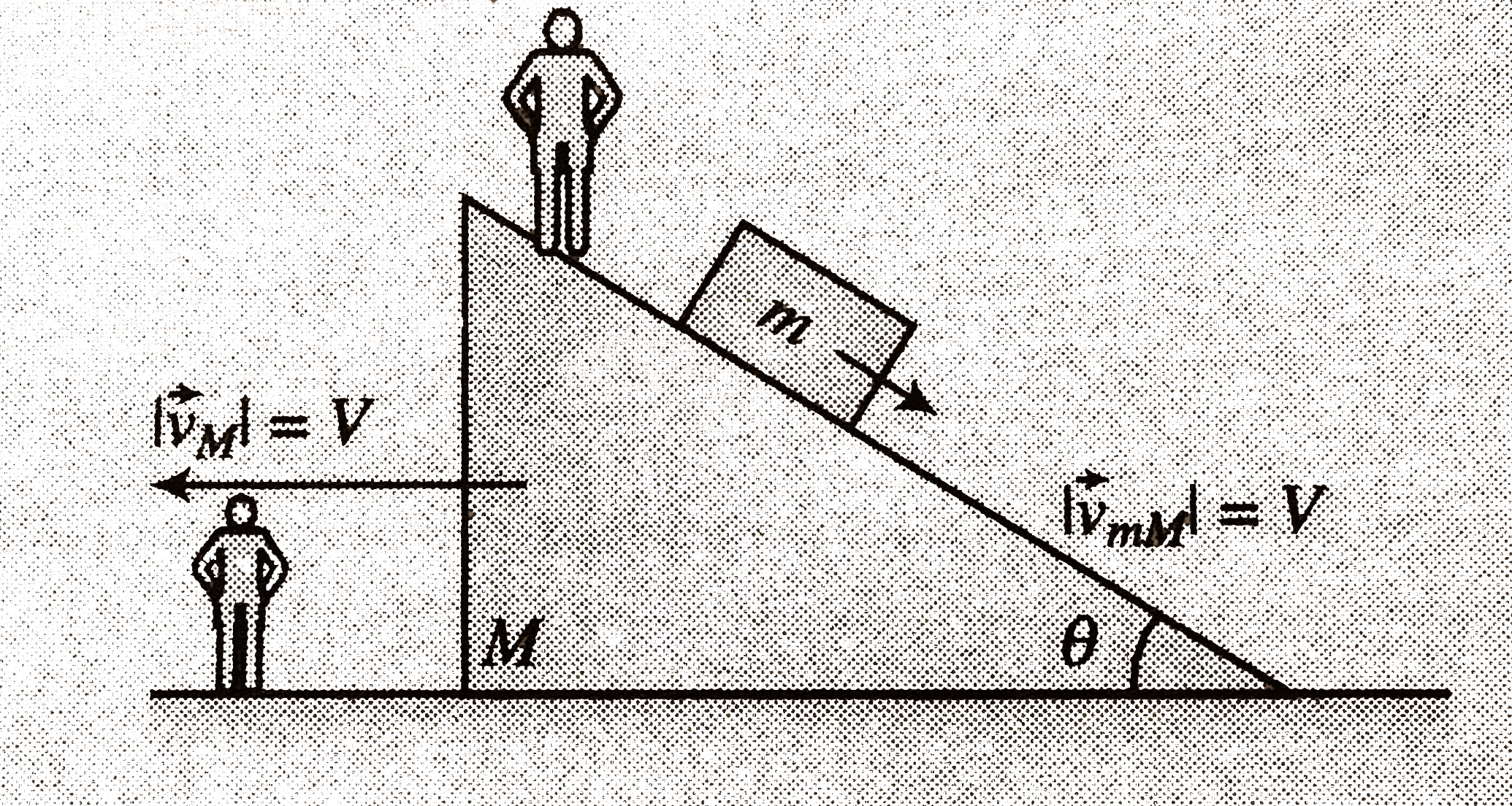
A block slips along an incline of a wedge. Due to the reaction of the block on the wedge, it slips backwards. An observer on the wedge will see the block moving straight down the incline. Discuss how to find the absolute velocity of the block.
.

Text Solution

Verified by Experts

We know that `vec v_(m//M) = vec v_m - vec v_M rArr vec v_m = vec v_(m//M) + vec v_M`
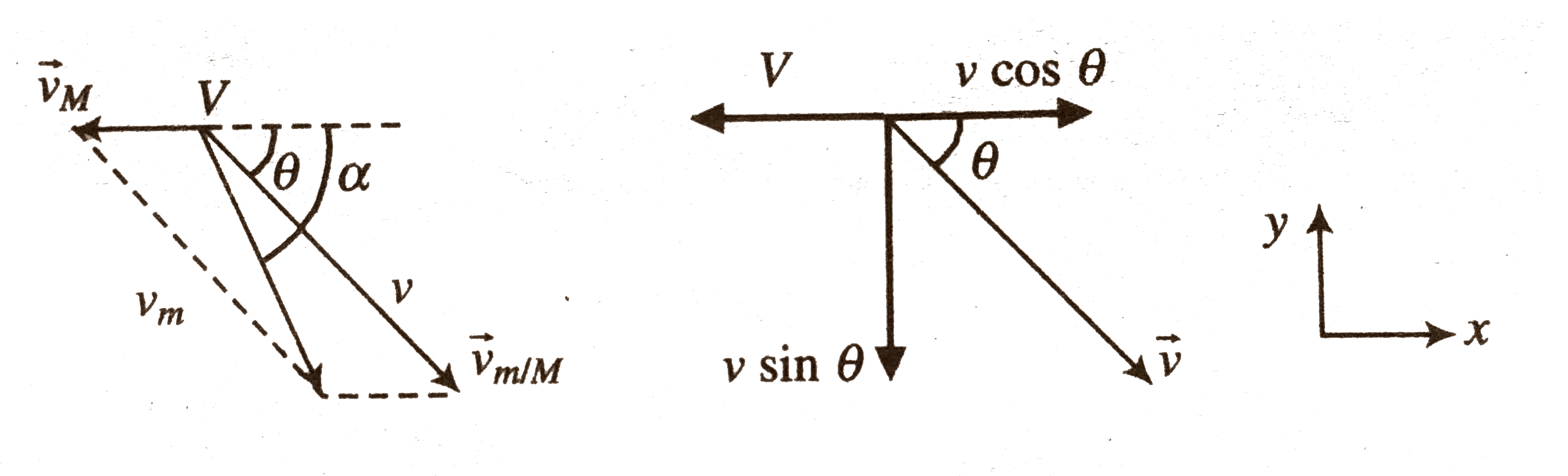
Note that a single subscript implies absolute velocity. The absolute velocity of block is the vector sum of its velocity relative to the wedge and velocity of wedge relative to ground.
The absolute velocity of block (ground reference frame) is shown in the vector diagram given in (Fig. 5.80).
`|vec v_m| = sqrt(v^2 + V^2 + 2 v V cos (pi - theta))`
=`sqrt(v^2 + V^2 - 2 v V cos theta)`
We can derive this result by resolving `v` into its components.
Sum of x - components `V_x = v cos theta - V`
Sum of y - components `V_y = v sin theta`
Resultant velocity `= sqrt(V_x^2 + V_y^2)`
=`sqrt((v cos theta - V)^2 + (v sin theta)^2))`
=`sqrt(v^2 + V^2 - 2 v V cos theta)`
`tan prop = (V_y)/(V_x) = (v sin theta)/(v cos theta - V)`.
,.
Promotional Banner

Topper's Solved these Questions

  • KINEMATICS-2

    CENGAGE PHYSICS ENGLISH|Exercise Solved Examples|7 Videos
  • KINEMATICS-2

    CENGAGE PHYSICS ENGLISH|Exercise Exercise 5.1|15 Videos
  • KINEMATICS-1

    CENGAGE PHYSICS ENGLISH|Exercise Integer|9 Videos
  • KINETIC THEORY OF GASES

    CENGAGE PHYSICS ENGLISH|Exercise Compression|2 Videos

Similar Questions

Explore conceptually related problems

A block of mass 'm' is kept on a smooth moving wedge. If the acceleration of the wedge is 'a'

The minimum value of acceleration of wedge for which the block start sliding on the wedge, is:

In fig, no relative motion takes place between the wedge and the block placed on it. The rod slides down wards over the wedge and pushes the wedge to move in horizontal direction, The mass of wedge is same as that of the block and is equal to M. If tan theta=(1//sqrt(3)) , find the mass of rod. (Neglect rotation of the rod).

System is shown in fig. and wedge is moving toward left with speed 2ms^(-1) . Find the velocity of the block B.

a Block of mass m is placed on a wedge of mass M there is no friction between the block and the wedge .The minmum coefficient of friction between the wedge and the gound so that wedge does not move is,

A block of mass m is placed at the bottom of a massless smooth wedge which if placed on a horizontal surface. When we push the wedge with a constant force, the block moves up the wedge. Find the work done by the external agent when the block has a speed v and is reaches the top of the wedge.

A block of mass m is placed on a smooth wedge of inclination Q. The whole system is accelerated horizontally so that the block does not slip on the wedge. Find the i) Acceleration of the wedge ii) Force to be applied on the wedge iii) Force exerted by the wedge on the block.

A smooth wedge A is fitted in a chamber hanging from a fixed ceiling near the earth's surface.A block B placed at the top of the wedge takes a time T to side down the length of the wedge. If the block is placed at the top of the wedge and the cable supporting the chamber is broken at the same instant, the block will

In figuer, shown all the surfaces are frictionless, and mass of the block is m=100g . The block and the wedge are held initially at rest. Now the wedge is given a horizontal acceleration of 10ms^-2 by applying a force on the wedge, so that the block does not slip on the wedge. Then find the work done in joules by the normal force in ground frame on the block in 1s .

Two smooth blocks of masses m and m' connected by a light inextensible strings are moving on a smooth wedge of mass M. If a force F acts on the wedge the blocks do not slide relative to the wedge. Find the (a) acceleration of the wedge and (b) value of F.