Home
Class 11
PHYSICS
Two particles A and B are moving with co...

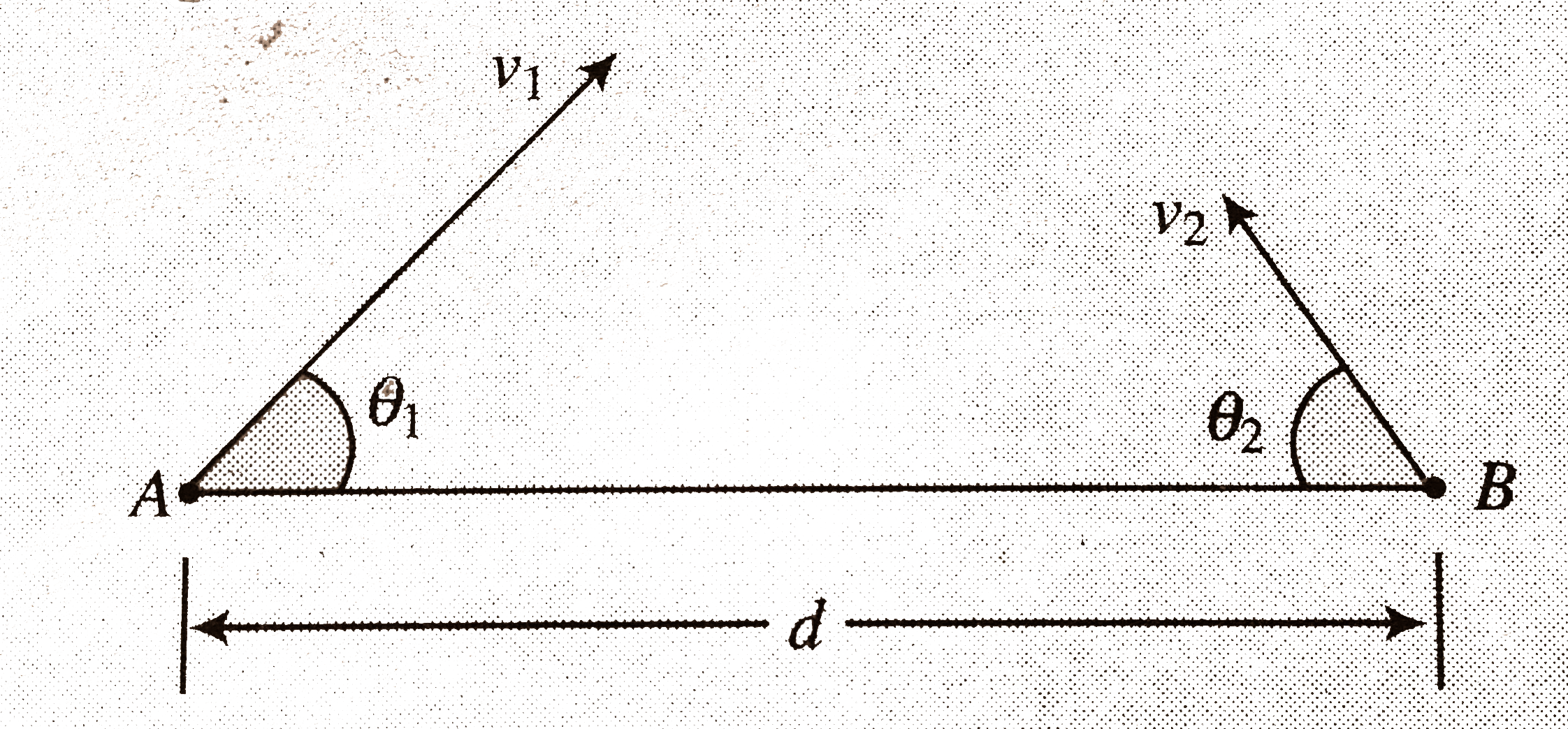
Two particles `A and B` are moving with constant velocities `v_1 and v_2`. At `t = 0`, `v_1` makes an angle `theta_0` with the line joining `A and B and v_2` makes an angle `theta_2` with the line joining `A and B`.
(a) Find the condition for `A and B` to collide.
(b) Find the time after which `A and B` will collide if separation between them is d at ` t = 0`.
.

Text Solution

Verified by Experts

Velocity of approach is the relative velocity along line `AB`
`v_(A P P) = v_1 cos theta_1 + v_2 cos theta_2`.
Promotional Banner

Topper's Solved these Questions

  • KINEMATICS-2

    CENGAGE PHYSICS ENGLISH|Exercise Solved Examples|7 Videos
  • KINEMATICS-2

    CENGAGE PHYSICS ENGLISH|Exercise Exercise 5.1|15 Videos
  • KINEMATICS-1

    CENGAGE PHYSICS ENGLISH|Exercise Integer|9 Videos
  • KINETIC THEORY OF GASES

    CENGAGE PHYSICS ENGLISH|Exercise Compression|2 Videos

Similar Questions

Explore conceptually related problems

The line joining A (-3, 4) and B (2, -1) is parallel to the line joining C (1, -2) and D (0, x). Find x.

Two particles are moving with velocities v_(1) and v_2 . Their relative velocity is the maximum, when the angle between their velocities is

Two particles 1 and 2 move with velocities vec v_1 and vec v_2 making the angles theta_1 and theta_2 with the line joining them, respectively. Find angular velocity of relative to 1 . .

The block A is moving downward with constant velocity v_(0.) Find the velocity of the block B. When the string makes an angle theta with the horizontal

Two particles, 1 and 2, move with constant velocities v_1 and v_2 . At the initial moment their radius vectors are equal to r_1 and r_2 . How must these four vectors be interrelated for the particles to collide?

A particle of mass m is moving with constant velocity v_(0) along the line y=b . At time t=0 it was at the point (0,b) . At time t=(b)/(v_(0)) , the

Two particles A and B are moving with constant velocities V_(1)=hatj and v_(2)=2hati respectively in XY plane. At time t=0, the particle A is at co-ordinates (0,0) and B is at (-4,0). The angular velocities of B with respect to A at t=2s is (all physical quantities are in SI units)

Two objects A and B are moving in opposite directions with velocities v_(A) and v_(B) respectively, the magnitude of relative velocity of A w.r.t. B is

A particle is moving with constant speed v along the line y = a in positive x -direction. Find magnitude of its angular velocity about orgine when its position makes an angle theta with x-axis.

A particle is moving with constant speed v along the line y = a in positive x -direction. Find magnitude of its angular velocity about orgine when its position makes an angle theta with x-axis.

