Home
Class 11
PHYSICS
Three particles A, B and C are situated ...

Three particles A, B and C are situated at the vertices of an equilateral triangle ABC of side d at time `t=0.` Each of the particles moves with constant speed v. A always has its velocity along AB, B along BC and C along CA. At what time will the particles meet each other?

Text Solution

Verified by Experts
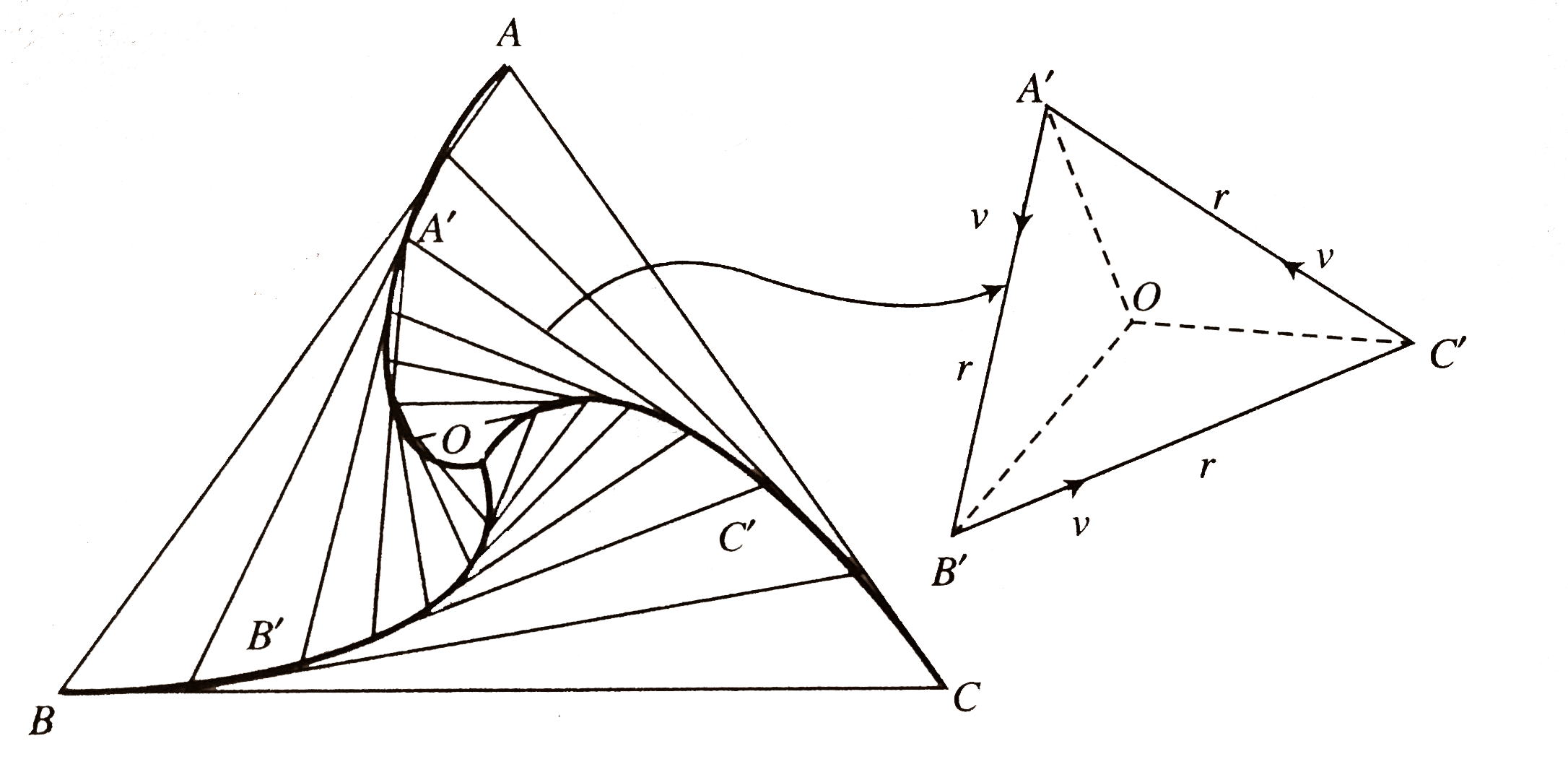
The motion of the particles is roughly sketched in (Fig. 5.132). By symmetery they will meet at the centroid `O` of the triangle.
As the speed of all the particles is equal they will cover equal distance in any given interval of time.
If we join the instantaneous position of the particle at any time, the particles will from an equilateral triangle of same centroid as initial triangle.
Let us consider the motion of any one particle say `A`. At any instant, its velocity makes an angle `30^@` with line `A O`.
The component of the velocity along `A O` is `V cos 30^@`. This component will be equal to the rate of change of distance between `A and O`.
At `t = 0`, distance between `A and O`,
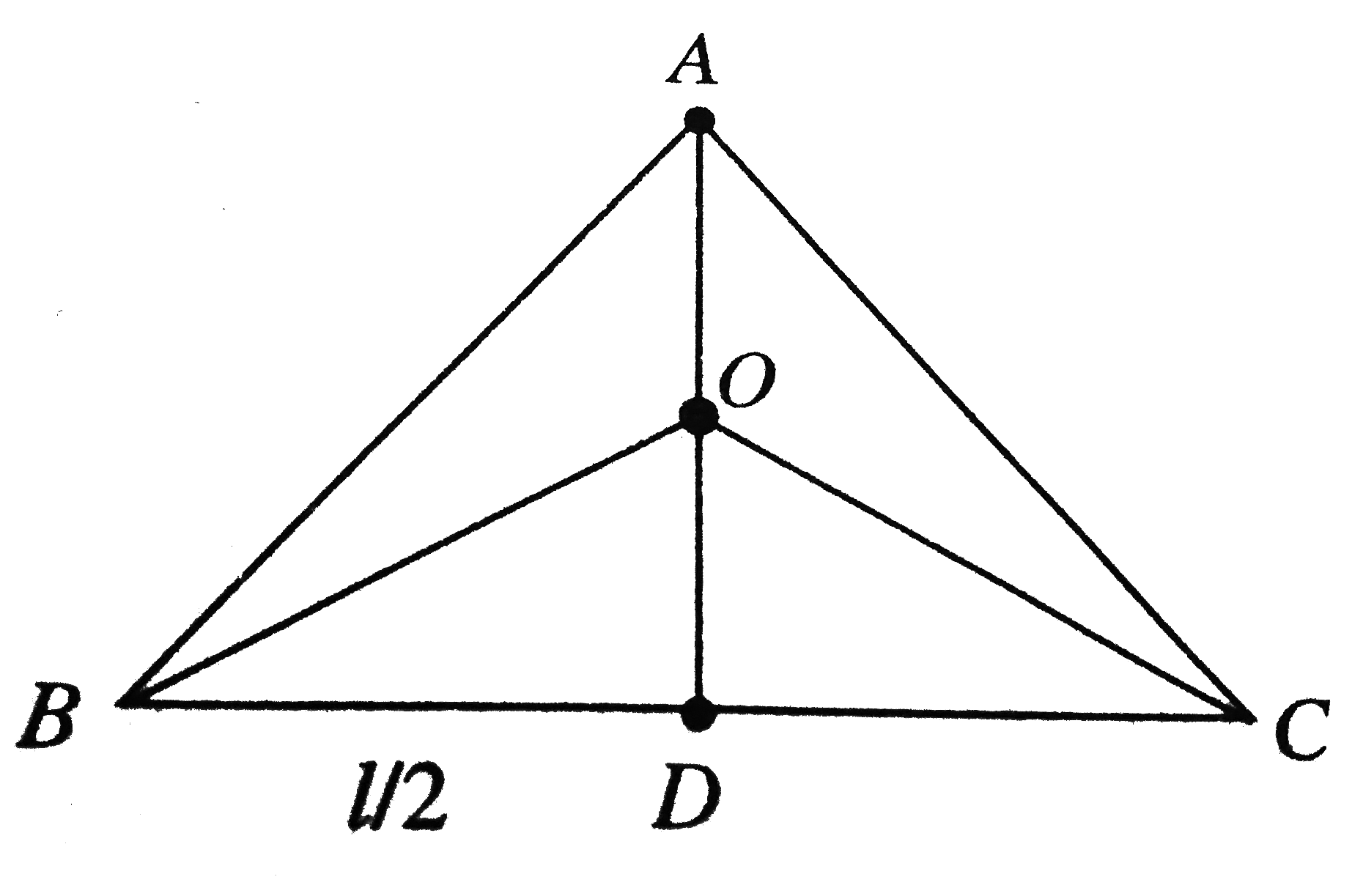
`A O = (2)/(3) A D = (2)/(3) sqrt( l^2 - ((l)/(2))^2) = (l) /(sqrt(3))`
At time `t = T`, the separation between `A and O` is zero.
Hence, time taken for `A O` to become zero,
`T = ((l//sqrt(3)))/(v cos 30^@) = ((l //sqrt(3)))/(v(sqrt(3 //2))) = (2 d)/(3 v)`
After time `t`, let the distance of separation between the insect be `r`. The velocity of approach (component of relative velocity `v_(rel)` between the insects along the line of their separation) is `= v + v cos 60^@ = 3 v//3`
Since `(v_(rel))_II dt = - dr.` substituting `(v_(rel))_II = (3 v)/(2)`, we obtain
`(3 v)/(2) dt = -dr`
As at time of meeting, integrating both sides, we have
`(3 v)/(2) int_0^(tau) dt = - int _l^0 dr`
This gives `t = (2 l)/(3 v)`.
, .
Promotional Banner

Topper's Solved these Questions

  • KINEMATICS-2

    CENGAGE PHYSICS ENGLISH|Exercise Solved Examples|7 Videos
  • KINEMATICS-2

    CENGAGE PHYSICS ENGLISH|Exercise Exercise 5.1|15 Videos
  • KINEMATICS-1

    CENGAGE PHYSICS ENGLISH|Exercise Integer|9 Videos
  • KINETIC THEORY OF GASES

    CENGAGE PHYSICS ENGLISH|Exercise Compression|2 Videos

Similar Questions

Explore conceptually related problems

Four particles A, B, C and D are situated at the corner of a square ABCD of side a at t-0. Each of particles moves with constant speed (v). A always has its velocity along AB, B along BC, C along CD~ and D along DA . At what time will these particles meet each other ?

Three particles A, B, Care located at the comers of an equilateral triangle as shown in figure. Each of the particle is moving with velocity v. Then at the instant shown, the relative angular velocity of

Three particles, each of mass m are situated at the vertices of an equilateral triangle ABC of side l (as shown in the figure). The moment of inertia of the system about a line AX perpendicular to AB and in the plane of ABC, will be:

Three particles, each of mass m are situated at the vertices of an equilateral triangle ABC of side L as shown in the figure. Find the moment of inertia of the system about the line AX perpendicular to AB in the plane of ABC

Three particles, each of mass m are fixed at the vertices of an equilateral triangle of side length a . The only forces acting on the particles are their mutual gravitational forces. Then answer the following questions. Force acting on particle C , due to particle A and B

Three particles A,B and C each of mass m are lying at the corners of an equilateral triangle of side L . If the particle A is released keeping the particles B and C fixed , the magnitude of instantaneous acceleration of A is

A particle moves with constant speed v along a circular path of radius r and completes the circle in time T. The acceleration of the particle is

Find the centre of mass of three particle at the vertices of an equilateral triangle. The masses of the particle are 100g, 150 g, and 200g respectively. Each side of the equilateral triangle is 0.5m along.

Three identical particles are located at the vertices of an equilateral triangle. Each particle moves along a meridian with equal speed towards the centroid and collides inelastically. (a) all the three particles will bounce back along the meridians with lesser speed. (b) all the three particles will become stationary. (c) all the particles will continue to move in their original directions but with lesser speed (d) nothing can be said

Six particles situated at the corners of a regular hexagon of side a move at a constant speed v. Each particle maintains a direction towards the particle at the next corner. Calculate the time the particles will take to meet each other.