Home
Class 11
PHYSICS
A bead is free to slide down on a smooth...

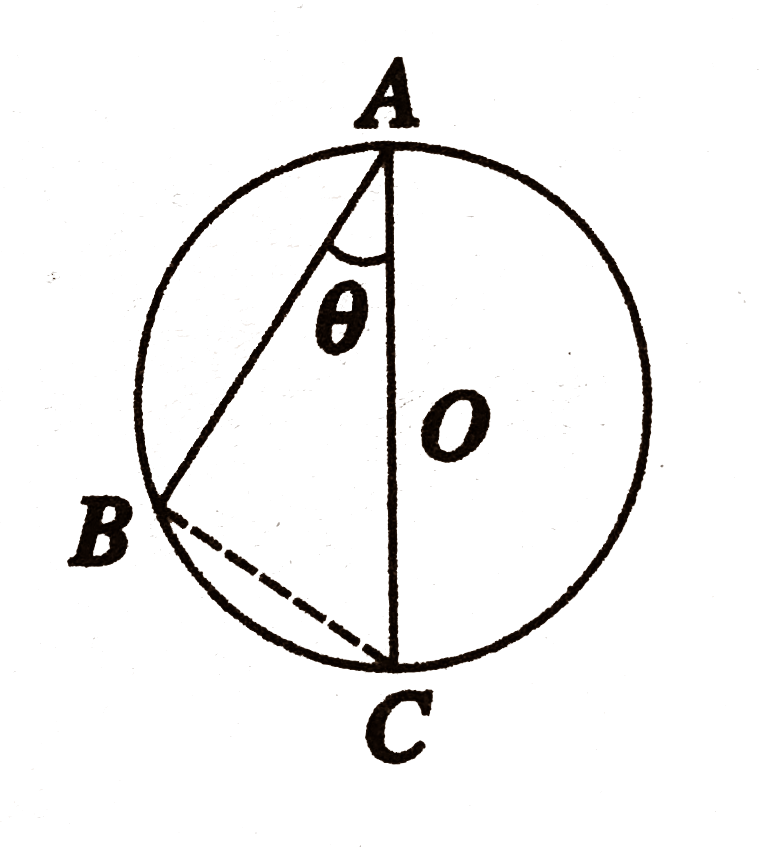
A bead is free to slide down on a smooth wire rightly stretched between points `A and B` on a vertical circle of radius `10 m`. Find the time taken by the bead to reach point `B`, if the bead slides from rest from the highest point `A` on the circle.
.

Text Solution

Verified by Experts

The correct Answer is:

`(2)`

`AB = 2R cos theta`
`AB = (1)/(2) g cos theta t^2 rArr 2 R cos theta = (1)/(2) g cos theta t^2`
`2 sqrt((R )/(g)) = t rArr 2 sqrt((10)/(10)) = t = 2 s`.
Promotional Banner

Topper's Solved these Questions

  • KINEMATICS-2

    CENGAGE PHYSICS ENGLISH|Exercise Exercise Comprehension|21 Videos
  • KINEMATICS-1

    CENGAGE PHYSICS ENGLISH|Exercise Integer|9 Videos
  • KINETIC THEORY OF GASES

    CENGAGE PHYSICS ENGLISH|Exercise Compression|2 Videos

Similar Questions

Explore conceptually related problems

A bead is free to slide down a smooth wire tightly stretched between points A and on a verticle circle of radius R. if the bead starts from rest at 'A', the highest point on the circle, its velocity when it arrives at B is :-

A frictionless wire is fixed between A and B inside a circle of radius R . A small bead slips along the wire. Find the time taken by the bead to slip from A to B .

A particle is projected vertically upwards from ground with velocity 10 m // s. Find the time taken by it to reach at the highest point ?

A particle of mass m is being circulated on a vertical circle of radius r. If the speed of particle at the highest point be v, then

A stone of mass 1kg is tied with a string and it is whirled in a vertical circle of radius 1 m. If tension at the highest point is 14 N, then velocity at lowest point will be

A bead slides on a frictoinless strainght rod fixed between points A and B of a vertical circular loop of radius as shown in the figure. Line BC is a vertical diameter. Denoting acceleration due to gravity by g , which of the following is correct expression for the time taken by the bead to slide from A to B

Find the length of a tangent drawn to a circle with radius 5 cm, from a point 13 cm from the centre of the circle.

A small bead of mass M slides on a smooth wire that is bent in a circle of radius R. It is released at the top of the circular part of the wire (point A in the figure) with a negligibly small velocity. Find the height H where the bead will reverse direction

Two beads A and B of masses m_(1) and m_(2) respectively, are threaded on a smooth circular wire of radius a fixed in a vertical plane. B is stationary at the lowest point when A is gently dislodged from rest at the highest point. A collided with B at the lowest point. The impulse given to B due to collision is just great enough to carry it to the level of the centre of the circle while A is immediately brought to rest by the impact. What is the coefficient of restituting between the beads?

Two beads A and B of masses m_(1) and m_(2) respectively, are threaded on a smooth circular wire of radius a fixed in a vertical plane. B is stationary at the lowest point when A is gently dislodged from rest at the highest point. A collided with B at the lowest point. The impulse given to B due to collision is just great enough to carry it to the level of the centre of the circle while A is immediately brought to rest by the impact. If m_(2) again comes down and collides with m_(1) then after the collision
