Home
Class 11
PHYSICS
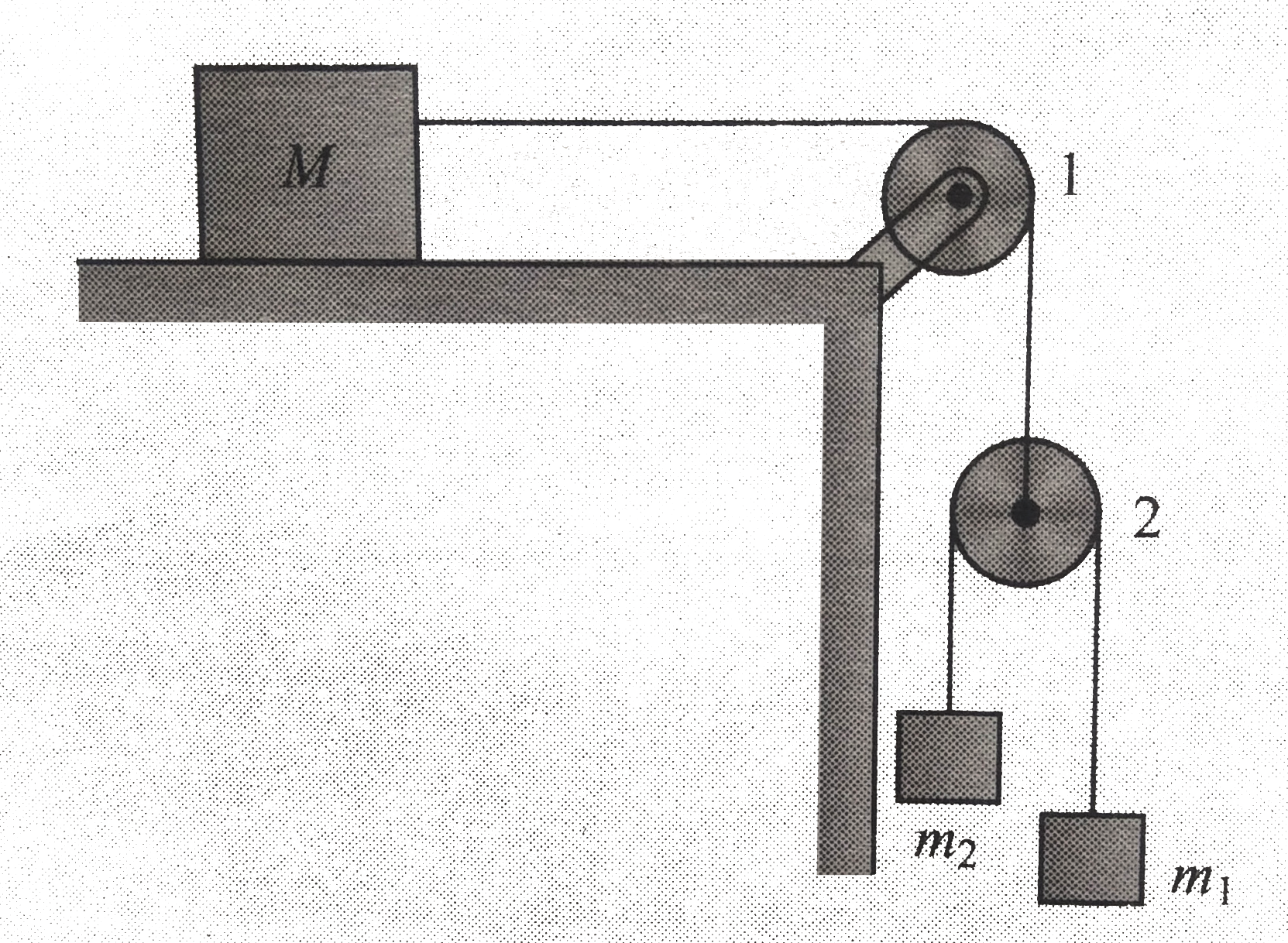
In the arrangement shown in fig. m(1)=1k...

In the arrangement shown in fig. `m_(1)=1kg, m_(2)=2 kg`. Pulleys are massless and strings are light. For what value of M, the mass `m_(1)` moves with constant velocity.

Text Solution

Verified by Experts

Mass `m_(1)` moves with constant velocity if tension in the lower string.
`T_(1)=m_(1)g=(1)(10)=10N` …(i)
Tension in the upper string
`T_(2)=2T_(1)=20N` …(ii)
Acceleration of block M is, therefore,
`a=(T_2)/(M)=(20)/(M)` …(iii)
This is also the acceleration of pulley 2.

The absolute acceleration of amss `m_(1)` is zero. Thus, the acceleration of `m_(1)` relative to pulley 2 is a upward or acceleration of `m_(2)` with respect to pulley 2 is a downward, Drawing free-body diagram of `m_(2)` with respect to pulley 2.
Equation of motion gives
`20-(40)/(M)-10 = 2a=(40)/(M)`
solving this we get, `M=8 kg`.
Promotional Banner

Topper's Solved these Questions

  • NEWTON'S LAWS OF MOTION 1

    CENGAGE PHYSICS ENGLISH|Exercise Exercise 6.1|11 Videos
  • NEWTON'S LAWS OF MOTION 1

    CENGAGE PHYSICS ENGLISH|Exercise Exercise 6.2|35 Videos
  • NEWTON'S LAWS OF MOTION 1

    CENGAGE PHYSICS ENGLISH|Exercise Integer|5 Videos
  • MISCELLANEOUS VOLUME 2

    CENGAGE PHYSICS ENGLISH|Exercise INTEGER_TYPE|10 Videos
  • NEWTON'S LAWS OF MOTION 2

    CENGAGE PHYSICS ENGLISH|Exercise Integer type|1 Videos

Similar Questions

Explore conceptually related problems

In the arrangment as shown below m_(1) = 1 kg, m_(2) = 2 kg . Pulleys are massless and strings are light . For what value of M the mass m_(1) moves with constant velocity . ( Neglect Friction)

In the arrangement shown in fig. pulleys are smooth and massless. Threads are massless and inextensible. Find acceleration of mass m_(1) .

In the arrangement , shown below pulleys are massless and frictionless and threads are inextensible , block of mass m_(1) will remain at rest if

In the arrangement shown in Figure, m_A=2kg and m_B=1kg . String is light and inextensible. Find the acceleration of centre of mass of both the blocks. Neglect friction everywhere.

In the arrangement shown in Figure, m_A=2kg and m_B=1kg . String is light and inextensible. Find the acceleration of centre of mass of both the blocks. Neglect friction everywhere.

In the arrangement shown if Fig. Pulleys are small and lught and spring are ideal and K_1=25(pi^2)(N)/(m) , K_2=2K_1 , K_3= and K_4=4K_1 are the force constant of the spring. Calculate the period of small vertical oscillation of block of mass m=3kg .

In the arrangement shown the fixed pulley is massless and frictionless. If the acceleration of block of mass 1kg is (30)/(x)m//s^(2) . Find the value of x .

In the arrangement shown in figure pulley and strings are ideal. End A of string connected to pulley P_(1) is moved upwards with acceleration a_(A)=2m//s^(2) while end B of another string shown in figure is moved up with acceleration a_(B)=1m//s^(2) . Block C of mass 1 kg is moving up with accelaration 1m//s^(2) . If block D to which string are connected are connected symmetrically moves such that its orientations remains same then (assume g=10m//s^(2))

In the arrangement shown in fig. the block of mass m=2kg lies on the wedge of mass M=8kg . The initial acceleration of the wedge, if the surfaces are smooth, is

Three blocks of masses m_(1), m_(2) and M are arranged as shown in figure. All the surfaces are fricationless and string is inextensible. Pulleys are light. A constant force F is applied on block of mass m_(1) . Pulleys and string are light. Part of the string connecting both pulleys is vertical and part of the strings connecting pulleys with masses m_(1) and m_(2) are horizontal. {:((P),"Accleration of mass " m_(1),(1) F/(m_(1))),((Q),"Acceleration of mass" m_(2),(2) F/(m_(1)+m_(2))),((R),"Acceleration of mass M",(3) "zero"),((S), "Tension in the string",(4) (m_(2)F)/(m_(1)+m_(2))):}

